Claude Code and the Loop Revolution: The End of Prompts in AI
Le brief IA que les pros lisent chaque soir
Les 7 actus IA du jour, décryptées en 5 min. Gratuit.
Inclus dès l'inscription : notre sélection des meilleurs guides & comparatifs IA.
Choisis ton rythme
Gratuit · Pas de spam · Désabonnement en 1 clic
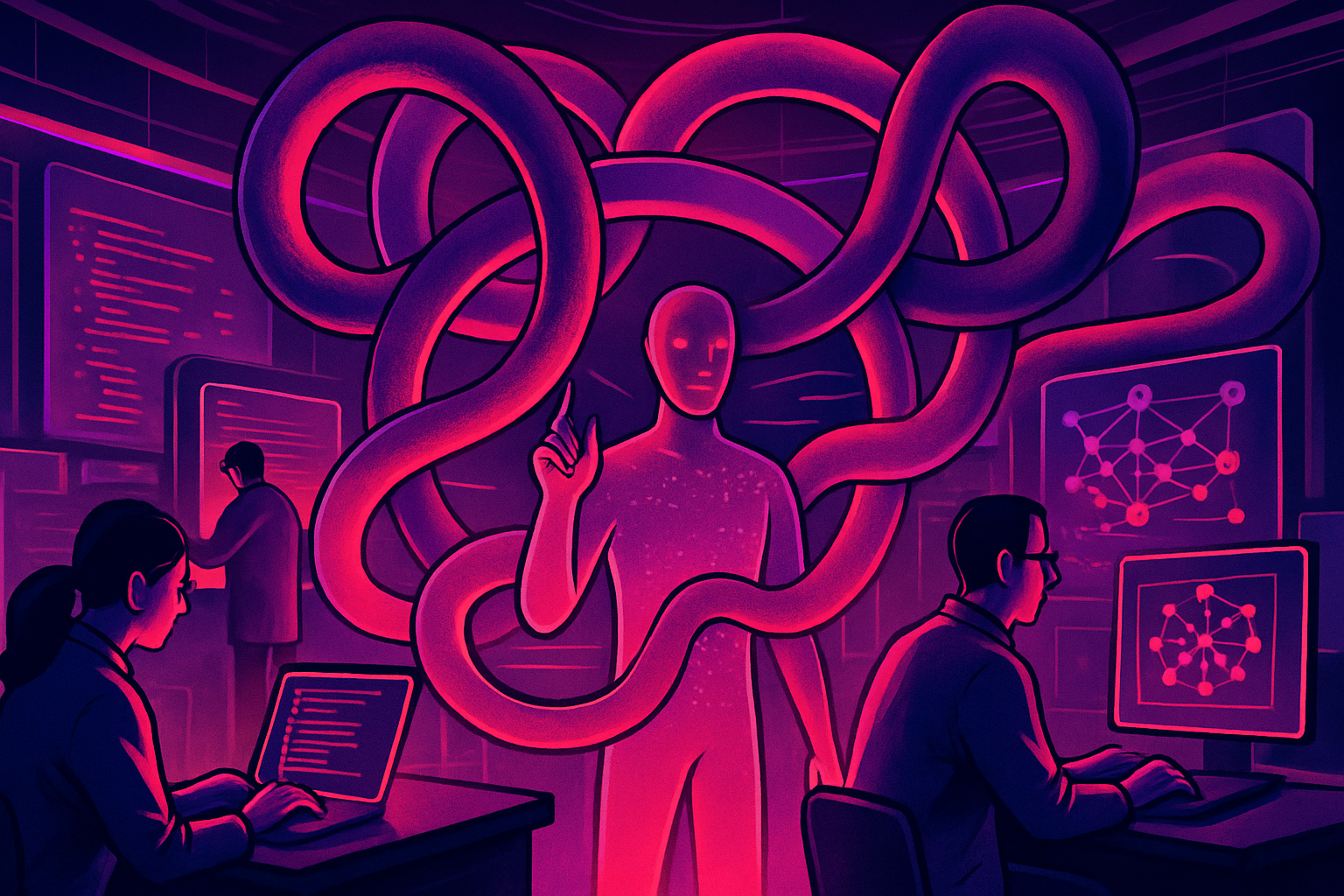
Boris Cherny, creator of Claude Code, recently shared a significant evolution in his approach to working with this system. In June 2026, he stated that he no longer handled writing prompts for Claude. Instead, he established loops that interact directly with Claude, determining the actions to be taken. His role has transformed into that of a loop designer, an approach that revolutionizes how engineers interact with AI models.
In just four years, the most valuable skill in applied AI has been rewritten four times. These transformations have seen the shift from prompt engineering to context engineering, harnessing, and finally loops. Each step has moved the work to a more abstract level, reducing manual interventions in favor of a more systematic and integrated design.
Layer 1: Prompt Engineering
Initially, prompt engineering focused on creating a single input chain. The main challenge lay in the precise formulation of prompts and the use of tools like few-shot learning, chain-of-thought, and ReAct. This method, while innovative, proved fragile as it relied on the assumption that the model already possessed all the necessary information to respond correctly.
Layer 2: Context Engineering
The second stage of this evolution focused on context engineering. Here, the goal was to fill a limited context window with the most relevant information. To achieve this, information retrieval techniques, memory, summarization, and specific strategies were developed to avoid context degradation. Engineers still had to decide which information to retrieve and when, making this stage still dependent on human intervention.
Layer 3: Harness Engineering
Harness engineering introduced a complete environment around the agent. This environment included tools, permissions, sandboxing mechanisms, lifecycle hooks, attempts, traces, and sub-agents. This layer shifted the concerns of reliability from the model's behavior to its configuration, making the system more robust and less dependent on direct prompts.
Layer 4: Loop Engineering
Finally, loop engineering allowed for the programming and execution of systems repeatedly without the need for constant manual prompts. This approach involves the use of triggers, persistence of goals and states, recognition tasks, invocation of embedded agents, frequent verification of results with a second agent, and memory writing across iterations. This method represents a significant advancement, further automating the process and reducing reliance on human interventions.
The article concludes by proposing a diagnostic to identify the engineering layer practiced by an engineer and offers a guide for progressing to the next level. It anticipates that the next step after loops will likely involve coordinating fleets of loops, further distancing the highest-paid skills from direct prompt writing.
Brief IA — L'actualité IA en français
L'essentiel de l'actualité de l'intelligence artificielle, décrypté et expliqué chaque jour.