Claude: The Solution to Avoid Repetition with AI
Le brief IA que les pros lisent chaque soir
Les 7 actus IA du jour, décryptées en 5 min. Gratuit.
Inclus dès l'inscription : notre sélection des meilleurs guides & comparatifs IA.
Choisis ton rythme
Gratuit · Pas de spam · Désabonnement en 1 clic
The Memory Challenge with Claude
Claude, the artificial intelligence developed to assist in various projects, presents a major problem: it does not retain memory of past interactions. Each new session starts as a blank slate, with no recollection of previous discussions or decisions. This lack of continuity forces users to constantly re-explain essential information, a tedious and inefficient process that can quickly become frustrating for those looking to optimize their workflow.
In March, I decided to switch from ChatGPT to Claude for my design projects. While the sessions were generally better, I quickly realized that I had to reiterate the same explanations with each new interaction. I had structured my projects using distinct workspaces for each design flow, each with its own context and expectations from Claude. However, this did not solve the problem of repeating personal information and work preferences.
For a while, I thought that more precise project instructions could resolve this issue. I tried to refine them, but even with stricter instructions, the need to re-explain the same concepts persisted. The problem was deeper, tied to the very structure of Claude.
The Nature of AI Systems
AI systems like Claude are designed to treat each session independently. They do not keep track of previous exchanges, meaning users must continually reintroduce personal and contextual information. This limitation becomes increasingly noticeable as one uses AI as a true collaborator, where the quality of collaboration is crucial.
Faced with this situation, I began to consider a different solution: what if Claude could remember essential information from each session, instead of starting from scratch? This led me to think about a method to give Claude a persistent memory, capable of retaining key information that defines my work style and expectations.
The Idea of Identity Files
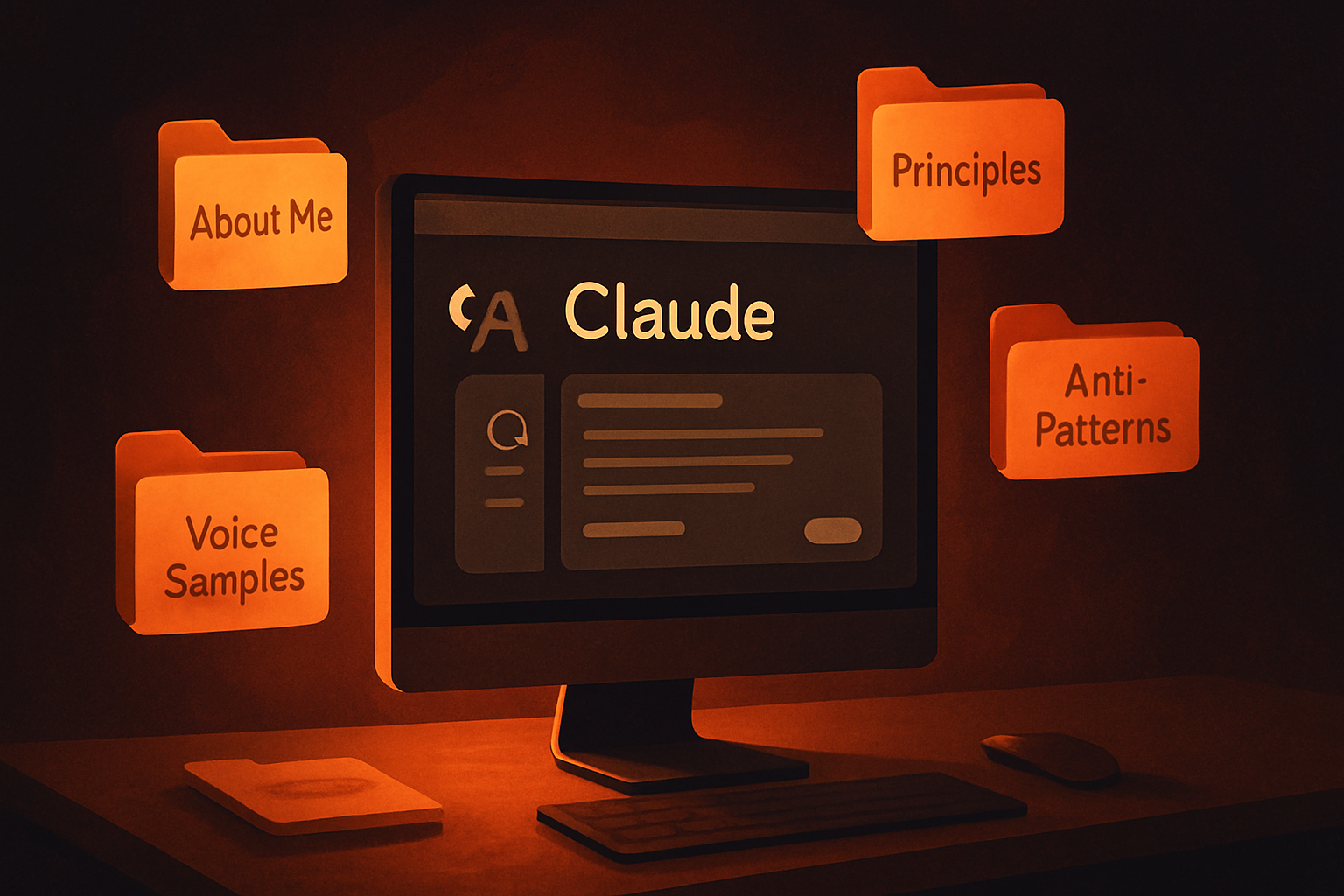
The solution lies in creating identity files, which provide Claude with a persistent image of who you are. These files are read by Claude before each response, regardless of the ongoing project. They contain key information about your work style, principles, and preferences, allowing the AI to better understand you and adapt to your needs. This approach aims to transform each session into a seamless continuation of the previous ones, rather than a constant restart.
Components of Identity Files
-
about-me.md: This file describes your role, current projects, strengths, and what you expect from Claude. It serves as a work brief rather than a formal biography, designed to guide the AI in its role as a collaborator. By detailing these aspects, you enable Claude to understand the context in which you operate and how it can assist you effectively.
-
principles.md: This file outlines your operational principles, the decisions you have made, and your approach to trade-offs. It is not a set of directives for Claude, but a reference framework for it to reason coherently with you. By sharing your principles, you help Claude align its suggestions and analyses with your way of thinking.
-
anti-patterns.md: This file lists common mistakes and failure modes to avoid. It serves as a guide to steer clear of recurring pitfalls in your collaboration with Claude. By documenting these anti-patterns, you reduce the risks of repeating the same errors and improve the quality of interactions.
-
voice-samples.md: This file contains examples of passages you have written that illustrate your communication style. These examples help Claude understand how you want your ideas to be expressed. By providing samples of your voice, you enable Claude to adopt a tone and style that are familiar to you.
How to Create These Files
Creating these files does not require starting from scratch. You can synthesize existing documents such as case studies, performance reviews, or Slack conversations. The idea is to gather these elements to form a coherent set that Claude can use. This approach allows you to capitalize on the work already done and structure the information in a way that is easily accessible for the AI.
To do this, share this material with Claude during a session and let it interview you section by section. In about 30 to 45 minutes, you can achieve a functional system. This collaborative process with Claude allows you to refine the identity files according to your specific needs and ensure they accurately reflect your work style.
I have also developed a playbook for setting up the Cowork identity layer. This guide details the entire process, directing Claude to interview you section by section, drawing on your existing writings to build each file. This playbook, along with streamlined versions of my four identity files, is available in a GDrive folder.
Automatic System Updates
Once established, the identity file system self-updates. Claude gradually incorporates corrections and adjustments made during sessions into the identity files. A weekly scan also detects recurring patterns and integrates them into the system. This continuous update ensures that the identity files remain relevant and reflect the evolution of your work style.
Over time, this process makes collaboration with Claude increasingly smooth and efficient. Corrections become less frequent, and the AI adapts better to your expectations. The cumulative effect of these adjustments is a noticeable improvement in the quality of interactions, making each session more productive.
The Benefits of the System
One of the main advantages of this system is the elimination of the need to constantly re-explain the same information. Claude gains a sufficient understanding of your voice and principles to apply this knowledge in new situations without requiring reaffirmation. This saves time and enhances the efficiency of work sessions.
Moreover, creating these identity files allows you to better articulate your own modes of operation and identify failure patterns that you may not have explicitly recognized before. This process of reflection and documentation is beneficial not only for Claude but also for you, helping you clarify and structure your ideas.
In summary, this system offers an effective solution for optimizing collaboration with Claude, reducing the time wasted on re-explaining essential information and improving the quality of interactions.
Finally, for those who wish to deepen their understanding of using Claude as a design collaborator, I am preparing a complementary article. This will explore in detail how I use Claude on a daily basis, the persistent project setup, and what a working session with the AI actually looks like. This article will be available soon.
Brief IA — L'actualité IA en français
L'essentiel de l'actualité de l'intelligence artificielle, décrypté et expliqué chaque jour.