Claude Science from Anthropic: Revolution Without a New Model
Le brief IA que les pros lisent chaque soir
Les 7 actus IA du jour, décryptées en 5 min. Gratuit.
Inclus dès l'inscription : notre sélection des meilleurs guides & comparatifs IA.
Choisis ton rythme
Gratuit · Pas de spam · Désabonnement en 1 clic
Anthropic Introduces Claude Science, an Innovative Tool for Researchers
Anthropic has recently launched Claude Science, an AI-based workspace specifically designed for scientists. This new environment aims to simplify computational research by centralizing resources, thus preventing researchers from having to navigate between various tools, databases, and pipelines.
Contrary to what one might think, Claude Science is not a new AI model. Anthropic has clearly stated that this tool does not enhance the performance of existing models in biology. It relies on the already available Claude models, such as Claude Opus 4.8, without offering special access or additional restrictions.
A Dedicated Space for Life Sciences
Claude Science builds on the previous launch of Claude for life sciences in October 2025. This version aimed to improve the efficiency of the Claude chatbot in tasks related to life sciences. Claude Science now provides a dedicated space for these activities, thereby facilitating the work of researchers in this field.
The announcement of Claude Science was made on Tuesday, as part of a broader strategy by Anthropic, which seeks to go beyond merely providing models. The company aims to have greater control over the operational layer in specific industries, similar to Claude Code for software development. This shift towards vertical products based on workflows could influence competition and pricing against its rivals.
Advanced Features for Scientists
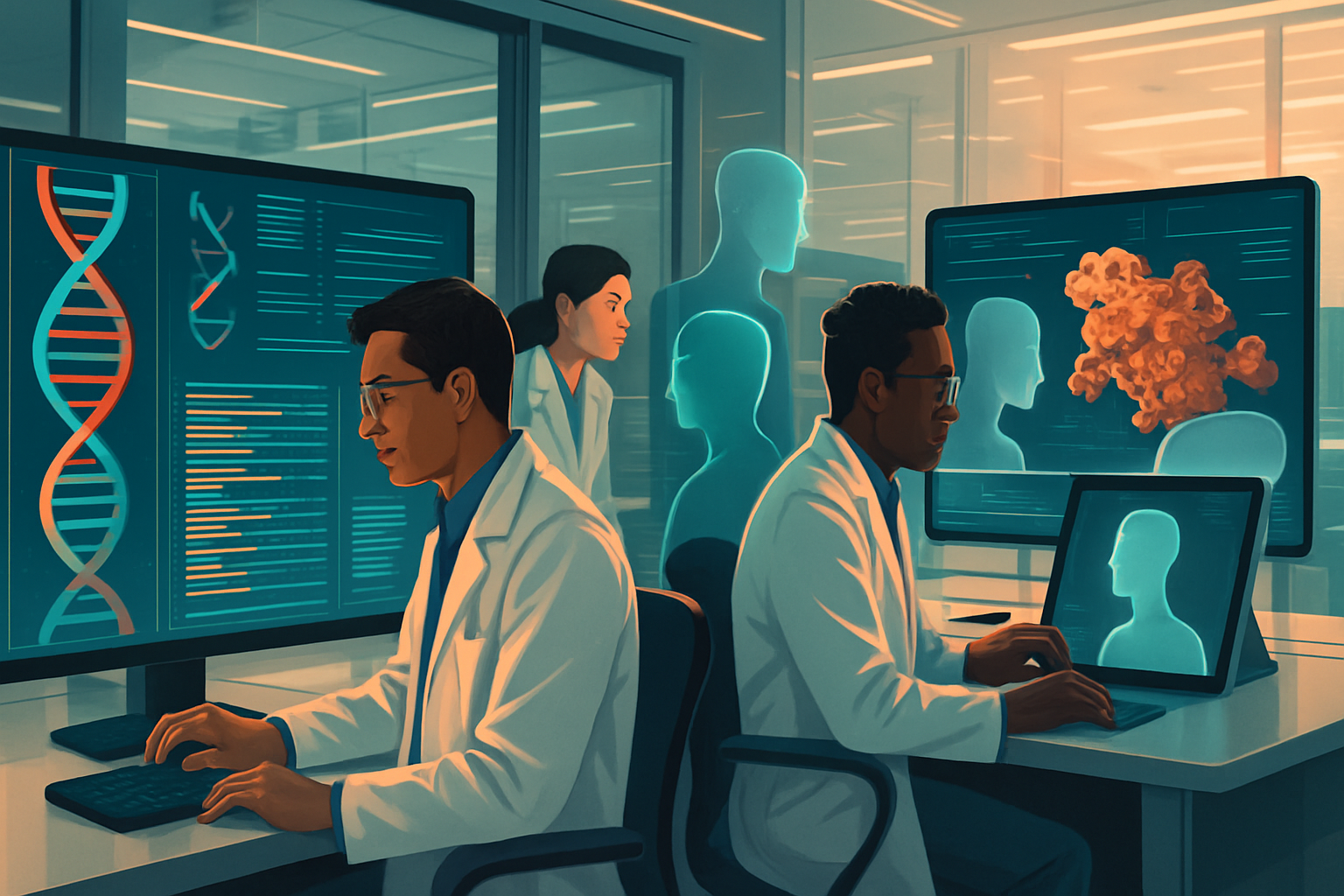
The operation of Claude Science relies on a main AI assistant that acts as a project manager for scientists. This assistant connects to over 60 scientific databases and offers pre-built toolkits for areas such as genomics, protein structure, and chemistry. The assistant can create sub-assistants to distribute tasks or delegate to a user-customized "expert" assistant.
A separate fact-checking assistant is also integrated to verify citations and calculations before any publication. This step is crucial to avoid the inclusion of fabricated citations or unverifiable statistics, a growing issue with AI-assisted writing. However, it is important to note that the underlying model verifies itself, without recourse to an independent source.
Ensuring Reproducibility and Saving Time
Anthropic has incorporated means to ensure the reproducibility of results with Claude Science. For example, the workspace can generate figures such as 3D protein structures, accompanied by the code that produced them. Each figure includes the exact code, a clear description of its creation, and a complete message history. This allows scientists to modify the figures in plain language, prompting the agent to adjust its underlying code.
Claude Science also offers significant time savings by operating on the laboratory's own infrastructure, thus avoiding the need to send data to Anthropic's servers.
Early Users and Real-World Applications
Early users have already begun to leverage Claude Science. Jérôme Lecoq, a neuroscientist at the Allen Institute, has used the tool to develop a multi-agent computational review pipeline. At the UCSF Brain Tumor Center, Stephen Francis's group has accelerated the analysis of germline lineages of gliomas, significantly reducing the time required while obtaining independently validated results.
Competition and Diverging Strategies
The launch of Claude Science comes shortly after OpenAI addressed a similar issue with a different approach. In April, OpenAI introduced GPT-Rosalind, a model specialized for biological reasoning.
The strategies of Anthropic and OpenAI differ not only in model specialization but also in access and deployment speed. GPT-Rosalind is a research preview limited to qualified enterprise customers in the United States, with restrictions based on qualification and security criteria. Partners like Amgen and Moderna have benefited from early access.
Meanwhile, Google DeepMind is taking a distinct approach with foundational scientific models like AlphaFold and AlphaGenome. Its Gemini for Science platform combines these models and over 30 databases on life sciences into a unique skill set.
Implications for the Scientific Research Market
These three different distribution strategies are competing for the same scientific research market. Anthropic offers broad access through subscriptions, OpenAI opts for a regulated approach for enterprises, and Google focuses on unique proprietary models. The evolution of these strategies could influence how AI providers compete in other specialized sectors such as law, finance, and engineering.
Claude Science is currently available in beta for Pro, Max, Team, and Enterprise subscriptions. Anthropic has mentioned Novo Nordisk and the Allen Institute as customer case studies, indicating that pharmaceutical organizations are already collaborating with multiple AI providers.
Supporting Research Projects
Anthropic plans to support up to 50 Claude Science projects, with funding of up to $30,000 in credits. The company is seeking postdoctoral and doctoral projects covering various fields and exploring the frontiers of science, with an initial focus on biomedical research. Applications are open until July 15, 2026, with award notifications expected by July 31. Projects will take place from September 1 to December 1, 2026.
Brief IA — L'actualité IA en français
L'essentiel de l'actualité de l'intelligence artificielle, décrypté et expliqué chaque jour.