Codeberg Rejects AI Code from Claude and Codex, an Ethical Choice
Le brief IA que les pros lisent chaque soir
Les 7 actus IA du jour, décryptées en 5 min. Gratuit.
Inclus dès l'inscription : notre sélection des meilleurs guides & comparatifs IA.
Choisis ton rythme
Gratuit · Pas de spam · Désabonnement en 1 clic
Codeberg Rejects AI Code from Claude and Codex, an Ethical Choice
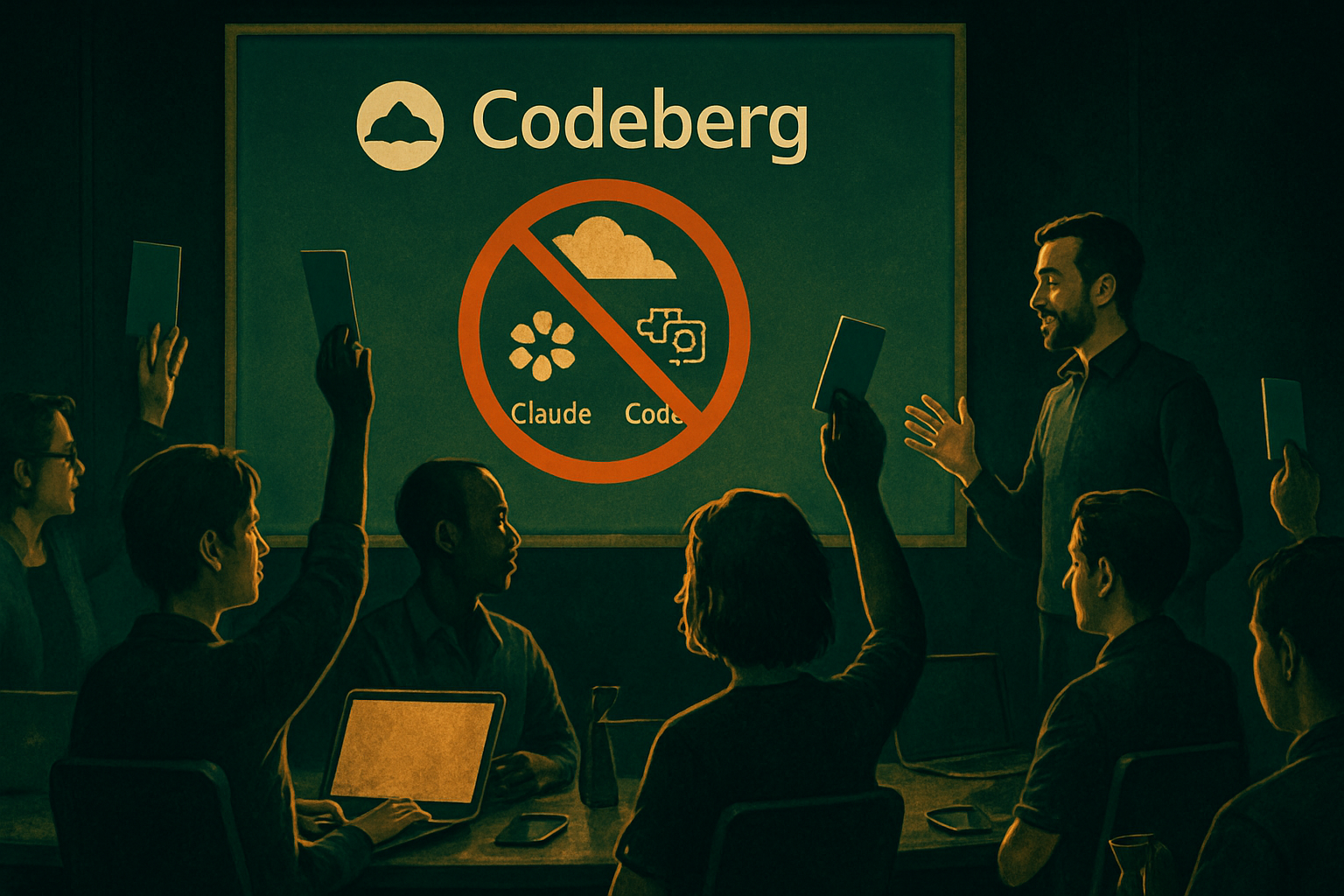
On July 22, 2026, the Codeberg community voted 71% in favor of banning predominantly AI-generated submissions, specifically targeting Claude and OpenAI Codex. This decision reflects both an ethical choice and an economic constraint.
What is Codeberg?
Founded in 2018 as a non-profit association under German law, Codeberg.org hosts free and open-source projects on an instance of Forgejo, the community fork of Gitea. With just over 1,100 members, two part-time employees, and funding through donations, the forge operates on a scale that makes every unit of storage and every continuous integration request valuable. Unlike GitHub, owned by Microsoft since 2018, Codeberg does not have the same industrial resources.
The Community Has Decided: AI Has No Place on Codeberg
The vote resulted in 358 votes for and 144 against, with 14 abstentions, from a participation rate of about 50%. The amendment to the Terms of Use clearly states: “You must not share projects that consist predominantly of code written by generative AI tools (including services such as Claude, OpenAI Codex).”
Codeberg presents two main reasons for this decision:
-
Legal Reason: The status of copyright on AI-generated code remains unclear under European law, exposing the host to legal risks.
-
Economic Reason: The cost of an SSD has risen from €700 to €3,700, partly due to the demand for memory chips driven by AI. AI-generated submissions consume resources without adding value to the community.
The ban also applies to future AI models: a second vote commits Codeberg to never train an AI model on hosted code or user data.
Limitations of the Decision
The rule concerns projects that are “predominantly” generated by AI, without a defined technical threshold or specified enforcement method. Detecting AI code remains a challenge, especially when mixed with human-written code. There will be no immediate purge of existing repositories with an active community or a history predating the era of LLMs.
Armin Ronacher, creator of the Python framework Flask, criticized this decision, calling it “very bad,” but failed to convince the voters.
Two Visions of Free Software
Since early 2025, open source has been in heated debate over AI-generated code. Other platforms, such as Flathub, have tightened their rules in response to low-quality automated submissions, and the Fedora community rejected a project for an “AI Developer Desktop” distribution.
Codeberg has also decided to ban cryptocurrency projects, relying on a precedent set by SourceHut in 2023. OpenAI Codex, mentioned in the new Terms of Use for Codeberg, was originally the model on which GitHub Copilot was built.
The divide is clear: on one side, a commercial forge backed by a valued company, viewing AI code as a competitive advantage; on the other, a European nonprofit that sees the same code as an existential threat to the FLOSS model.
Conclusion
For French and European developers seeking an ethical alternative to GitHub, Codeberg stands out as a reference. Although gray areas remain, its commitment to not feeding AI labs with its users' code is consistent with the context of the EU Chips Act and discussions on digital sovereignty. The question of adoption remains open, but those who wish to vote with their submissions now know where to turn.
Brief IA — L'actualité IA en français
L'essentiel de l'actualité de l'intelligence artificielle, décrypté et expliqué chaque jour.