Darren Aronofsky and AI: '1776', a Series that Disrupts History
Le brief IA que les pros lisent chaque soir
Les 7 actus IA du jour, décryptées en 5 min. Gratuit.
Inclus dès l'inscription : notre sélection des meilleurs guides & comparatifs IA.
Choisis ton rythme
Gratuit · Pas de spam · Désabonnement en 1 clic
A Bold Exploration of History by Aronofsky
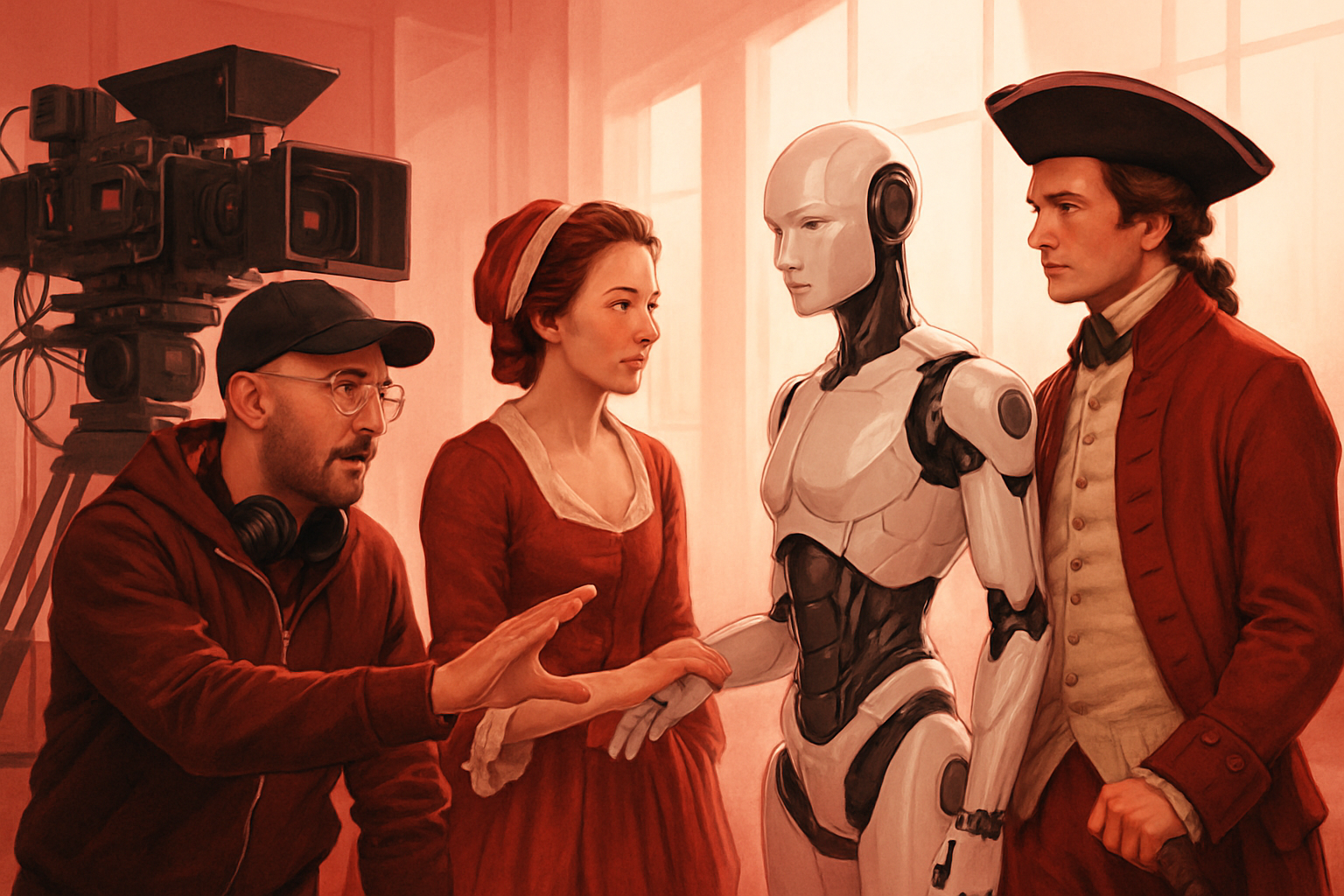
Since its debut on YouTube at the end of January, Darren Aronofsky's video series On This Day…1776 has captivated the attention of many viewers. This project, which leverages artificial intelligence, revisits the year 1776, a pivotal time in U.S. history marked by key events in the American Revolution. As an initiative closely tied to Hollywood, this series also serves as a testing ground for creators exploring the possibilities offered by the burgeoning tools of generative AI.
As we approach the 250th anniversary of American independence on July 4, the series stands out for its bold combination of technical prowess, instant patriotism, and a penchant for the grotesque. It evokes an almost morbid fascination, akin to that felt for a television series deemed the worst, yet one cannot help but watch to discover the next unexpected twist. Some sequences are truly bewildering.
Mixed Reactions and Media Impact
The series is produced by Aronofsky's studio Primordial Soup and promoted by Time Studios. From the simultaneous launch of its first two episodes, On This Day…1776 attracted considerable media attention, accompanied by sharp criticism. Many dismissed the series due to its heavy reliance on AI, pointing out glaring execution flaws and a betrayal of the humanity present in Aronofsky's previous films. Despite a willingness to keep an open mind, the series has been described by some as a "hellish broth" of human errors and misguided decisions.
For a time, it seemed the weight of the criticism was too heavy to bear, and the project had been put on pause. Time Studios had promised weekly episodes, but nearly a month passed before the third episode was released. Unlike a grand launch, this one simply appeared on the YouTube page, as has been the case with each episode since.
Audience and Personal Obsession
The series On This Day…1776 offers numerous encounters with iconic historical figures such as General George Washington. However, it has struggled to maintain consistent public interest. The first episode garnered 199,000 views, which is not insignificant, but subsequent episodes have struggled to reach 2,000 views each. Despite this drop in audience, the series continues to captivate certain viewers, including the author of this article, who follows its evolution with keen interest.
My compulsive viewing has focused on three aspects: the series' ability to adhere to its weekly schedule (which has been a total failure), how it presents history (increasingly absurd), and the use of AI (sometimes impressive, sometimes questionable).
In May, at the Cannes Film Festival during the AI Summit, Aronofsky encouraged the audience to watch the series, describing it as an experience aimed at observing its evolution. I accepted this challenge.
An Unconventional Approach to History
Unlike a traditional history lesson, On This Day…1776 offers an unconventional take on the year 1776. It explores significant events, such as the British fleet's withdrawal from Boston, while highlighting lesser-known facts, such as the forced recruitment of German villagers into the Hessian army. However, the series takes certain liberties with the historical timeline. For example, the episode on March 5: Massacre Day focuses on the Boston Massacre, even though this event occurred six years earlier. Moreover, this episode was only released on YouTube on March 17, a significant date in 1776 corresponding to the departure of the British fleet.
The series incorporates a global perspective, presenting the events of the year from multiple angles: American revolutionaries, British soldiers, French royalty, Hessian mercenaries. Extended sequences are spoken in French and German, with subtitles, or with a marked Scottish accent. The production emphasizes that accredited human voice actors from the SAG handle the dialogue. Other humans involved include the writer, director, editor, and composer, all credited at the end of each episode starting from the fourth.
It's an ensemble cast that largely features a parade of Great Men of History: Ben Franklin, Thomas Jefferson, Thomas Paine, George III, John Adams. If there is a main character, it is George Washington, a central and imposing figure in 1776. A rare exception is the curiously two-episode saga featuring an unfortunate unknown conscript in the Hessian ranks just after his wedding.
We spend time with Betsy Ross in the Flag Day episode (which arrived a few days late), but she has no lines. She is too busy sewing.
Technical Progress and Visual Challenges
In his comments in May at Cannes, Aronofsky described the production advancements from January to the episode of April 29 (the sixth and most recent at that time) as "breathtaking." It wasn't just the AI models that were improving, he said, but also the pipeline of Primordial Soup and the unspecified artists working on the project.
I am not convinced. Perhaps it's more a matter of back-end adjustments as the production team becomes familiar with the tools. But from a commercial standpoint, where do I look? Sorry, no.
The faces remain inconsistent from scene to scene and frame to frame within the same scene. Ben Franklin looks a bit chubbier, then less so; a bit older, then a bit younger. The lip-syncing is also desperately off almost all the time, like a poorly dubbed foreign film. Historical figures often seem too much like props: Washington entering a room feels scripted, not lived. And there is often a plastic quality to the images.
There is a constant feeling that Primordial Soup is boasting: Look at the macro detail in this fabric! Look at someone making perfectly round bubbles! It's technically impressive, but also downright distracting. Time Studios has labeled On This Day...1776 as an "animated series," which seems a strange description given its relentless pursuit of photorealism.
Yet, somehow, the more recent episodes seem improved in a way that is hard to pinpoint.
Episode 10, the one about Betsy Ross, features an emotional montage of red, white, and blue flag threads forming and reforming into Uncle Sam, Amelia Earhart and her plane, the moon landing, the flag-raising at Iwo Jima, an elephant and a donkey facing off, Jimi Hendrix, the Arlington Cemetery. It resembles something you might see on the Jumbotron at a political rally. It’s one of the most impressive sequences in the series so far.
I think it's a matter of confidence. The Primordial Soup team seems increasingly empowered to be strange. To give in to their inner David Lynch. To go beyond diorama history and toward a specific vision, however deranged it may be.
One of the early episodes gave us George Washington having a bad dream, playing out doubts he really recorded in his private correspondence. As he prepares for bed, we get an overly vivid glimpse of his false teeth. In the extended dream sequence, a musket ball hits him squarely in the forehead, lingers for a moment, and then falls.
This reminder of the Boston Massacre? It is presented in a vertical video format, as if someone recorded the episode on a smartphone. This is not the only anachronism. In later episodes, we catch a glimpse of "Join or die!" painted on a statue, and in another, a call for "More kings."
A Series That Defies Conventions
The episode of April 29 was trippy from start to finish. A report on the debates within the French ruling class about whether to help the American colonists, it opens with a tracking shot of a fly traversing the palace halls before being comically squashed on a map. In another scene, a fish flops on a table in front of a bewildered royal. Wigged ministers debating in a palace room suddenly find themselves aboard a ship on a choppy sea, table and chairs included. (The episode ends with a guillotine decapitation. Whee!)
The episode of June 5 introduces a stressed John Adams who dangerously resembles a clone of Larry from the Three Stooges.
It's touch-and-go for a while in a cartoonish battle between Thomas Jefferson, author of the Declaration of Independence, and King George III. When Jefferson — and the Declaration — finally triumph, the crowd chants "USA! USA! USA!"
In conclusion, On This Day…1776 is a unique cinematic experience that explores the possibilities offered by AI in artistic creation. While the series has its flaws, it paves the way for new forms of visual storytelling, raising questions about the future of cinema and history told through technology.
Brief IA — L'actualité IA en français
L'essentiel de l'actualité de l'intelligence artificielle, décrypté et expliqué chaque jour.