Dataland in Los Angeles: AI Art Challenges the Senses and Certainties
Le brief IA que les pros lisent chaque soir
Les 7 actus IA du jour, décryptées en 5 min. Gratuit.
Inclus dès l'inscription : notre sélection des meilleurs guides & comparatifs IA.
Choisis ton rythme
Gratuit · Pas de spam · Désabonnement en 1 clic
Dataland: A World First in Los Angeles
Dataland recently opened its doors in Los Angeles, positioning itself as the very first museum dedicated to art generated by artificial intelligence. This unique venue offers a multi-sensory immersive experience, integrating wearable devices and artworks created by AI algorithms. The displayed creations are the result of an AI model trained on data sourced from nature.
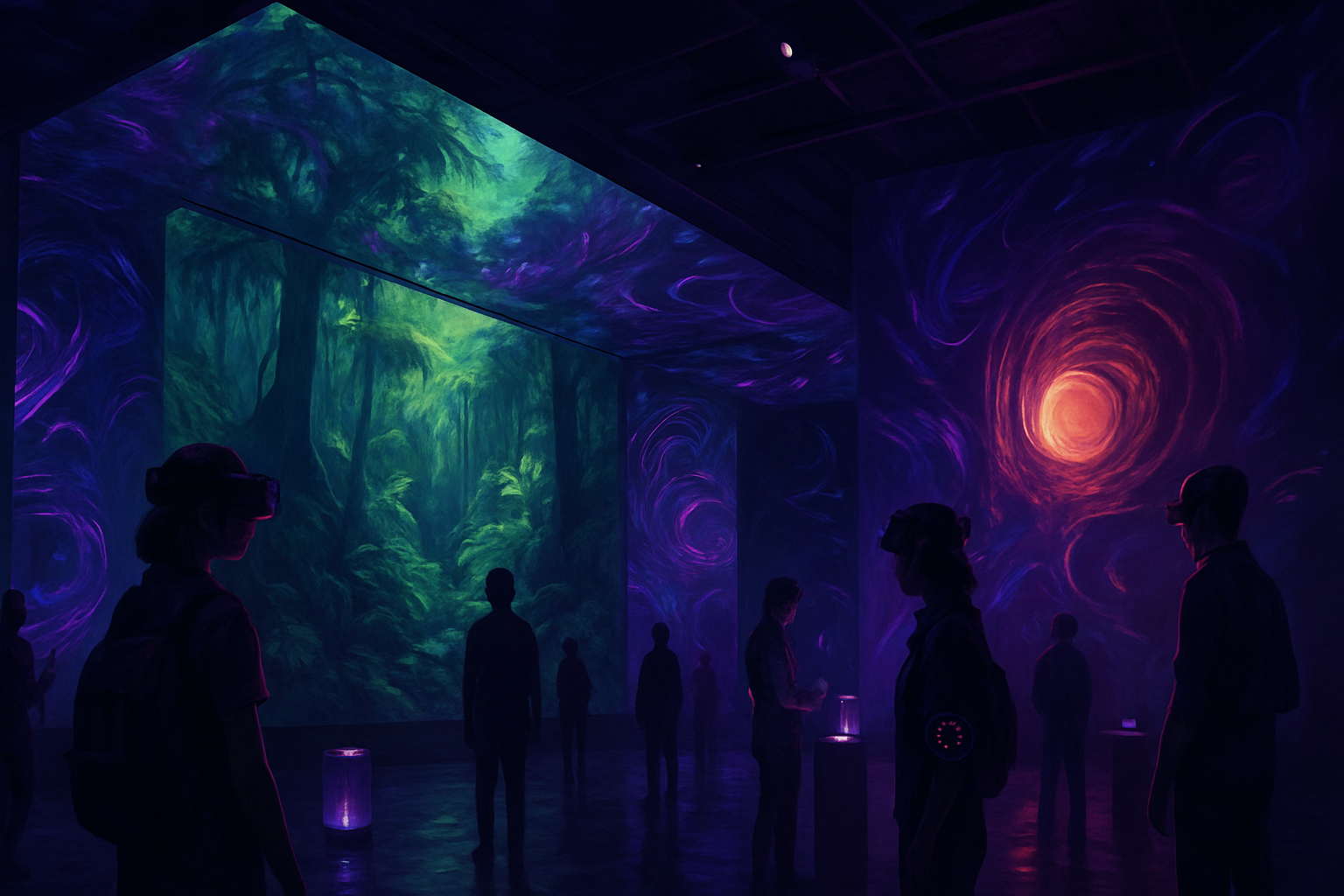
During my visit, I entered a vast digital rainforest, where images of greens and golds, vaguely resembling trees, animated across the walls. The floor and ceiling displayed a network of blue lines, resembling roots, that lit up with each of my steps. The sounds of an orchestra resonated, interspersed with the chirping of crickets, while a herbaceous and spicy scent, reminiscent of fresh jalapeño, floated in the air.
A Captivating Inaugural Exhibition
The inaugural exhibition, titled "Machine Dreams: Rainforest," consists of five galleries where multi-sensory art is generated by an AI trained on data from the natural world. Dataland is the result of a collaboration between media artist Refik Anadol and his partner Efsun Erkiliç. Google, a partner of the museum, provided Google Cloud tools to create generative soundscapes, detect visitors' emotions, algorithmically adjust scents, and interact with human movements.
In a context where the use of AI in art still sparks debate, Dataland embodies a bold adoption of this technology. The exhibited works are often beautiful and interactive, offering a complete sensory experience.
A Total Sensory Immersion
Dataland offers a combination of visuals, scents, sounds, and interactive experiences. My ticket for a weekday visit cost $59. After our group of about twenty people formed, we entered the first of the five galleries.
A recorded voice welcomed us: "You are inside a work of art that is still unfolding. Your presence shapes the world you are about to enter." Visitors receive two wearable devices to enhance their experience.
Wearable Technology Serving Art
We were given a bracelet, similar to a watch, that tracked our movements, temperature, and pulse, as well as a U-shaped device worn around the neck that emitted scents. Rather than saturating the rooms with a single fragrance, each visitor perceived different scents through their individual devices.
I could observe my movements, identified under the code M4, projected on a screen. The visuals were often psychedelic, ranging from abstract shapes, like waves of colorful balls reminiscent of Dippin' Dots, to more literal representations, such as fantastical flowers or brightly colored birds fluttering across the screen. At times, the images evoked more of an interior computer than nature, highlighting the blend of technology and environment that underpinned the entire concept.
Create Your Own AI Art
In one of the galleries, visitors had the opportunity to create their own AI art on small interactive screens. I made a few brush strokes and watched as the image on the large screen transformed into an abstract bird of paradise flower, vaguely resembling the shape of my drawing.
The idea of being tracked in a museum might unsettle some. Visitors interacted with the space, observing their steps and waving their hands to see how the art reacted. At one point, the screens dimmed, and glowing circles appeared around our feet, displaying our pulse and temperature.
The Art of Measuring Emotions
According to the museum, the bracelets track "skin electricity" to "capture your response to the artwork." They also monitor your movements in the space, and on a screen, I could see my avatar, labeled M4 according to my bracelet, moving.
One screen displayed how each person in the room reacted to the space — I could see the line representing me, M4, on graphs illustrating changes in my "emotional temperature" and "heart rate" during my visit. It was interesting to see my avatar on the screen and realize how much time I had spent in each room, but I wasn't quite sure what to make of the data, and I wondered if some people might feel a bit uncomfortable being monitored.
An Unforgettable Experience
I spent about 90 minutes exploring Dataland. Some images enchanted me, and I felt a renewed curiosity each time a new scent surprised me — "Is it more woody or smoky?" — and the sounds often harmonized fascinatingly with the hypnotic movements of the images.
It was impossible not to think about the fact that the art had been created by an AI. I often ask myself two questions when observing a work of art: How does it make me feel? and What does the artist mean? Without the sense that the art was the direct result of a human being thinking and feeling, I found it difficult to connect with much of it.
The most moving part of the experience for me was not generated by the AI at all — it was a real recording of an extinct Hawaiian bird calling for a mate and receiving no response.
I spent much of my time at Dataland pondering a simple question: What is art? And can it truly come from AI? Although the images were often dazzling and I enjoyed parts more than I had anticipated, I left with a lingering uncertainty about whether I had seen art, technology, or a strange new combination of both.
Brief IA — L'actualité IA en français
L'essentiel de l'actualité de l'intelligence artificielle, décrypté et expliqué chaque jour.