Dataland: AI and Art Merge in the Heart of Los Angeles
Le brief IA que les pros lisent chaque soir
Les 7 actus IA du jour, décryptées en 5 min. Gratuit.
Inclus dès l'inscription : notre sélection des meilleurs guides & comparatifs IA.
Choisis ton rythme
Gratuit · Pas de spam · Désabonnement en 1 clic
Dataland: An Innovative Fusion of AI and Art in Los Angeles
In Los Angeles, Dataland stands out as a one-of-a-kind museum dedicated to exploring art through artificial intelligence. This fascinating venue offers a complete immersion into data visualization, utilizing sophisticated language models to transform data into captivating artistic experiences. Contrary to common misconceptions about generative AI, often accused of producing imitations of human art, Dataland provides an experience that invites visitors to interact with its artistic installations.
Dataland opened its doors on June 20, nestled in the Grand LA, an artistically designed office complex offering stunning views of the Walt Disney Concert Hall, designed by Frank Gehry. Upon entering, visitors are greeted by the inaugural exhibition "Machine Dreams: Rainforests," which unfolds across five specially designed windowless rooms, featuring smooth black floors that reflect swirling colors.
Refik Anadol: The Visionary Behind Dataland
The creative mind behind Dataland is Refik Anadol, a Turkish artist who has spent a decade pushing the boundaries of digital art. Anadol uses algorithms to metamorphose raw data into dynamic visuals, often in the form of orbs of changing colors. His works have been showcased in prestigious institutions such as the Museum of Modern Art in New York and the Guggenheim Museum in Bilbao. For Anadol, data is the "pigment" of his art, and Dataland represents a permanent installation dedicated to his experiments.
AI and Art: A Complex Relationship
The opening of Dataland comes at a time when the use of AI in art sparks passionate debates. AI-generated works are often perceived as artificial and insincere, as they mimic the artistic styles on which they were trained. However, Dataland distinguishes itself with its unique approach: the works do not seek to compete with traditional art but to offer an immersive experience based on data.
An Unprecedented Immersive Experience
Unlike the AI productions flooding the internet, the works at Dataland are not designed to imitate human art. They are the result of a collaboration between humans and machines, where data plays a central role. Anadol poses an intriguing question: "Can the artwork feel us?" This inquiry lies at the heart of the experience offered by Dataland, where visitors are invited to explore the balance between human and machine.
The Importance of Ethical Data
To create the visuals of Dataland, Anadol uses datasets from 16 rainforests around the world. These data are obtained ethically, licensed from the Smithsonian and other repositories. While the provenance of data remains a challenge, Anadol emphasizes the importance of ethics in the creation process.
The Large Nature Model: A Powerful Tool
The visuals at Dataland are generated by a large language model called the "Large Nature Model," developed from images of rainforests. This model generates the museum's images on the fly, offering a unique experience with each visit. Anadol specifies that this process operates in data centers located in Oregon.
A Multisensory Experience
Dataland offers a multisensory experience that goes beyond mere observation. Visitors must scan a QR code to unlock a box containing two devices: a wearable bracelet that tracks their location and vital signs, thus influencing the visuals and sounds in real-time, and a scent emitter that releases aromas based on the exhibition, adding an olfactory dimension to the experience.
An Unforgettable Visit
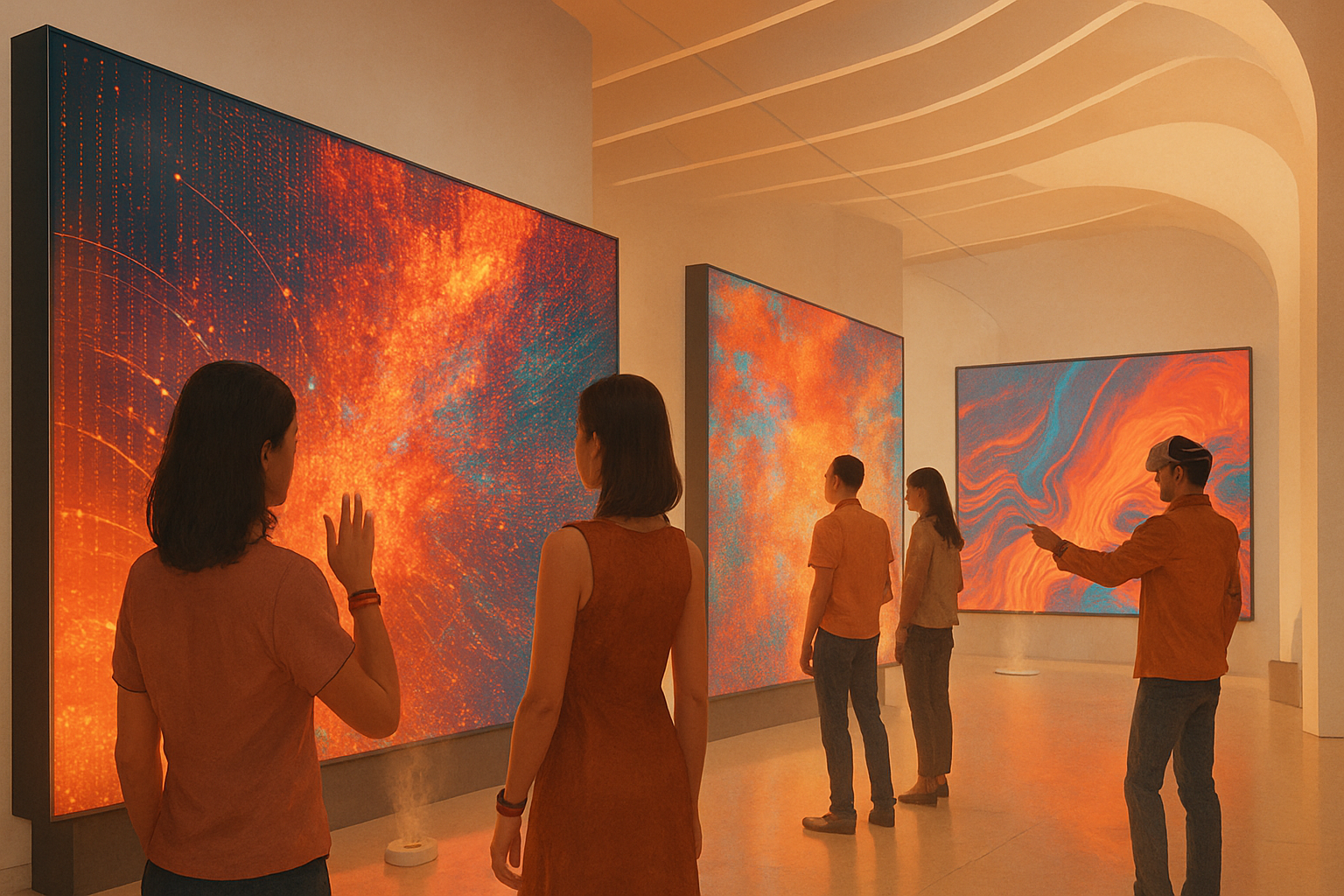
The highlight of the visit is the Data Pavilion, a vast room where screens stretch up to the ceiling. Visitors are immersed in a kaleidoscope of colors and sounds, where their movements influence the visualizations. Although the impact of personal data on the experience is not immediately perceptible, the overall effect offers an impressive visual and auditory spectacle.
A Museum Worth Discovering
With an entry fee of $49, Dataland is a curiosity that is worth the visit for those interested in digital art and AI. As visitors move from room to room, they are invited to reflect on how data influences our perception of the world. Dataland is an invitation to explore the possibilities offered by AI in the realm of art while raising questions about the future of artistic creation.
Diving into the AI Museum: See, Feel, Smell, Eat
The museum begins with a welcome room showcasing the exhibition. As Dataland opens - and likely throughout its first year - this exhibition is "Machine Dreams: Rainforests," which uses data from 16 rainforests around the world to create a multisensory experience. Anadol plans to rotate the exhibitions annually.
The first room sets the stage for the four others, featuring LED screen walls that project a dynamic light show like the most advanced screensaver in the world. The wall screens were the only light in the room, reflected on the carefully maintained smooth black floor to preserve the mirror effect. (I was asked to wear shoe covers during my visit, although public visitors do not need to).
After a brief preview of the rooms ahead, we scanned a printed QR code (public visitors scan one via a mobile app) to unlock a box containing a pair of devices. The first is a simple wearable bracelet to track your location and vital signs (heart rate, skin temperature, etc.), generating data that is supposed to adjust your experience. The second is a plastic scent emitter shaped like a horseshoe that is worn around the neck and discreetly releases aromas based on the part of the exhibition nearby. In my experience, it was barely perceptible, but it's much better than being overwhelmed by a scent.
The Data Pavilion, accessible via an escalator, is the largest room in the museum. It is by far the centerpiece and experimental anchor. Screens stretched 30 feet up to the ceiling, and projectors seamlessly extended the visualizations onto the floor and ceiling. Different "chapters" transitioned the visuals from a rainbow spectrum of strings and dots to a cybernetic world of chips resembling the inside of a server rack, to a digitized forest. Anadol highlighted the lidar scanners on the ceiling that track everyone's position; I observed projected fireflies spreading around my feet while glowing vines on the walls undulated in response to my movements.
"So, when we enter the museum, and of course, when I enter the gallery, the entire gallery feels us - our heartbeats, our emotions, our movements," Anadol stated.
I have no reason to doubt this, although I did not notice the contributions of my data to the experience. I was more impressed by the high-production visuals and sound than by contemplating the "real-time sand molecules personally composed for you," as he described. Again, I must determine for myself which parts of the experience were tailored to me, and whether this changes my perception of them.
At a certain point, you transition from the audiovisual kaleidoscope of the Data Pavilion to the next room. It is a long hallway with a few exhibits, including a wall of dots representing all the data used in the museum - a constellation of information. There was a platter of chocolates made by a local chef who designed the flavors based on the rainforest data - or at least the descriptive words Anadol selected to represent all the soils, plant, and animal life of those environments. These chocolates add a subtle gustatory dimension to the experience, inviting visitors to reflect on how data can be translated into physical sensations.
In conclusion, Dataland is a bold exploration of the interaction between AI and art, offering a multisensory experience that encourages visitors to rethink how we perceive and interact with digital art. It is a place where technology and creativity meet to create something truly unique.
Brief IA — L'actualité IA en français
L'essentiel de l'actualité de l'intelligence artificielle, décrypté et expliqué chaque jour.