Mistral AI Partners with Airbus and BMW to Revolutionize the Industry
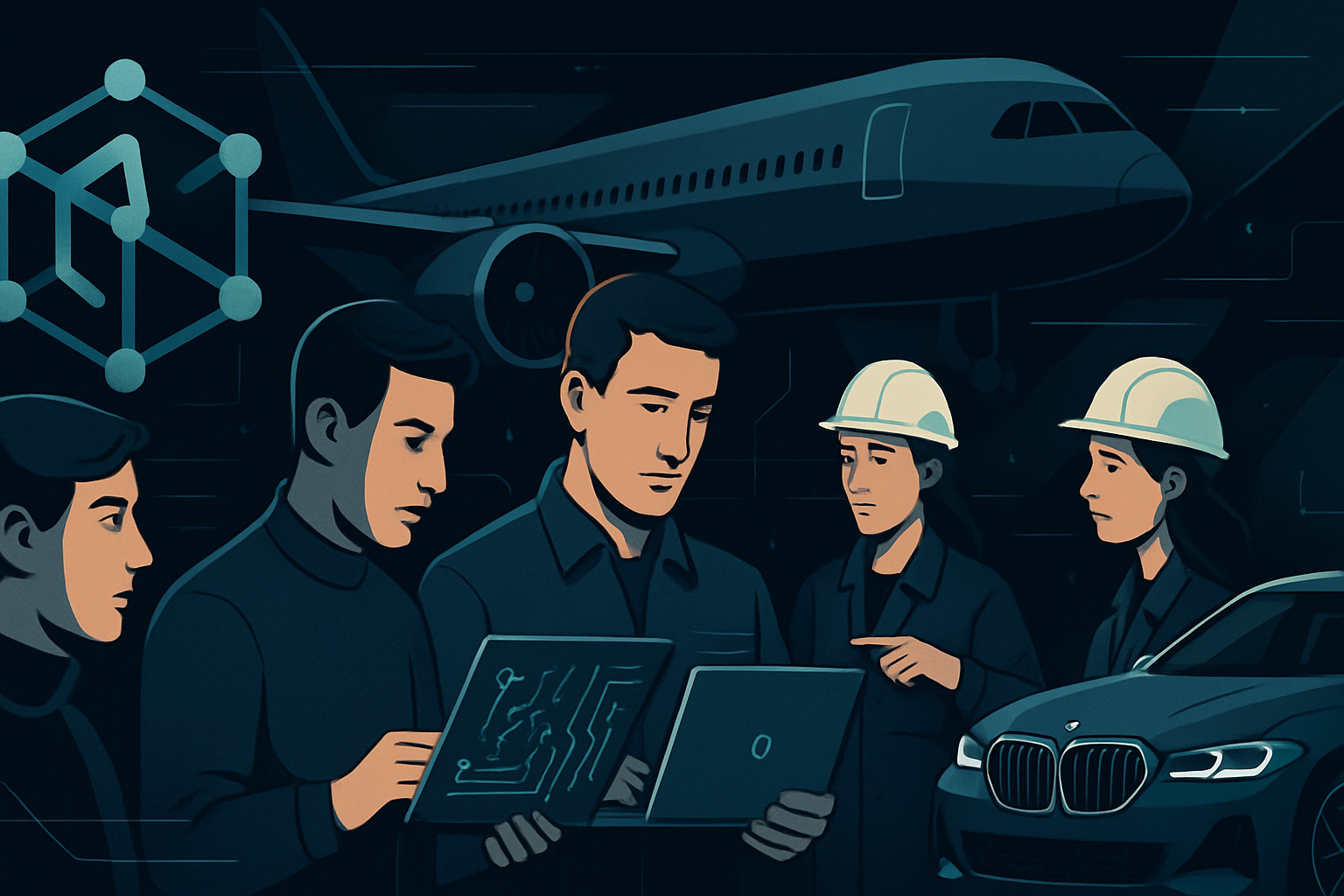
Mistral AI Turns to Industry with Major Partnerships
While most companies in the field of artificial intelligence focus on conversational assistants and office applications, Mistral AI, a French startup, is taking a different direction by moving closer to industry. At the "AI Now Summit" held at the Carrousel du Louvre in Paris, Mistral AI unveiled a series of announcements that mark a significant strategic evolution, far beyond mere product enhancement.
Among the announcements are a partnership with Airbus, a collaboration with BMW, the launch of a suite called "Mistral for Industrial Engineering," and the acquisition of the Austrian company Emmi AI. These initiatives demonstrate that Mistral AI no longer wants to be just a European competitor to ChatGPT but aims to become a strategic industrial layer for major European corporations.
A New Era for Generative AI
This evolution marks a significant break in the trajectory of generative AI. Since the explosion of ChatGPT at the end of 2022, competition has primarily focused on conversational uses: office co-pilots, text generation, software assistance, or administrative task automation. However, the next wave could unfold much further from consumer interfaces, right at the heart of industrial systems.
Industry represents a particularly strategic terrain for AI players. The barriers to entry are much higher than in general-use applications. Data is sensitive, integration cycles are long, regulatory constraints are significant, and technological dependencies are critical. Most importantly, the economic value created can be directly linked to production costs, research and development (R&D) cycles, and industrial competitiveness.
Strategic Partnership with Airbus
The partnership announced with Airbus precisely illustrates this shift. The agreement covers various branches of the European aerospace group: commercial aviation, helicopters, defense, and space. Airbus has been working for several years with Palantir Technologies through its Skywise platform, used for maintenance and operation of aerospace data, but with Mistral AI, the focus is elevated within the value chain. It is no longer just about analyzing operational data flows but about introducing AI into the engineering processes themselves.
The difference is significant; future AI systems will no longer merely assist employees with documentation tasks but will gradually enter into industrial simulation, product design, manufacturing chain optimization, and advanced engineering workflows.
BMW and Multimodal Models
The partnership with BMW goes even further in this direction. As part of its "Large Industry Model" initiative, the German automaker aims to develop multimodal reasoning models capable of working from complex engineering data. Among the use cases mentioned are automotive crash simulations, a domain historically extremely costly in terms of computation, modeling, and regulatory validation.
Le brief IA que les pros lisent chaque soir
Les 7 actus IA du jour, décryptées en 5 min. Gratuit.
Inclus dès l'inscription : notre sélection des meilleurs guides & comparatifs IA.
Choisis ton rythme
Gratuit · Pas de spam · Désabonnement en 1 clic
This evolution reflects a profound transformation in artificial intelligence. Until now, large language models were primarily designed to manipulate text, code, or images. Now, the ambition is to enable them to understand complex physical behaviors: fluid dynamics, mechanical constraints, multi-physical systems, or thermal simulations. AI is gradually moving away from the purely linguistic field to enter the realm of scientific and industrial engineering.
Acquisition of Emmi AI to Strengthen Engineering
This logic is precisely what underpins the acquisition of Emmi AI announced about ten days ago. The Austrian company develops "Large Engineering Models" intended to create digital twins capable of accurately reproducing industrial physical phenomena. The goal is to accelerate simulation cycles, reduce design costs, and optimize industrial processes.
This positioning gradually brings Mistral AI closer to players historically specialized in industrial software and advanced simulation, such as Dassault Systèmes, Siemens, or Ansys. The difference is that Mistral is attempting to inject the capabilities of generative models and multimodal reasoning systems into this space.
A Geopolitical and Strategic Dimension
This strategy also has a strong geopolitical dimension. For Arthur Mensch, artificial intelligence is now a technology capable of altering global economic balances by capturing an increasing share of the value added produced by developed economies.
In this context, the sovereignty of industrial data becomes a central issue. Major European corporations, particularly in aerospace, defense, or automotive, remain particularly sensitive to issues of intellectual property, data control, and dependence on American cloud infrastructures. Mistral AI is precisely trying to build a European alternative capable of addressing these concerns.
The company also strongly emphasizes the control of proprietary data and mastery of critical infrastructures. This discourse goes far beyond mere marketing and reflects a deeper transformation in the AI market: competition is no longer solely about the models themselves but about the entire industrial chain that enables the production, training, and deployment of these systems.
Computing Capacity and Critical Infrastructures
This also explains Arthur Mensch's recent statements regarding data centers, electricity, and computing capacities, notably one that garnered attention before the Economic Affairs Committee of the National Assembly. On that day, the CEO of Mistral AI announced the deployment of 200 megawatts of capacity by the end of 2027 and aims for a power of one gigawatt by 2030.
As models grow in size and industrial applications multiply, computing capacity becomes a strategic asset on par with data or the software itself. This analysis was also echoed yesterday by Mark Zuckerberg during Meta's annual meeting, where we reported on new strategic directions regarding AI infrastructure. Thus, in this new economy, access to energy, computing infrastructures, and critical industrial workflows could become even more important than the mere quality of a conversational assistant.
The AI battle is thus entering a new phase. After chatbots and office co-pilots, technology players are now beginning to target the most sensitive industrial layers of the global economy. For Mistral AI, the challenge is now to position itself as one of the future industrial operators of European artificial intelligence.
Brief IA — L'actualité IA en français
L'essentiel de l'actualité de l'intelligence artificielle, décrypté et expliqué chaque jour.