Genesis AI: the robot that cooks and plays piano like a human
Le brief IA que les pros lisent chaque soir
Les 7 actus IA du jour, décryptées en 5 min. Gratuit.
Inclus dès l'inscription : notre sélection des meilleurs guides & comparatifs IA.
Choisis ton rythme
Gratuit · Pas de spam · Désabonnement en 1 clic
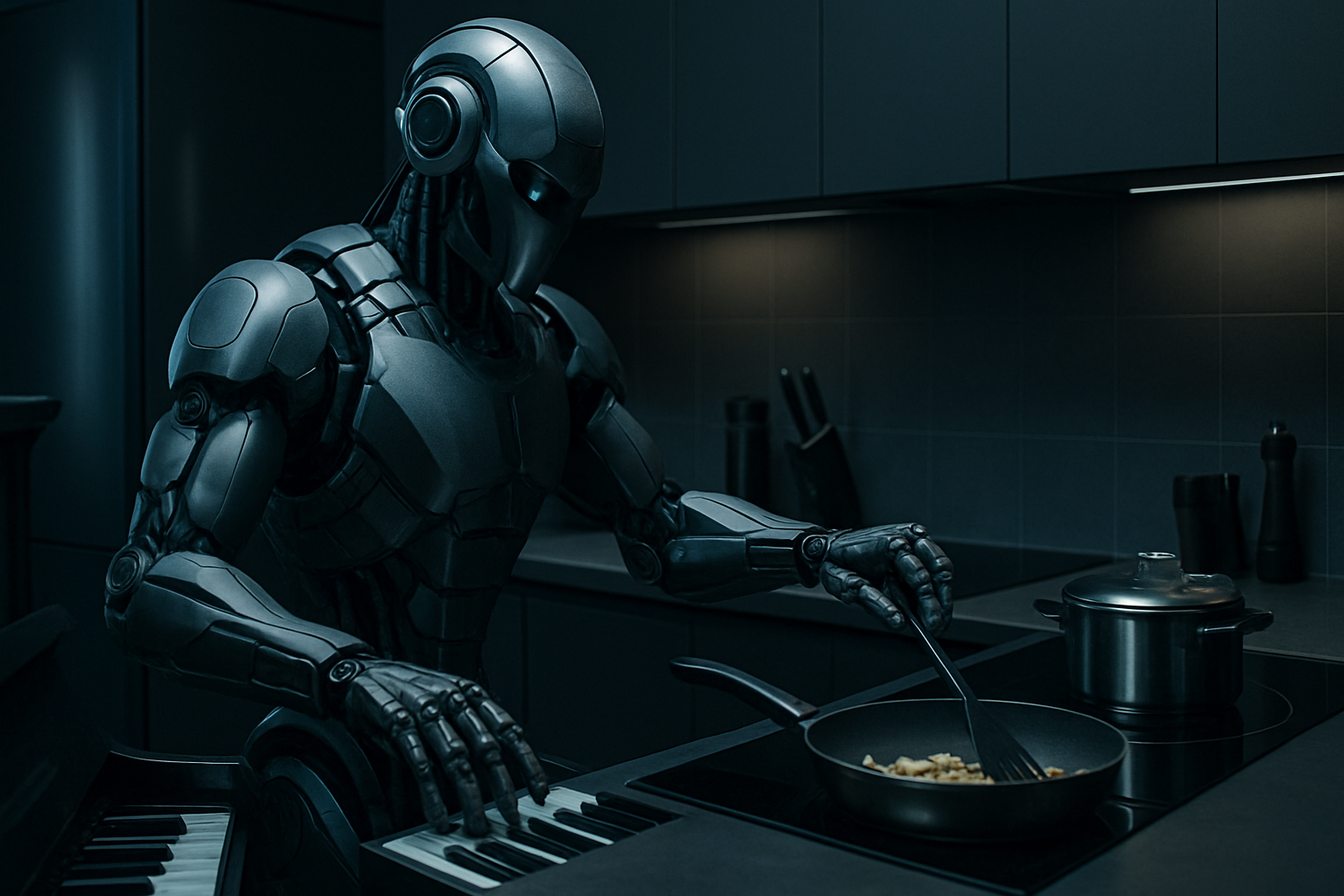
Genesis AI, a French robotics startup with an R&D center in Silicon Valley, has recently garnered attention by showcasing the advanced capabilities of its robots. Backed by Eclipse and former Google CEO Eric Schmidt, the company presented videos where its robots perform complex tasks such as playing the piano and cooking, skills that are approaching human-like proficiency.
The CEO of Genesis AI, Zhou Xian, explained that these robots are trained using a combination of real-world data and simulations. The videos notably feature a robot playing the piano at an impressive tempo of 130 beats per minute, as well as cooking demonstrations where the robot cracks an egg and handles wires. These performances were carried out autonomously, without direct human intervention.
However, these demonstrations are not examples of execution without training. The robots still require training for specific tasks. Zhou Xian revealed in an interview with Business Insider that his team of about 60 people taught the robot to play a new song on the piano in just one hour. For the cooking demonstration, it took "a few hundred trajectories" or recorded examples to train the robot to crack an egg or cut a tomato.
He specified that a "complex skill" lasting 30 seconds requires several hours of human data, combined with less than half an hour of data from the robot performing the task. The robot exhibited about 60% to 70% of human speed, which represents a significant advancement in the field of robotics. However, the robot struggled with some subtasks during the cooking demonstration: while most steps achieved around 90% to 95% success, the task of cracking an egg with one hand and transferring a cut tomato with a knife was closer to 50% to 60% during filming.
Unlike companies focused on models like Physical Intelligence, Genesis AI develops the entire chain: the AI model, the robotic hand, training gloves, the simulator, and ultimately, the robot itself. Zhou Xian envisions a future where Genesis robots could be used in both factories and homes, thanks to their full-stack design that integrates hardware and software. According to him, this approach allows for better responses to the specific needs of different environments. In 10 years, Zhou stated that he sees no reason why a factory robot should be fundamentally different from a household robot.
Genesis manufactures a hand that closely resembles the human form, featuring 20 degrees of freedom and 20 integrated motors, distinguishing it from traditional tendon-controlled models. Rather than relying solely on video data and teleoperation, the startup employs a mix of internet data and raw human data collected through proprietary training gloves. Xian mentioned that his company is in discussions with several industrial partners who could have their employees wear the training gloves for data collection during work.
Genesis also utilizes an internal simulator to test models trained on real-world data in various virtual environments, allowing the company to evaluate systems more quickly than conducting each test on a physical robot. The CEO stated that he is not making the bold claim that manipulation has been solved, but that Genesis's approach is a "critical step" towards improving robot manipulation. "We are indeed an ambitious company," Xian said, "and we are not satisfied with the status quo; we want to advance the field."
Brief IA — L'actualité IA en français
L'essentiel de l'actualité de l'intelligence artificielle, décrypté et expliqué chaque jour.