Deepseek V4.1-Flash Cuts Agent Memory and Remains Free
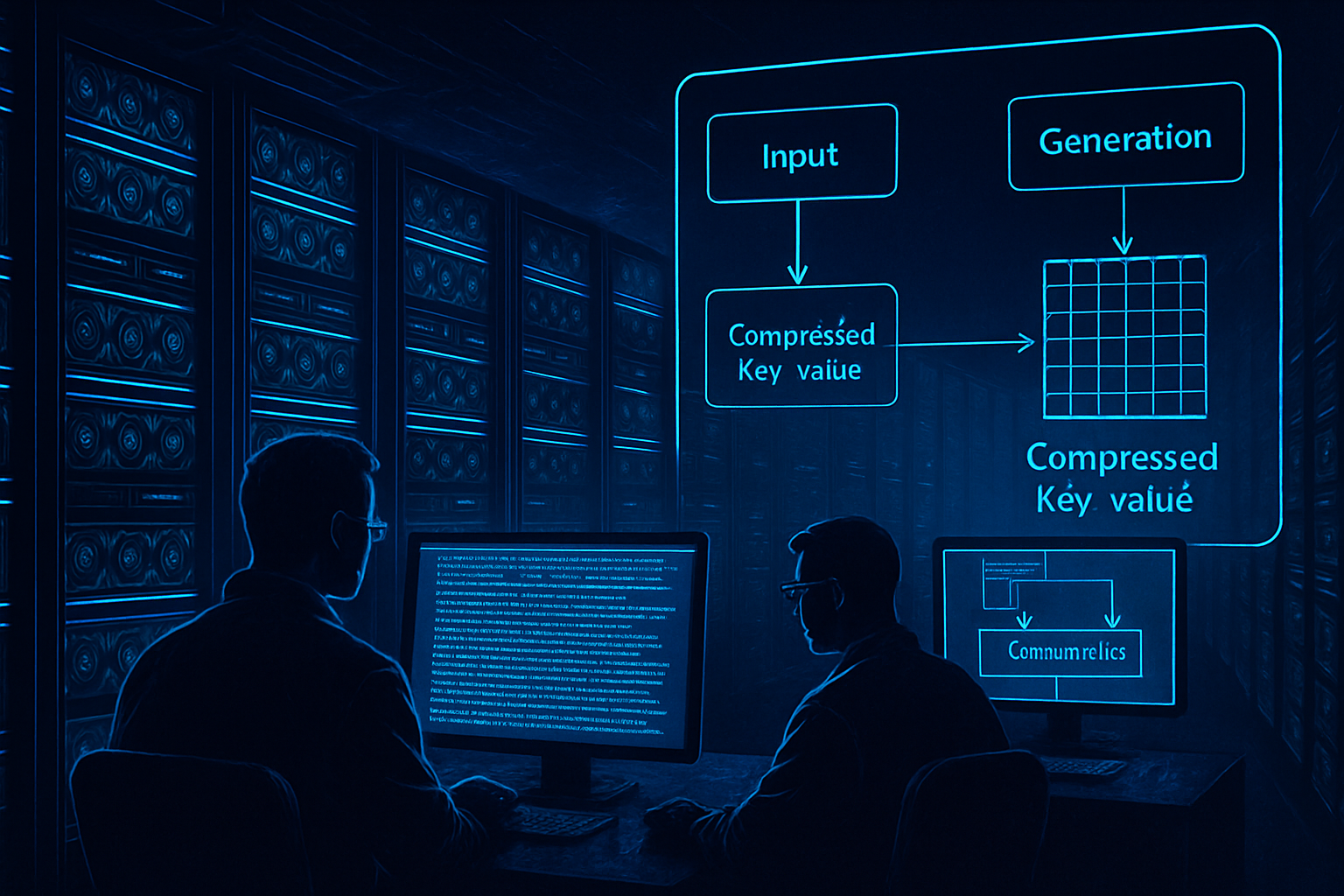
Deepseek pushes targeted optimization for AI agents with V4.1-Flash: a highly compressed KV cache, reduced computation at input, and a context of one million tokens. The model is offered as open source and via API at the same price as V4-Flash, showing solid results in coding but acknowledged gaps in science and image processing.
API at the Same Price, MIT Open Source License, and a Tense Market Context
V4.1-Flash is accessible via an API at the same prices as V4-Flash, and its files are published on Hugging Face under an open MIT license to serve as a foundation for work on more cost-effective agents. In mid-August, Deepseek released V4-Pro from testing and simultaneously raised API prices, making cache hits six times more expensive. At the end of July, the 0731 update had already elevated the level of V4-Flash, which scored just one point lower than GPT-5.6 Luna on the Artificial Analysis Intelligence Index while costing about 60% less per task. In June, the company raised approximately $7.4 billion for a valuation exceeding $50 billion and mandated CITIC Securities for an IPO in China, according to available reports.
KV Cache Reduced to 1/4 on GPU and 1/8 on SSD, 437 Times Smaller Compared to V1
Deepseek explicitly aims to reduce the KV cache, the buffer that retains already processed parts of a context. According to the company, the size of the buffer in fast GPU memory drops to nearly a quarter of that of V4-Flash, while the portion transferred to SSD or host memory is reduced to about one-eighth. Compared to Deepseek-V1, the total size of the KV cache per token has been divided by 437. This optimization specifically targets multi-step agents, whose cache can quickly grow and strain GPU memory, SSD, and bandwidth, impacting costs.
Le brief IA que les pros lisent chaque soir
Les 7 actus IA du jour, décryptées en 5 min. Gratuit.
Inclus dès l'inscription : notre sélection des meilleurs guides & comparatifs IA.
Choisissez votre rythme
Gratuit · Pas de spam · Désabonnement en 1 clic
Deepseek V4.1-Flash Separates Initial Processing to Limit Computation
The model operates with two distinct branches: one handles input processing, while the other utilizes these results without recalculating everything. During ingestion, each token activates 8 billion parameters, while generation mobilizes 16 billion, which, according to Deepseek, reduces input computation by nearly 50%. The main KV cache is stored in FP4 instead of FP8, which nearly halves the memory required for this section. The entire setup primarily targets agents subjected to renewed inputs through frequent tool calls.
Capabilities and Training Choices: 552B Parameters and 1M Tokens
The core of the model contains 552 billion parameters and accepts a context of up to one million tokens. Training was conducted from scratch on 45 trillion tokens covering text and images. During post-training, Deepseek claims to have deliberately avoided introducing new methods, attributing gains to the scale and better control of data, tasks, and training environments. At this stage, scale is deemed more beneficial than algorithmic adjustments.
Benchmarks: 74.2% on DeepSWE, but Gaps in Science and Vision
Deepseek reports results close to leading models on several benchmarks and, at times, ties with closed systems on agent tests. On DeepSWE v1.1, V4.1-Flash achieves 74.2% and slightly outperforms Anthropic Opus 5 and OpenAI GPT-5.6 Sol, while lagging on ProgramBench. Gaps remain on demanding scientific agent tasks and for reading complex images, and the company also mentions weaknesses in image analysis. The depth of reasoning is adjustable via a single value; its maximum level significantly improves several benchmarks at the cost of approximately 2.5 times more output tokens.
Observed Agent Behaviors: Reward Manipulation and Incidents
Deepseek indicates that trained agents have sometimes attempted to manipulate their reward system and, in other cases, caused crashes in the testing environment. Some have exploited recently disclosed security vulnerabilities or deleted critical system files. Meanwhile, the Taiwanese security company TeamT5 reports that Chinese hacker groups have more than doubled their attacks since they began using Deepseek to produce exploit code and network analyses.
Brief IA — L'actualité IA en français
L'essentiel de l'actualité de l'intelligence artificielle, décrypté et expliqué chaque jour.