Figma and AI: Dylan Field Advocates a Bold Vision
Le brief IA que les pros lisent chaque soir
Les 7 actus IA du jour, décryptées en 5 min. Gratuit.
Inclus dès l'inscription : notre sélection des meilleurs guides & comparatifs IA.
Choisis ton rythme
Gratuit · Pas de spam · Désabonnement en 1 clic
A Meeting with Dylan Field: The Journey of an Innovator
This week, Stratechery had the opportunity to interview Dylan Field, the co-founder and CEO of Figma. Field, who left Brown University in 2012 thanks to a Thiel Fellowship, founded Figma based on a major technological advancement: the use of WebGL to provide advanced graphics capabilities directly in the browser. This innovation allowed Figma to become an essential collaborative tool, often described as the "operating system of design."
Figma's journey has been marked by significant events. In 2022, the company accepted an acquisition offer from Adobe. However, due to regulatory pushback, this merger was abandoned at the end of 2023. Figma then chose to go public in 2025, achieving an impressive valuation of $56.3 billion. Unfortunately, this valuation has since dropped to under $10 billion, partly due to market perceptions that view Figma as a struggling player in the face of AI.
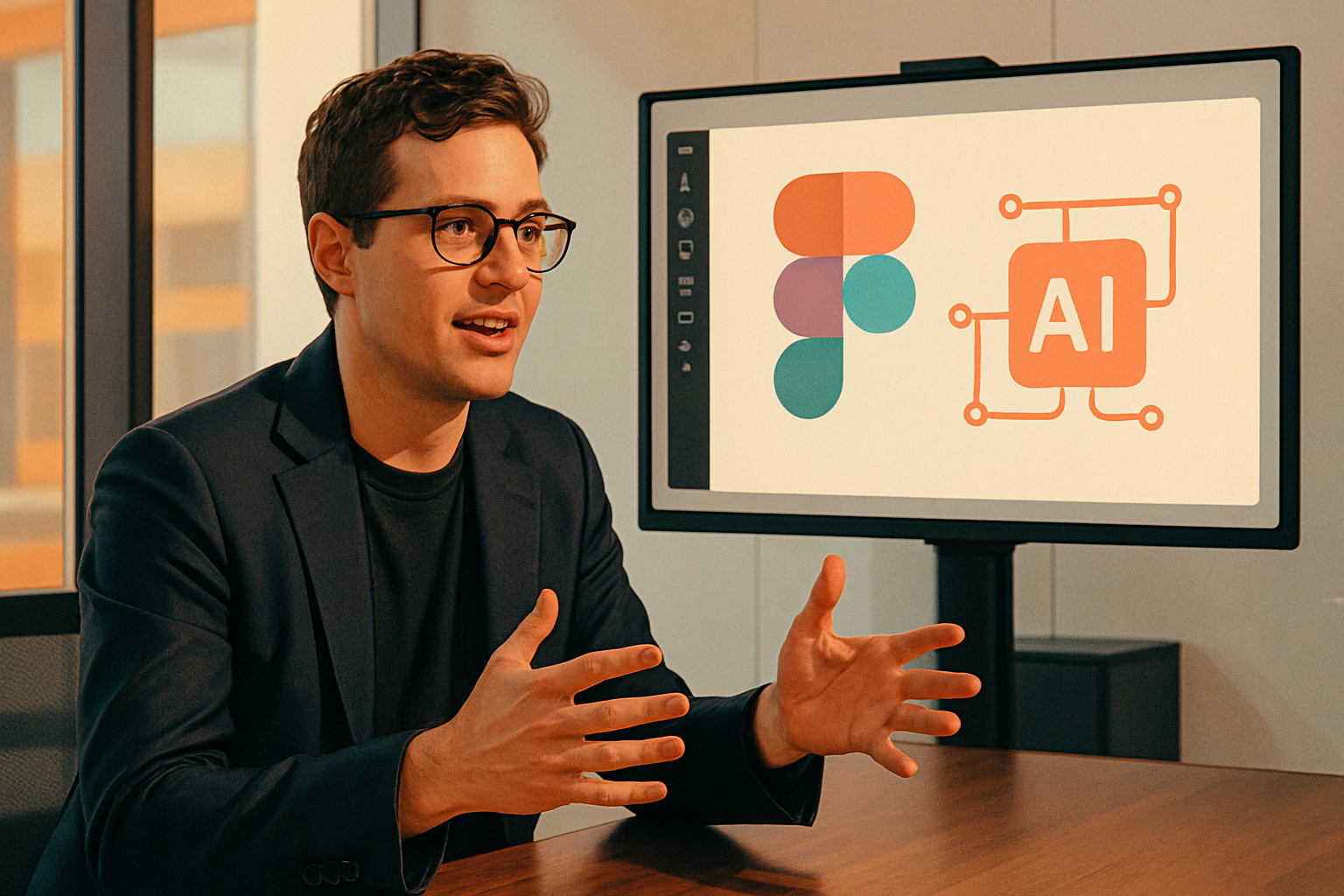
During our interview, Field shared his personal journey, the evolution of Figma, and his vision for creativity and design. He also addressed the issue of AI, which many see as a challenge, but which he perceives as an opportunity. This interview took place during Figma's Config conference, where Field presented how Figma's "Canvas" represents the natural intersection of design and AI.
The Interview
Background | WebGL and the Foundation of Figma | Working with Figma | The Unfulfilled Adobe Acquisition | Art vs. Design | AI-Related Obstacles | Code on the Canvas | Acquisition of AI Natives | AI and Path Dependency
Dylan Field, we have been looking forward to this interview for a long time. Welcome to Stratechery.
DF: Thank you for having me, I’m excited to be here.
Let’s talk about your background. Where did you grow up and how did you develop your interest in technology? I always love hearing these stories, especially when I first meet someone, and yours is particularly fascinating.
DF: I grew up in Penngrove, California, near Petaluma in Sonoma County. It’s important to clarify that it’s not in Sonoma itself. My mother was an elementary school teacher and my father was a respiratory therapist. Neither of them was particularly tech-savvy, but my mother quickly realized that a computer could keep me occupied and answer my endless questions. So, I got a Compaq Presario when I was five years old, and I spent a lot of time on it.
As far back as I can remember, I’ve always been fascinated by technology. I was eager to learn how to program, but I didn’t have access to a BASIC compiler until later, through a school program. I’ve also always had a passion for math, even if I didn’t always have the skills I would have liked.
So, it was a fascination with technology — how it actually works, and how can I make it do what I want?
DF: For me, it was always more about thinking about the end product, the design, and the future of technology, rather than wanting to master and control the technology itself.
What kinds of things did you imagine wanting to create as a child when you had that computer you wanted to explore?
DF: As a child, I thought less about the computer and more about concepts like teleportation, or when I first visited San Francisco Airport, I wondered why the whole bathroom system couldn’t be automated. I was a germophobic child, and those ideas fascinated me.
Are you encouraged or discouraged by the evolution of bathroom technology over the years?
DF: Encouraged. Toto is wonderful.
Yes! It’s funny because Toto is in the news for making a certain type of ceramic that is used for AI applications. I’m like, “Look, I know Toto and I’ve been a fan and supporter for many years.”
DF: (laughs) I didn’t know that. Well, the other critically underrated design invention here is that if you leave a bathroom and can use your foot to open the door, that’s an underrated progression.
Oh, there you go, that makes perfect sense. I can’t say I have that in my bathroom, but I do have a Toto Washlet, and it’s definitely worth it — the only problem is you’ll be spoiled for life and won’t be able to live without it.
So, you find yourself at Brown — not what one might think of as a tech school, it’s next to RISD, which is a design school, so there’s an angle to your journey. What was the path to getting there, and the path to leaving as a Thiel Fellow?
DF: During high school, I was probably a bit overconfident, thinking I could do anything and that I was beyond brilliance, and the world quickly proved me wrong, “Okay, there are people much smarter than you.” But because of that identity, I thought maybe MIT would be the place I wanted to go, then I visited MIT on a cloudy day during exams, and I thought, “No, this isn’t for me,” and I looked at other places.
One person I had talked a lot with was Danah Boyd — I met her through O'Reilly Media — and she was really brilliant and thoughtful, and she told me, “You really need to think about Brown,” and I kept randomly meeting Brown alumni while I was doing this East Coast college tour, very randomly, and they all took an hour to tell me, “You need to apply to Brown, and if you get in, you have to go.” I ended up applying to Olin and Brown on the East Coast among ten schools I visited, I was thorough, I didn’t get into Olin, which I thought was my first choice at the time. And then Brown, I was very surprised but thrilled to be accepted.
What did you think you wanted to study at that time?
DF: Computer science and math, I formally declared that as my concentration, but I didn’t progress as much as I would have liked on the math side — I took more computer science courses, and I also took advantage of Brown’s incredible open curriculum, where you can explore very broadly, I had amazing classes in areas that were not technical at all.
So, where did the Thiel Fellowship fit into the story?
DF: It was the fall semester of my junior year. I was aware of the Thiel Fellowship — I had seen it online, I thought it was a bit of a strange but interesting idea. I was introduced to it by Elizabeth Stark, who now, I believe, runs Lightning, she introduced me to one of the Thiel Fellows at the time, Dale. It was a strange meeting where he was 25 minutes late for a 30-minute meeting at Starbucks — we met for five minutes, but then he just texted me, “You need to apply for the Thiel Fellowship,” very similar to the Brown story.
I ended up applying after talking with my now co-founder, Evan Wallace. Evan was the smartest person I knew — a year above me at Brown, my TA for several classes, and really a genius, someone who is also fundamentally kind, humble, wonderful. I thought, “Well, I’ve done a few internships now, there’s no one better to start a company with,” and if Evan was on board for this instead of any number of jobs he could get upon graduation, I would learn more from this than anything else — I can always go back to Brown, so I should at least explore this, and he was surprisingly on board to explore this with me.
So I applied for the Thiel Fellowship with an idea about drones — which I now think is better realized by BRINC. Evan wasn’t on board for that direction, he was on board for WebGL and graphics, and I was excited about that too, that’s the direction we took.
Tell me about the drone idea and the pivot to the WebGL angle, as that ties back to the question I asked at the beginning — what were you pursuing? Was it the technology, or the end state? I think that’s an interesting thread here.
DF: I’ve always been excited about a lot of things — creation, creativity, design, even before I knew how to call it design, which has been most of my life at that point, I had only recently learned what the word “design” meant, despite having done a lot of design.
For me, I saw the act of starting a company as a way to ask the question, “Why now?” There are so many answers to “Why now?” that you can give, it can be a societal, cultural, technological, regulatory change. But we were technologists at our core, so we made a long list of all the technologies that were changing at the time and gradually crossed each of them off, we ended up with two finalists.
One was drones, at the end of 2011, the other was WebGL. I think we would have totally failed with drones anyway, it’s extremely hard. You look at Zipline, BRINC — those are incredible companies, and you really have to bite the glass to make it happen, we wanted to do something where we felt we had a technological advantage and a vision that others didn’t have.
WebGL and the Foundation of Figma
And what was the technical advantage and insight regarding WebGL? This is obviously the foundation of Figma — you can do incredible graphical things in the browser, which until this point had all been on dedicated desktop applications. What was the insight that made you think this could be possible, even though it was barely possible?
DF: To be clear, just after applying for the Thiel Fellowship with the drone idea, I ended up working at Flipboard as a design intern, using design programs all day. We had this hammer with WebGL looking for a nail, we didn’t find the, “Let’s go build design...”
Brief IA — L'actualité IA en français
L'essentiel de l'actualité de l'intelligence artificielle, décrypté et expliqué chaque jour.