Ford Rehires Veterans After AI Failure
Le brief IA que les pros lisent chaque soir
Les 7 actus IA du jour, décryptées en 5 min. Gratuit.
Inclus dès l'inscription : notre sélection des meilleurs guides & comparatifs IA.
Choisis ton rythme
Gratuit · Pas de spam · Désabonnement en 1 clic
Ford Rehires Its Veterans After AI Failure: A Lesson for the Industry
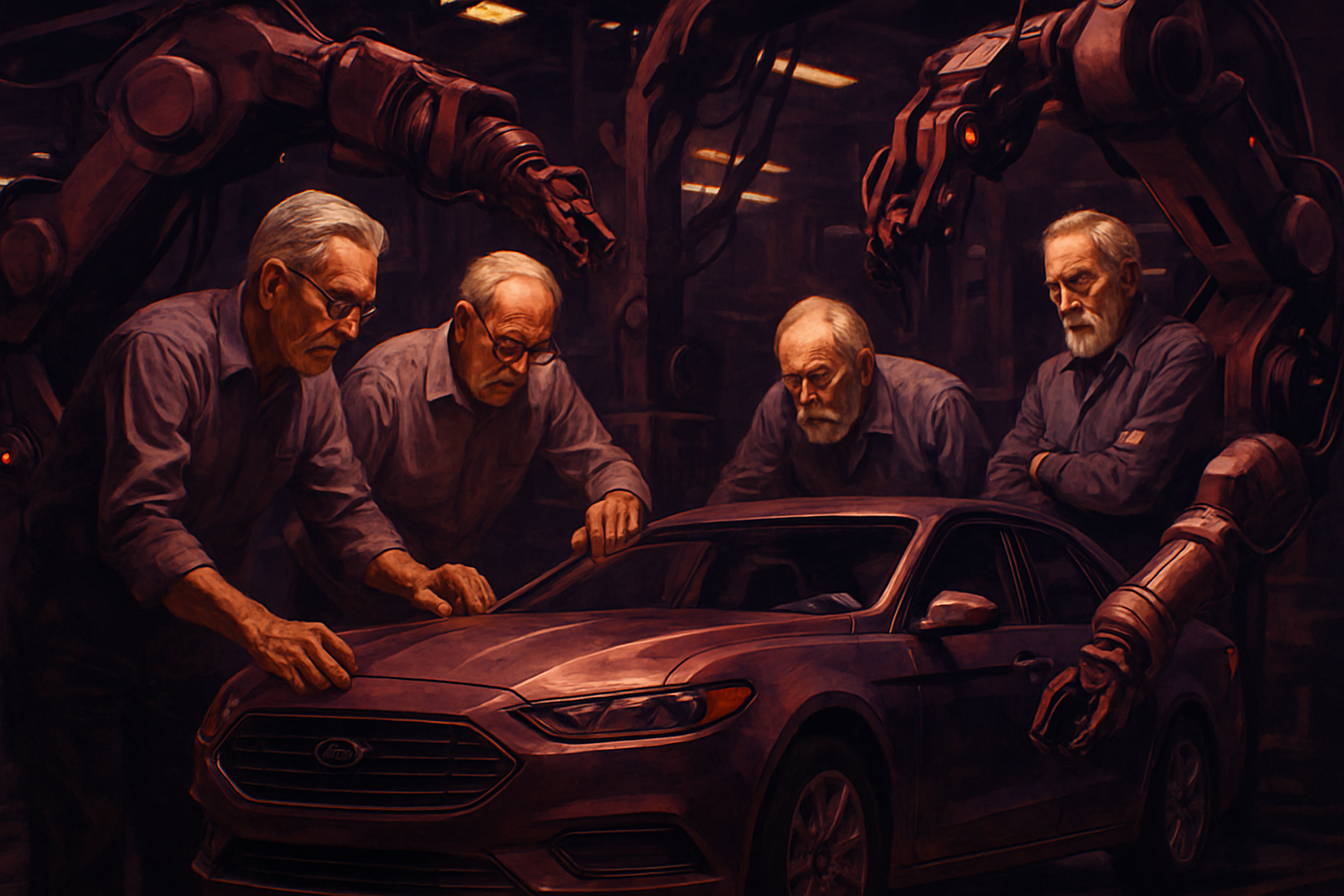
At a conference last year, Jim Farley, CEO of Ford, made a bold statement claiming that artificial intelligence could replace half of the office workers in the United States. However, last week, Ford revealed that it had quietly rehired more than 350 experienced engineers, dubbed "gray beards," over the past three years. These veterans were brought in to address issues encountered by AI-based quality control systems, which did not perform as expected.
Over the past decade, major American automakers, including Ford, General Motors, and Stellantis, have cut more than 20,000 jobs, representing a reduction of about 20% of their workforce. Ford did not specify how many of these rehires involved employees previously laid off to make way for AI, nor how many were retirees returning to work. Farley’s statements on automation and the replacement of workers with AI paint a complex picture of the current situation.
Spokespeople for Ford and the United Auto Workers union did not immediately respond to requests for comments on this situation.
Unmet Expectations of AI
Charles Poon, Vice President of Vehicle Hardware Engineering at Ford, recently emphasized that while artificial intelligence is a powerful tool, it heavily relies on the quality of the data used for its learning. He admitted that Ford had overestimated AI's ability to produce high-quality products simply by integrating existing design requirements.
Kumar Galhotra, Ford's Chief Operating Officer, was even more direct in acknowledging that the company had relied too much on automated quality control systems, without achieving the expected results. This excessive dependence on automation has cost Ford billions of dollars in recalls and warranty costs. A study conducted by iSeeCars ranked recent Ford models among the most recalled in the industry, highlighting the flaws in the automated approach.
Many companies across various sectors have used AI to justify massive layoffs, often without fully assessing the loss of human expertise. Some have had to reverse their decisions when the actual costs of AI proved too high.
The Future of Ford and the Importance of Veterans
Last week, Ford announced that it had achieved, for the first time in 16 years, the top spot among mass-market brands in JD Power's 2026 Initial Quality Survey, after ranking tenth the previous year. This improvement is partly attributed to the contributions of the rehired engineers. However, it is important to remember that, much like the folklore hero replaced by the steam engine, these veterans could one day be replaced by new technologies.
Galhotra clarified that these rehired specialists, some former Ford employees and others from industry suppliers, were brought back to identify failure points before parts reach the factory floor.
Ford is not abandoning AI, however. The reintegrated veterans are tasked with training younger employees and rebuilding the data pipelines necessary for the effective operation of AI tools. Meanwhile, Ford has established a dedicated team of 40 people for software quality assurance and has added over 100,000 AI-powered automated tests to detect anomalies late in the development process.
Technology continues to evolve, and Ford has had the opportunity to learn from its mistakes. However, it is unlikely that other companies will always be able to rely on veterans to set things right.
Brief IA — L'actualité IA en français
L'essentiel de l'actualité de l'intelligence artificielle, décrypté et expliqué chaque jour.