Gavin Newsom: Federal Tax and AI Fund for All
Le brief IA que les pros lisent chaque soir
Les 7 actus IA du jour, décryptées en 5 min. Gratuit.
Inclus dès l'inscription : notre sélection des meilleurs guides & comparatifs IA.
Choisis ton rythme
Gratuit · Pas de spam · Désabonnement en 1 clic
Newsom Advocates for a Federal Tax and an AI Equity Fund
California Governor Gavin Newsom recently expressed his support for the creation of a national public equity fund. This fund would be aimed at holding stakes in the largest artificial intelligence (AI) companies in the United States. At the same time, he reiterated his opposition to implementing a state-level tax on billionaires, deeming this approach ineffective and misguided. Instead, Newsom advocates for a federal tax on billionaires, which he considers a fairer solution.
In a Substack post, Newsom explained that the fight to increase taxes on the wealthiest Americans should not be conducted state by state. He pointed out that, unlike the majority of citizens, billionaires have the ability to relocate to states like Texas or Florida to escape higher taxes. This mobility among the wealthy, he argues, makes federal taxation essential.
A "Modern Buffett Rule"
Newsom described his proposal for a federal tax on billionaires as a "modern Buffett rule." This reference echoes a policy from the Obama era aimed at ensuring that billionaire Warren Buffett does not pay a lower tax rate than his secretary. Newsom highlighted that office workers or construction workers could end up paying higher tax rates than wealthy heirs or real estate developers.
He also criticized "tax-exempt lifestyle loans," a practice that allows some wealthy Americans to use their assets, such as stocks, as collateral to obtain funds without selling those assets, thereby avoiding capital gains taxes. Newsom calls for a return to the corporate tax rates of 2017, prior to the tax reform under Donald Trump, and a revision of estate tax rules. He warned that if no action is taken, it could lock in a permanent American aristocracy of inherited wealth, with significant political consequences.
An Equity Fund for the Future of AI
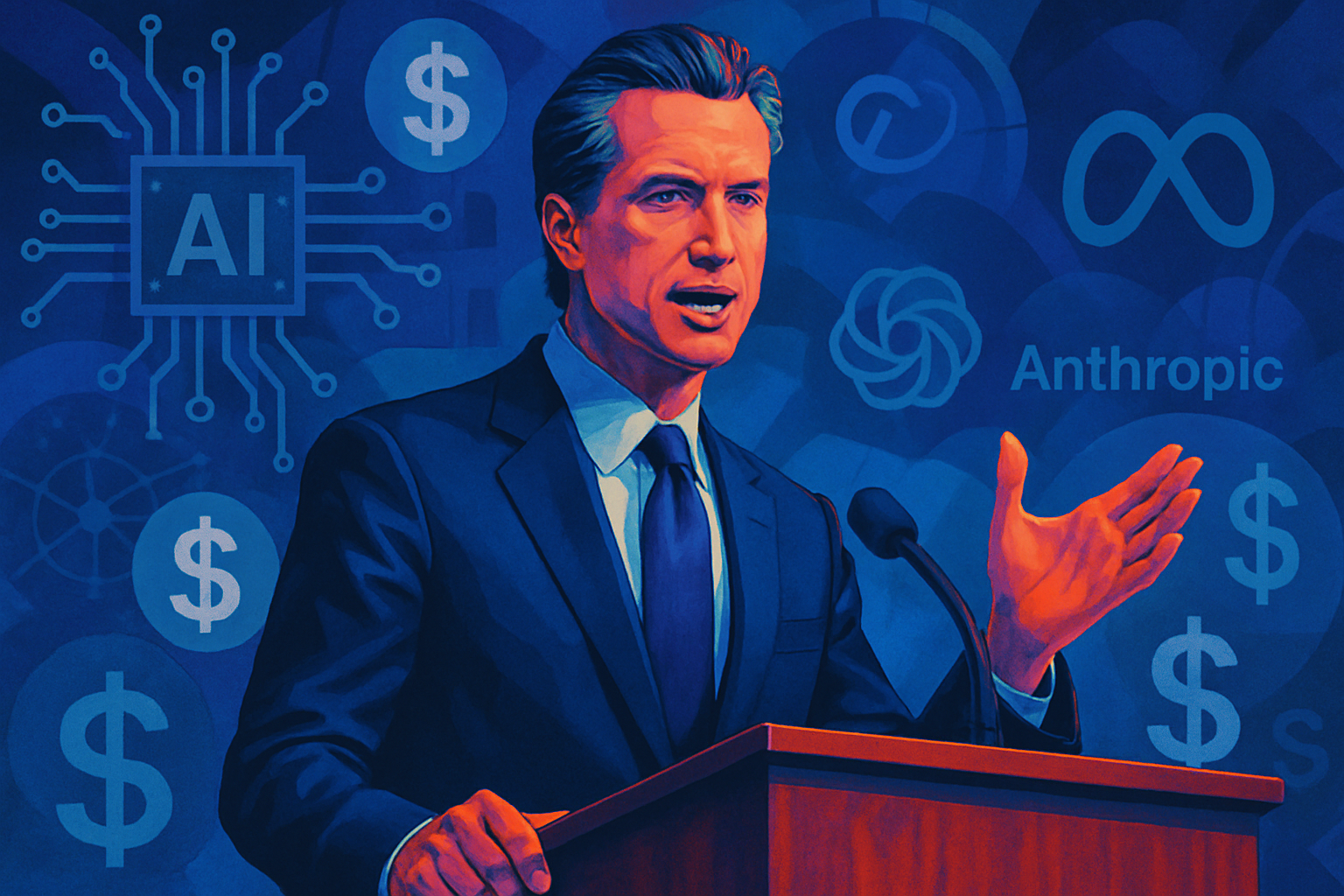
Newsom also expressed his support for the idea that every American should own a share of the major AI companies. He stated that it is time to implement a national tax on billionaires and redefine the social contract. According to him, a national public equity fund could help workers adapt to labor market changes brought about by AI.
Currently, 10% of Americans hold two-thirds of the national wealth, while wages stagnate and the cost of living rises. Newsom believes that the system is fundamentally flawed and that this fund could provide a solution for redistributing wealth generated by technological innovations.
Support and Future Proposals
Senator Bernie Sanders has also called for the U.S. government to take a 50% stake in major AI companies, an idea that has resonated with other political figures. Companies like SpaceX, which controls xAI, are already publicly traded, and others like Anthropic and OpenAI are preparing for their initial public offerings.
Newsom, considered a potential candidate for the 2028 presidential election, clarified that his proposals are just the beginning and that he plans to further develop his national agenda in the coming weeks. He intends to address issues such as closing loopholes in lifestyle loans and rewriting estate tax codes.
Opposition to the California Tax
In California, Newsom opposes an initiative that would impose a one-time 5% tax on residents with assets exceeding one billion dollars. This proposal, backed by the SEIU-UHW union, is viewed by Newsom as sending the wrong message. He believes that the state's budget priorities should not be dictated by a single organization, even one with good intentions.
The initiative will be put to a vote in November, following the failure of negotiations between the organizers and Newsom before the deadline. Competing initiatives, funded by billionaires such as Sergey Brin, co-founder of Google, will also be on the ballot. This battle could become one of the most expensive in California's history.
A controversial aspect of the proposal is its retroactive application to billionaires living in California starting January 1. Before the deadline, Business Insider reported that Google co-founders Sergey Brin and Larry Page moved assets out of California. Others, like Jensen Huang of Nvidia, chose to stay.
Ron Conway, a prominent Silicon Valley investor, stated that Newsom's stopping of the initiative is the best hope for its opponents. According to him, it is crucial to keep this proposal off the ballot, and there is still much work to be done to achieve that.
Brief IA — L'actualité IA en français
L'essentiel de l'actualité de l'intelligence artificielle, décrypté et expliqué chaque jour.