General Intuition: Robotics Ready for Its ChatGPT Revolution
Le brief IA que les pros lisent chaque soir
Les 7 actus IA du jour, décryptées en 5 min. Gratuit.
Inclus dès l'inscription : notre sélection des meilleurs guides & comparatifs IA.
Choisis ton rythme
Gratuit · Pas de spam · Désabonnement en 1 clic
A Turning Point for Embodied AI Inspired by GPT-3
Before the arrival of GPT-3 from OpenAI, developing natural language processing models required starting from scratch. Companies had to train these models on massive volumes of task-specific data. Today, this approach has radically changed. Organizations are now beginning with general models, such as those from OpenAI's GPT series, Claude, or Llama, which they then adapt to their specific needs.
Pim de Witte, the CEO of General Intuition, envisions a similar future for embodied AI. According to him, rather than striving to collect vast amounts of real-world data to create specialized robotic models, the industry should prioritize high-quality datasets. These datasets could then enable the development of foundation models capable of transferring insights about movement and interaction across various environments.
Towards Generalization of Robotic Models
De Witte emphasizes that many companies are currently focusing on specialized work, targeting individual embodiments, environments, and robots. In a recent episode of Equity on TechCrunch, he explained that these efforts could soon become obsolete with the emergence of general models, such as the one developed by General Intuition.
He asserts that the generalization of the model is, in itself, the product. According to him, a model with basic reasoning about space and time could significantly reduce the need to collect millions of hours of real-world data. In reality, just a few minutes of data would be sufficient to achieve meaningful results.
A Model Trained on Video Game Data
General Intuition has designed its own foundation model based on millions of hours of data derived from video games. This data includes information about player actions, such as button presses on a controller and the timing of these actions. Pim de Witte and Vinod Khosla, the lead investor in the startup, believe that this action data is essential for developing human-like intuition regarding spatio-temporal reasoning.
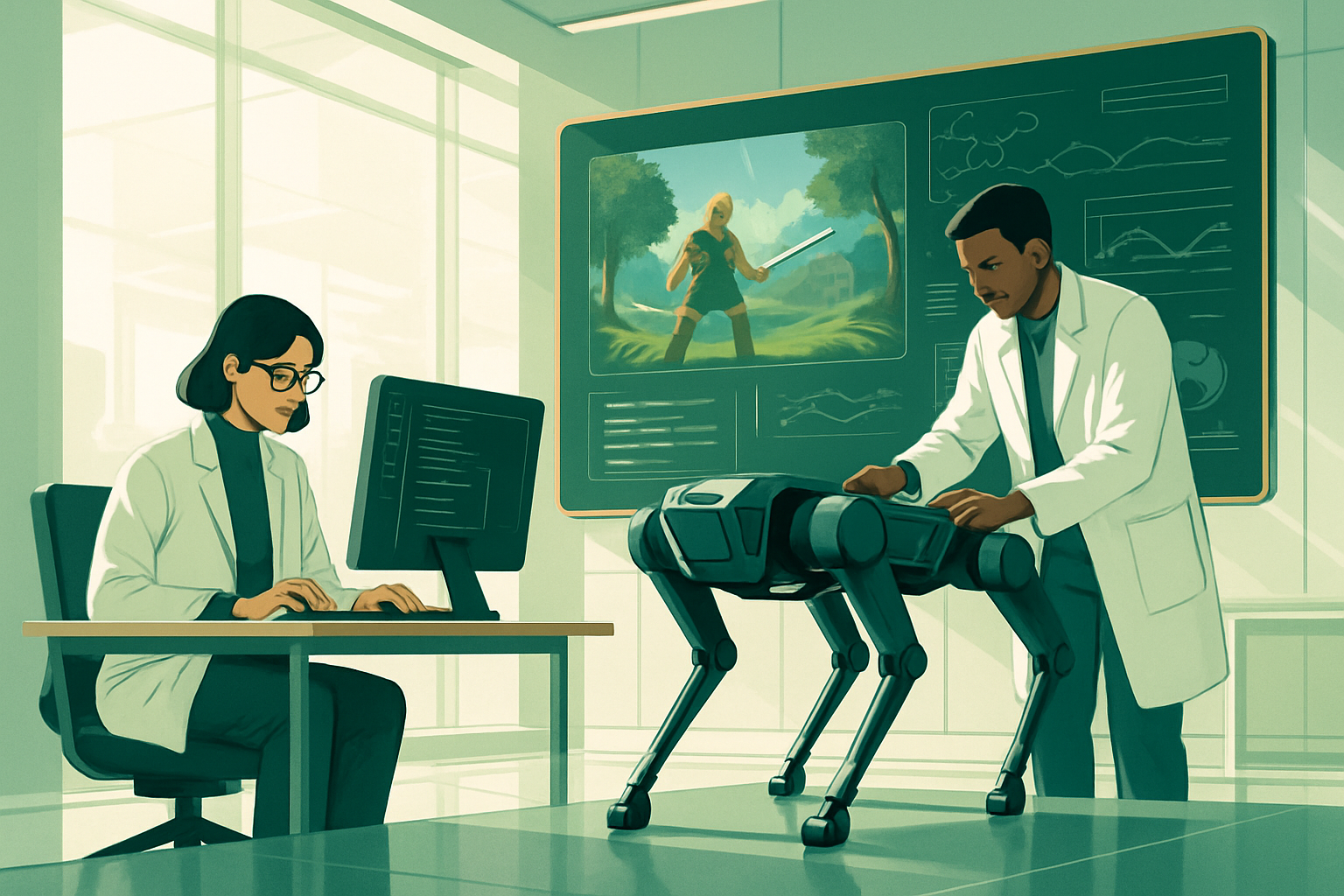
Last month, the startup successfully raised $320 million, reaching a valuation of $2.3 billion. This funding round is based on the thesis that their current model is capable of playing a video game for hours and controlling a quadruped robot, the latter feat being accomplished after just eight minutes of training with real-world robotic data.
Surprising and Promising Results
Pim de Witte expressed his surprise at the capabilities demonstrated by the robot. It was able to operate without prior learning, using only its front camera, without any other sensors, in a dynamic office environment with moving objects and people. "I think this is a sign of what's to come," he stated.
The ultimate goal of General Intuition is not to manufacture robots but to become the foundational model for physical AI. The idea is to provide a foundation model that other robotics companies can use to develop their own machines. As de Witte summarized: "We are not going to create a self-driving car company. We are going to make it ten times easier for the next person to create a self-driving car company."
Brief IA — L'actualité IA en français
L'essentiel de l'actualité de l'intelligence artificielle, décrypté et expliqué chaque jour.