Google and UNICEF Revolutionize Education with AI in Four Countries
Le brief IA que les pros lisent chaque soir
Les 7 actus IA du jour, décryptées en 5 min. Gratuit.
Inclus dès l'inscription : notre sélection des meilleurs guides & comparatifs IA.
Choisis ton rythme
Gratuit · Pas de spam · Désabonnement en 1 clic
Google and UNICEF Join Forces for AI-Driven Education
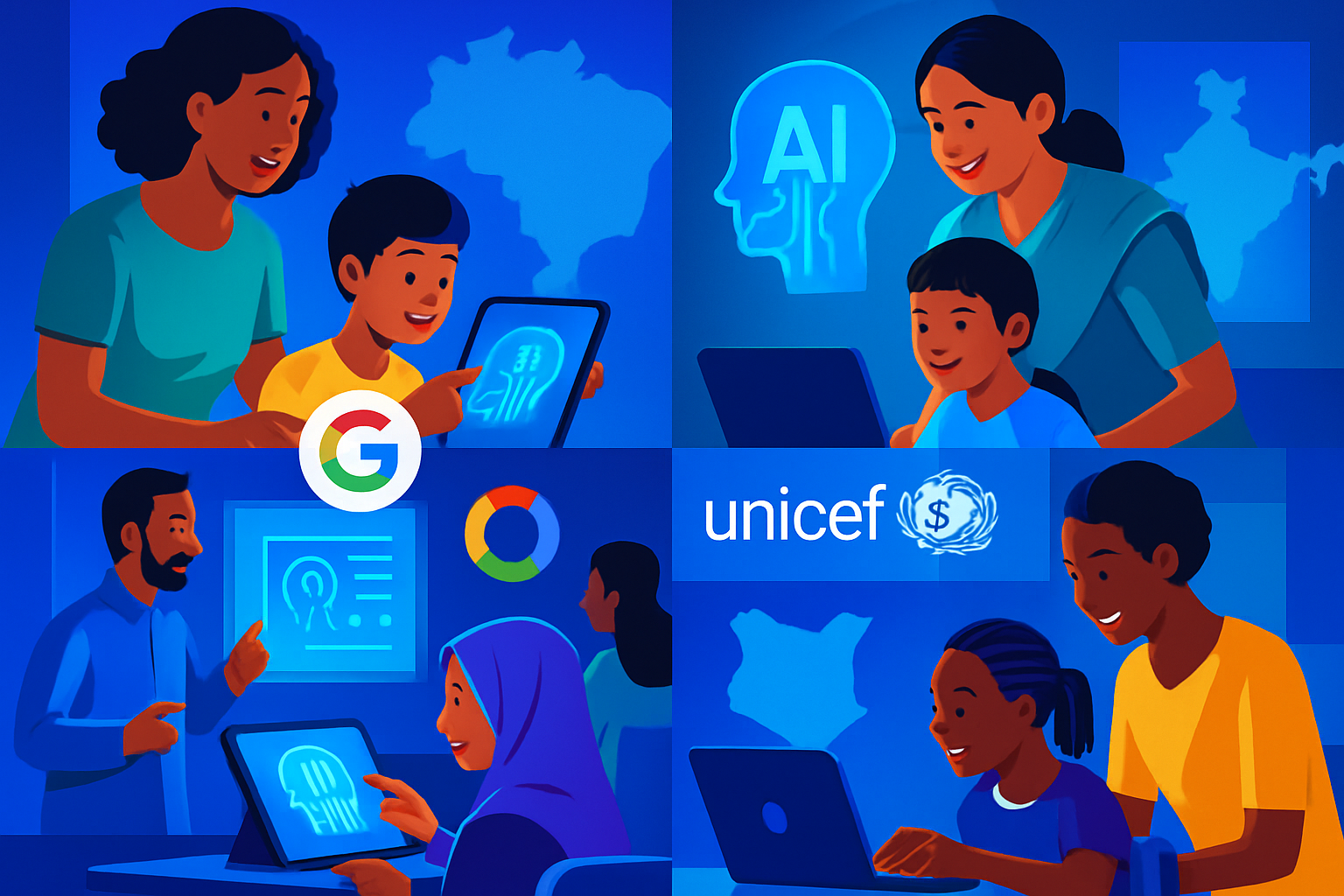
Google, through Google.org, Google for Education, and UNICEF, has announced an ambitious three-year partnership aimed at integrating artificial intelligence into the educational systems of four emerging countries: Brazil, India, Pakistan, and Kenya. This project aims to enhance the learning experience for millions of students by utilizing advanced technologies for teacher training, personalized learning, and digital access. One of the key objectives is also to reduce inequalities in access to digital tools.
The partnership, announced on May 19, 2026, is based on a local and collaborative approach. UNICEF will work closely with governments, educational authorities, and local communities to tailor solutions to the specific needs of each country. Google will provide access to its educational technologies, as well as technical support and training for UNICEF teams, teachers, and education officials.
Technological Tools for Personalized Learning
Among the tools highlighted in this partnership are Gemini, NotebookLM, and ReadAlong, an application designed to enhance reading through guided practice. These technologies aim to address concrete issues such as learning to read, write, and calculate, while personalizing educational content. Supporting teachers in using AI is also a crucial challenge, especially in regions where digital infrastructure and training are limited.
The generative tools offered by Google are no longer limited to conversational assistants but are becoming platforms capable of supporting comprehensive educational policies, including pedagogical tracking, content creation, adaptive learning, and large-scale digital access. This partnership also strengthens Google's presence in emerging markets.
Initial Results in Pakistan and Kenya
Pakistan and Kenya are already cited as examples of the operational application of this partnership. In Pakistan, UNICEF plans to train teachers in the safe use of Google's AI tools to provide large-scale adaptive learning experiences both in schools and outside. The country faces significant challenges, with a large number of out-of-school children and substantial delays in reading, writing, and math skills.
In Kenya, the partnership translates into a digital learning program developed in collaboration with the government, which combines teacher training, student access to technologies, and the evolution of educational policies. The tools Gemini for Education and NotebookLM play a central role there.
These initiatives also aim to develop essential skills such as critical thinking, problem-solving, and self-directed learning, which are crucial in an increasingly automated economy.
UNICEF will publish annual impact reports to assess the effectiveness of the initiatives deployed in the four countries. This measurement aspect is essential to distinguish truly effective uses from mere technological experiments. Companies in the EdTech sector view this partnership as confirmation that global demand is shifting towards AI solutions that can operate in heterogeneous contexts, with constraints related to accessibility, connectivity, and user training.
This partnership demonstrates that education is becoming a major expansion area for generative AI. For Google, the stakes are both technological and strategic, as by integrating its tools into the educational systems of several rapidly growing countries, the company is preparing the emergence of future users familiar with its AI ecosystem from their initial training.
Brief IA — L'actualité IA en français
L'essentiel de l'actualité de l'intelligence artificielle, décrypté et expliqué chaque jour.