Google Flow Sessions: AI Reinvents Filmmaking
Le brief IA que les pros lisent chaque soir
Les 7 actus IA du jour, décryptées en 5 min. Gratuit.
Inclus dès l'inscription : notre sélection des meilleurs guides & comparatifs IA.
Choisis ton rythme
Gratuit · Pas de spam · Désabonnement en 1 clic
The Impact of AI on Filmmaking
For about two years now, the debate surrounding images generated by artificial intelligence has been dominated by a derogatory term: slop. This word is used to describe visual creations from language models that often appear strange, incoherent, and visually jarring. These images, generated from simple user instructions, are quickly disseminated across the Internet and social media.
However, is it fair to reduce all AI-generated artistic production to this term?
Google Labs is seeking to change this perception with its Flow Sessions. Last Wednesday, Google hosted a screening of several short films created by the fourth cohort of its artistic residency program, Google Flow Sessions, at the Metrograph theater in New York.
I had the opportunity to discover the films made by each of the 11 resident artists. Contrary to what the term "AI slop" might suggest, these works are deeply emotional, personal, and infused with great imagination. For someone who has studied avant-garde cinema, these projects resemble more cinematic memories or "essay films." They incorporate the use of generative AI tools not to simplify the creative process but to realize visions that would otherwise require significant budgets and large teams.
Google Flow: A Collaborative Tool for Artists
At the heart of these short films is Google Flow, a generative media creation tool designed to serve as a collaborative canvas, allowing artists' visions to come to life. The Flow Sessions residency program, lasting six weeks, brings together artists from various backgrounds, ranging from fine arts to commercial agencies, to develop innovative projects. Brianna Doyle, community lead at Google Labs, explains that the mission of the Flow Sessions is to bridge the gap between the developers who design these tools and the artists who use them.
The goal is not just to create AI for artists but to design it with them, so that these tools become a means of expression rather than a substitute for human creativity.
"AI has opened up new avenues for them in terms of creativity," Doyle stated. "It has not been limiting in any way. In fact, it has redefined what they are capable of achieving."
Lowering Barriers While Expanding Possibilities
Among the fears of traditionalists is the idea that AI could dilute artistic authenticity, reducing art to artificial creations. However, for the artists in this cohort, technology has served as a catalyst for a new form of storytelling while remaining nuanced. The credo, as Doyle emphasizes, is to "lower the barriers to entry while expanding possibilities." This means making cinema more accessible to newcomers while enhancing the creative capabilities of independent artists.
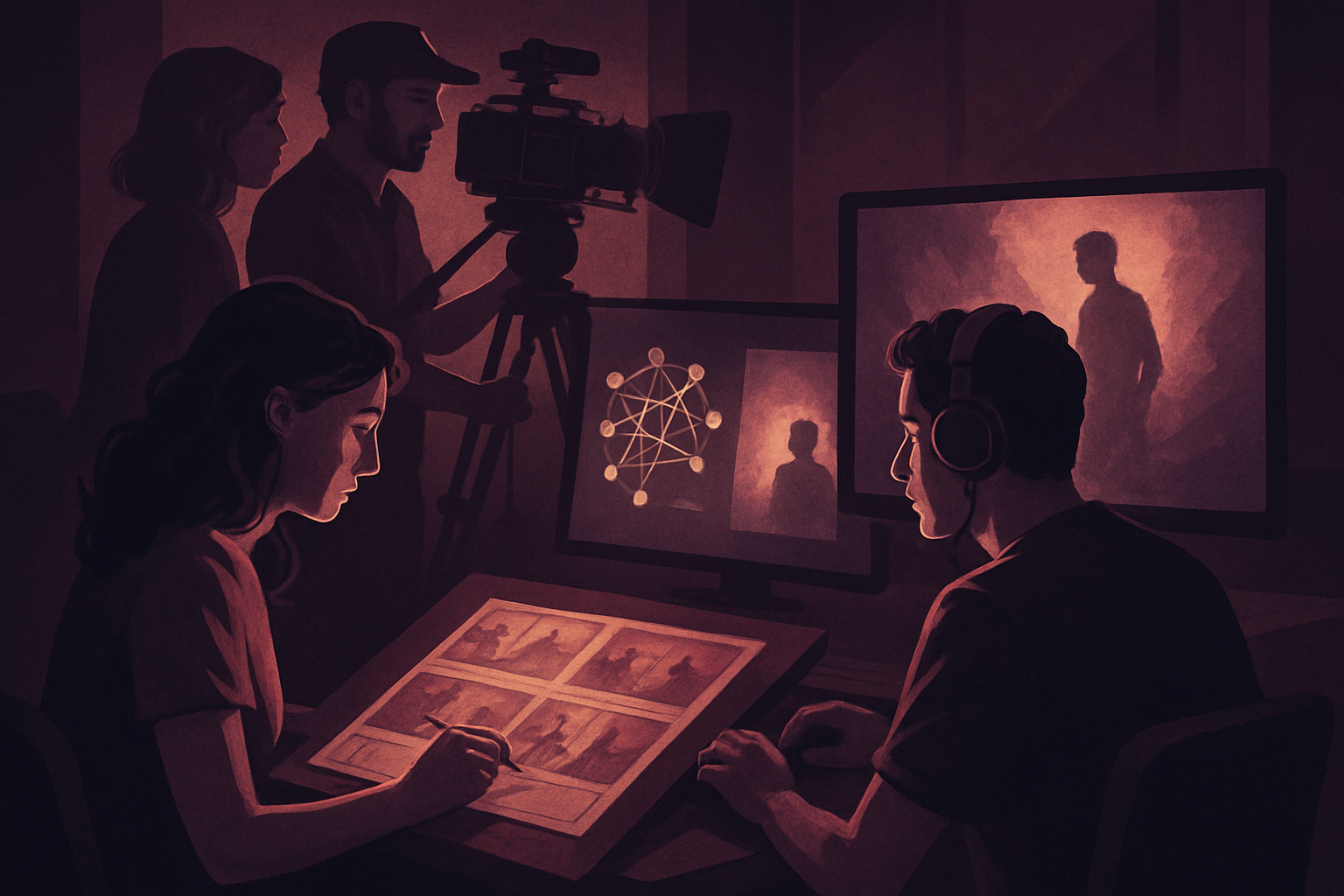
This shift is reflected in the evolution of the tool itself. Flow started as a video-focused system, but artists quickly reported that they were spending more time working on images and storyboards than with video sequences. In response, Flow integrated image generation and an organizational interface that includes folders, tags, and a structure to help ideas transition from concept to production without losing momentum.
For resident artists like Ikenna Mokwe, founder of OnGen Studio, this efficiency is a game changer. After 15 years in traditional media, he has developed a new workflow where language models and video generation bridge the gap between an abstract idea and its realization. His process is structured like a loop: he uses Gemini via voice commands to transform nighttime ideas into structured scripts, thus eliminating the bottleneck of manual input, and then relies on custom micro-tools to automate repetitive camera movements.
However, Mokwe insists on the importance of storytelling. "Storytelling is at the heart of everything," he asserts.
For Mokwe, AI does not write the story, but it offers a faster path from conception to completion.
"I had absolutely no hesitation," he says. "I jumped right in. I embraced it and never let go. I think [AI] is absolutely amazing. It is extremely empowering."
The Importance of the Human Touch
The work of the resident artists demonstrates that the use of AI does not mean the absence of humanity and intimacy.
Take the film Two Chairs by artist Dion Lee, a poignant reflection on women's decisions regarding motherhood. In this film, Lee writes two letters — one to her 18-year-old daughter and the other to a version of herself that never became a mother. Using two chairs as a visual anchor, she stages parallel lives, creating an emotionally powerful internal debate.
Other artists explore the boundary between digital and physical mediums. Adam Brumley, who runs Studio Heartfelt, uses Flow to translate his poems and drawings into 3D felt characters that he then animates. What is remarkable is that Brumley's engagement with AI tools brings him back to a physical felting process to complete his digital work.
For Brumley, AI comes into play at the end of a deeply human process, helping him refine specific textures and lighting in his projects, while the agents expand his universe without altering his vision for his characters.
"What excites me about AI is simply the ability to explore so many possibilities quickly," Brumley states. "As an artist working alone, being able to carry an idea to fruition […] that simply would not be possible if I had to build all the sets, create all the characters, and everything else."
Although the 11 artists come from varied backgrounds, methods, aesthetics, and inspirations, their artistic impulses read similarly: there is a shared insistence on personal authority in each film.
A Promising Future for AI and Art
Renowned artists and filmmakers have expressed skepticism about the use of AI in art. "I would rather die," Guillermo Del Toro stated when asked if he would use AI in his films. However, with the evolution and refinement of AI tools, a new era of filmmaking could be on the horizon — an era where AI and humans collaborate to create art.
In this cohort, generative tools and agents are not used to bypass craftsmanship or process, but to storyboard with more freedom, iterate with less friction, and refine until the emotional depth of the film is achieved. The question is not so much whether a machine can produce an image, but whether the film can still carry meaning.
This is where the argument "beyond the slop" makes perfect sense. The Flow Sessions are not merely an accumulation of productions; these films treat generative AI tools as instruments of their vision, helping to refine narrative intent and preserve the human perspective in every frame, every image, and every moment.
Brief IA — L'actualité IA en français
L'essentiel de l'actualité de l'intelligence artificielle, décrypté et expliqué chaque jour.