Graphs and Vectors: Choosing or Combining with GraphRAG
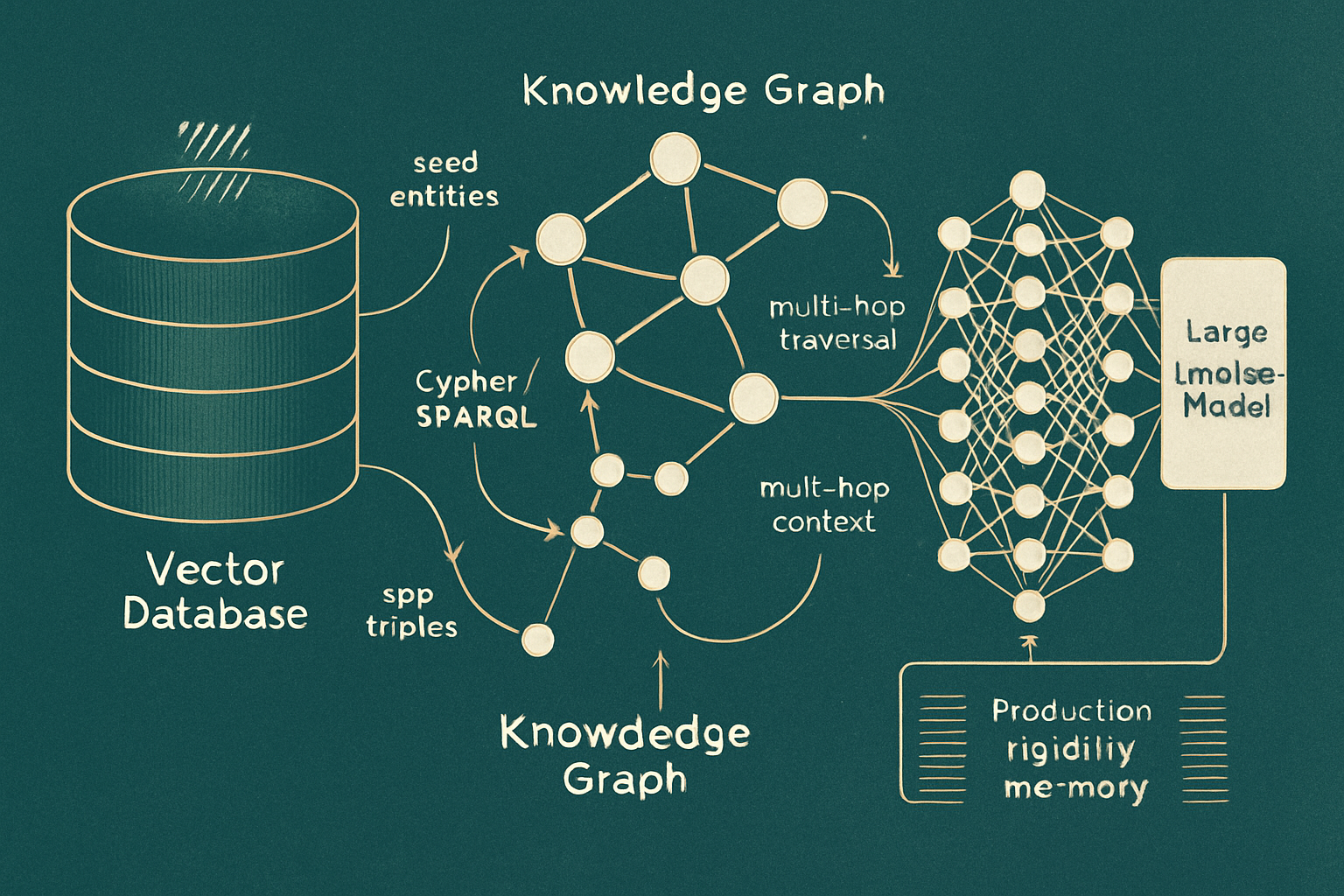
Two ways of structuring information coexist for AI: knowledge graphs and vector databases. They address different needs and present distinct limitations in production. A hybrid schema like GraphRAG is described as practical for businesses, with a recommendation for a neuro-symbolic fusion depending on the type of reasoning sought.
Production Limitations: Graph Rigidities, Errors, and Memory Constraints in Vectors
Several operational risks are identified. Knowledge graphs exhibit structural rigidity and face challenges with cold starts. Vector databases can produce erroneous inputs or outputs and are limited by memory constraints. There are real-world use cases for each paradigm. A neuro-symbolic fusion is recommended, to be chosen based on whether the need is for strict reasoning or flexible semantic discovery.
Le brief IA que les pros lisent chaque soir
Les 7 actus IA du jour, décryptées en 5 min. Gratuit.
Inclus dès l'inscription : notre sélection des meilleurs guides & comparatifs IA.
Choisissez votre rythme
Gratuit · Pas de spam · Désabonnement en 1 clic
Choosing the Tool: Explicit Facts for Graphs, Similarity for Vectors
The recommended usage distinguishes two registers. Knowledge graphs allow for modeling explicit facts through Subject–Predicate–Object triples and are queried via graph traversals using languages like Cypher or SPARQL. Vector databases transform text into points in a high-dimensional space to assess semantic similarity, employing approximate nearest neighbor search techniques like HNSW.
Combining with GraphRAG to Contextualize LLM Responses
For businesses, a hybrid approach like GraphRAG is presented as often the most practical. Vector search helps identify relevant seed entities, which are then mapped into a knowledge graph. Multi-hop traversals within this graph provide verifiable context used for language model responses. The goal is to build scalable AI, grounded in facts and limiting hallucinations.
Brief IA — L'actualité IA en français
L'essentiel de l'actualité de l'intelligence artificielle, décrypté et expliqué chaque jour.