AI at Work: The "Verification Tax" Increases the Burden
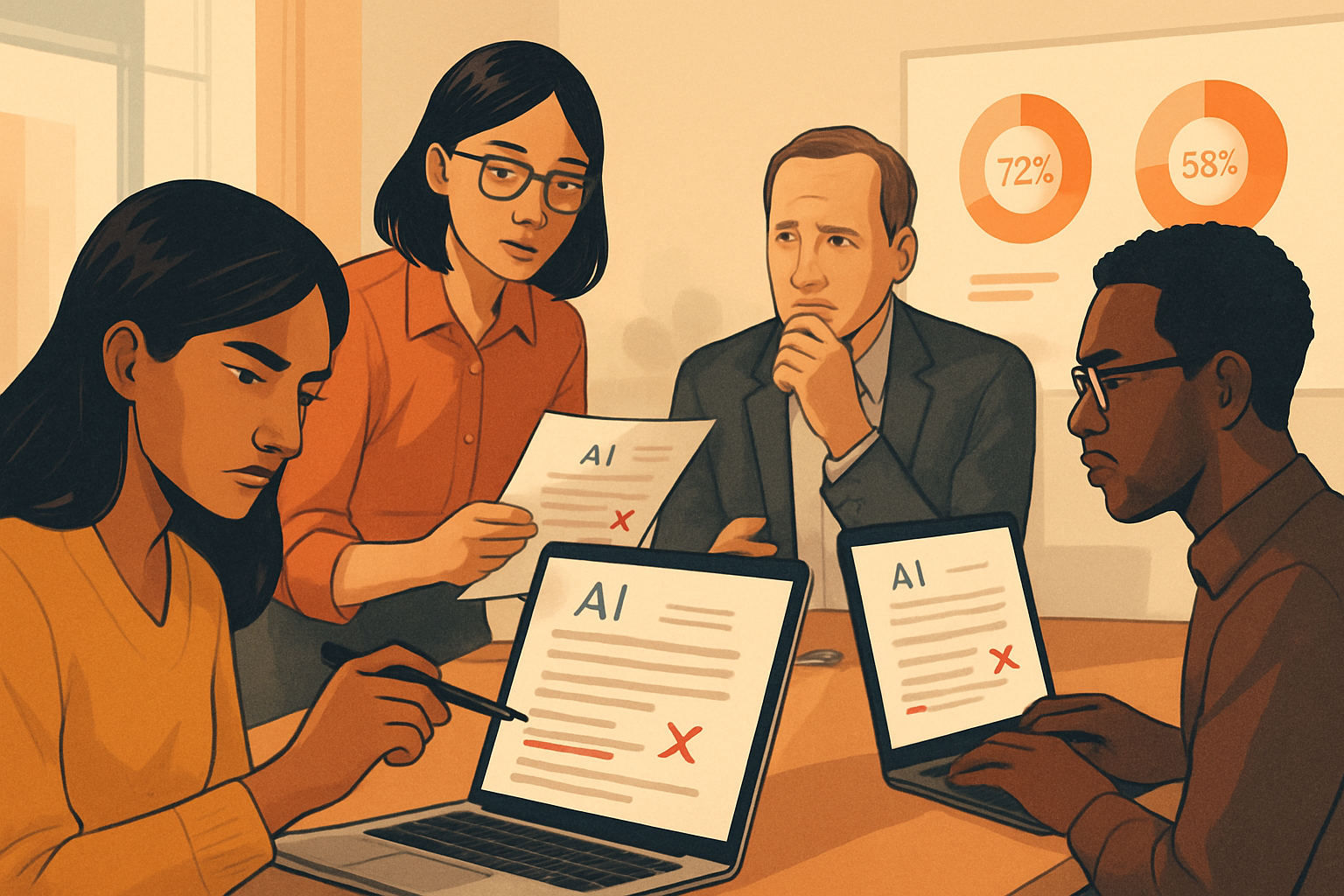
According to a survey conducted by Adaptavist among 2,500 knowledge workers, the time spent monitoring generative AI outputs is impacting organization. More than one in two respondents fears that their role will become obsolete within five years, a concern particularly strong among leaders.
Employment Concerns Extend to Management, 29% "Very" Worried
More than half of the knowledge workers surveyed, or 54%, fear that artificial intelligence will render their role unnecessary in the next five years. This concern is not limited to junior profiles: Adaptavist indicates that it is most pronounced among leaders, with 29% expressing that they are "very" worried about the diminishing need related to their own positions. The British firm observes that those driving AI transformation are also among the most uncertain about its long-term consequences.
Reviewing and Correcting Adds a Layer of Work and Slows Down Projects
Adaptavist describes the emergence of an additional layer of work, consisting of reviewing and correcting, which adds to existing tasks. Nearly 49% of respondents believe that the poor quality of certain outputs slows down projects, and 55% feel that AI-generated content undermines their team's overall efficiency. Furthermore, 52% report having to regularly correct the work produced by their colleagues' AI. The firm refers to this phenomenon as a "verification tax," which, according to them, increases workload and deadline pressure instead of alleviating it. This reality is also evident in daily operations: 42% of respondents indicate they spend more time checking AI results than they save through its use. In this context, Adaptavist believes that for many employees, AI is changing the distribution of tasks rather than lightening it.
Le brief IA que les pros lisent chaque soir
Les 7 actus IA du jour, décryptées en 5 min. Gratuit.
Inclus dès l'inscription : notre sélection des meilleurs guides & comparatifs IA.
Choisissez votre rythme
Gratuit · Pas de spam · Désabonnement en 1 clic
Pressure to Compete with Machines and AI Usage to Keep Up
Half of the participants believe that their performance is now evaluated, directly or indirectly, in comparison to AI outputs. Adaptavist notes that this creates pressure to match the speed and volume of machines, even when quality, nuance, and judgment are essential. This pressure is reflected in practices: 25% of respondents use AI to manage their workload, and 23% to keep pace with their colleagues. Additionally, 46% feel that their tasks have become more repetitive and less meaningful since the arrival of AI.
What the Study Measures: Scope, Countries, and Adaptavist's Positioning
Generative AI is said to have effects on the organization of work. It is based on responses from 2,500 knowledge workers from the United States, Canada, Germany, the United Kingdom, and Spain. The document is published under the title "Understanding the human cost of AI transformation." Adaptavist, a British company specializing in helping businesses integrate tools such as GitLab and Monday.com, conducted this study.
Brief IA — L'actualité IA en français
L'essentiel de l'actualité de l'intelligence artificielle, décrypté et expliqué chaque jour.