AI in Europe: Shared Diagnosis, Delayed Execution
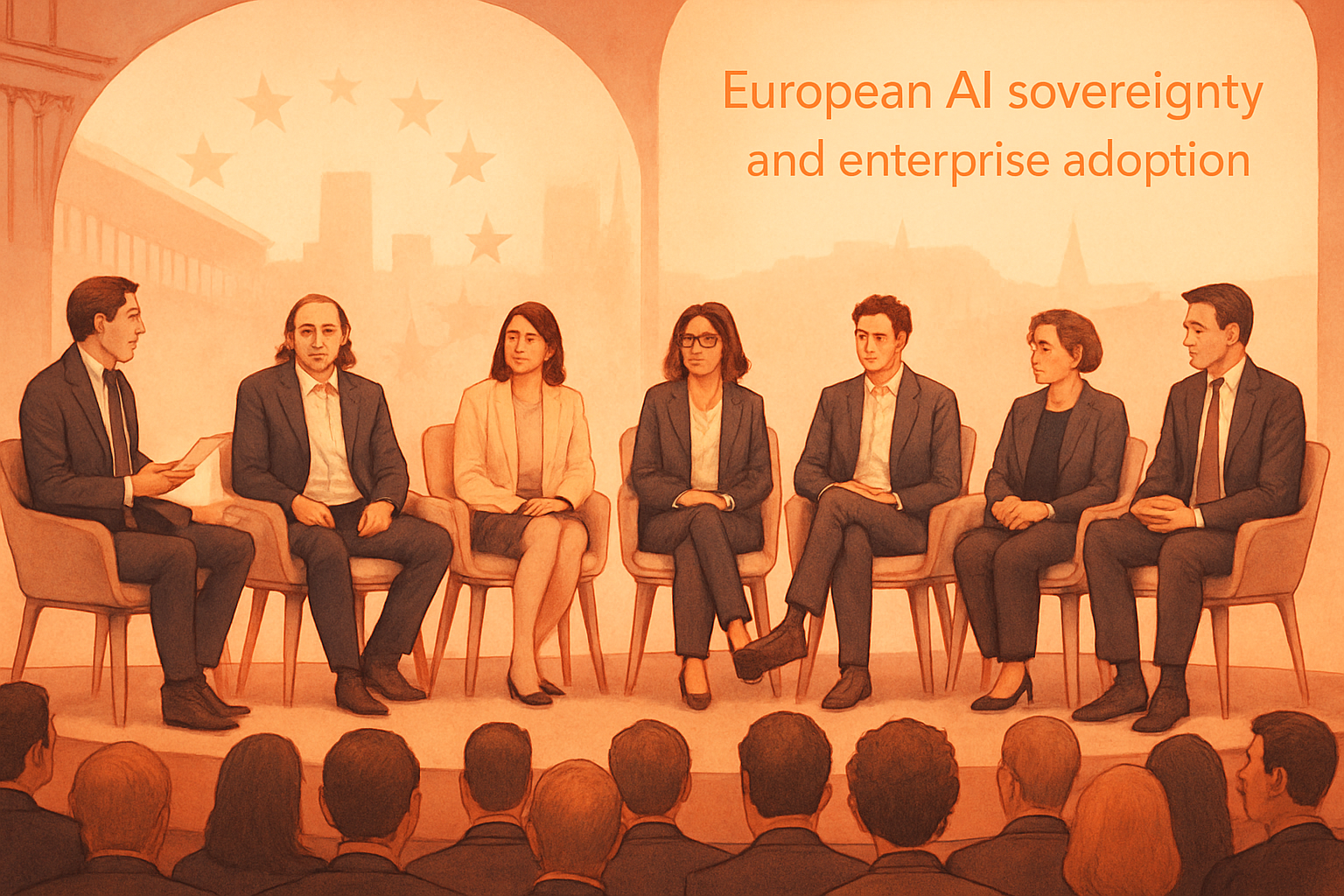
A survey presented at La REF indicates that 73% of executives have not revised their choices following the cutoff of access to Anthropic's models. The speakers gathered on stage describe a Europe rich in plans and assets, but hindered by fragmented markets, insufficient demand, and execution that does not keep pace with technological advancements.
The Anthropic case has hardly influenced purchases in Europe
In June, a decision by the U.S. administration suspended foreign users' access to two of Anthropic's models, concretely illustrating the kill switch scenario. Presented on August 27 at La REF, the results of a SIA–OpinionWay study show that 73% of the executives surveyed have not changed their stance following this episode. Among the criteria for choosing an AI solution, sovereignty accounts for only 11% of mentions, a two-point increase. A thousand executives from companies of all sizes were surveyed.
Decisions remain dominated by performance, price, and speed
Companies indicate that they prioritize selecting their AI solutions based on performance, cost, speed of implementation, availability of skills, and the breadth of the ecosystem. This focus results from short-term operational objectives: ensuring system availability, adhering to budget constraints, and meeting execution deadlines, rather than aiming for a contribution to sovereignty over a ten-year period. Béatrice Cossa-Dumurgier confirms the priority given to the performance-price ratio in her decisions.
Acknowledged dependence as long as an exit remains possible
According to Catherine Fieschi, no state alone holds the entirety of the technological chain, which distinguishes sovereignty from autarky. Dependence takes on a strategic character when it cannot be ended without incurring excessive costs or when a foreign actor has the ability to block access to a service. The Anthropic case does not imply that all American technologies will necessarily be inaccessible in the future, but it highlights that a decision made in Washington can have repercussions on access to services used in Europe. The challenge becomes the ability to switch models without losing data, memory, processes, or applications.
Le brief IA que les pros lisent chaque soir
Les 7 actus IA du jour, décryptées en 5 min. Gratuit.
Inclus dès l'inscription : notre sélection des meilleurs guides & comparatifs IA.
Choisis ton rythme
Gratuit · Pas de spam · Désabonnement en 1 clic
What data, technology, and operations encompass according to Octave Klaba
Octave Klaba distinguishes three dimensions of sovereignty. Data sovereignty concerns who can access and use information. Technological sovereignty refers to the ability to develop and evolve tools. Operational sovereignty relates to the daily operation of infrastructures and ensuring their continuity. A company can host its data in Europe while depending on a model it does not control, or use an open model while relying on infrastructure subject to foreign jurisdiction.
Multiple European plans but difficult synchronization
Laurent Solly describes AI as a system that brings together data, computing, energy, models, deployment actors, and capital. Europe has recognized strengths, from ASML to Mistral AI and Aleph Alpha, as well as OVHcloud and Scaleway, along with a pool of researchers and startups. However, the United States aggregates laboratories, hyperscalers, processor manufacturers, platforms, venture capital, and major clients in an integrated loop, while China orchestrates this integration through its industrial policy and national procurement. In Europe, coordination remains lacking, growth capital and major tech buyers are scarce, and nearly 30% of unicorns founded between 2008 and 2021 have moved their headquarters abroad. Despite a succession of diagnostics and programs—from InvestAI to AI Gigafactories and the new single market roadmap—the difficulty lies in their synchronization.
The externality of sovereignty exceeds the scale of a company
The speakers gathered at La REF believe that Europe is now accurately identifying the sources of dependence, but demand remains insufficient, markets fragmented, and public decisions lagging behind technology. Frédéric Mazzella argues that a sum of rational decisions does not create a common strategy, and one cannot expect every company to carry industrial policy. Sovereignty is described as an externality poorly reflected in prices: an American solution may appear less costly while collectively reinforcing dependence, whereas a European purchase may seem riskier while funding capabilities useful to others. Revolut illustrates another lever with PRAGMA, a proprietary foundation model designed with NVIDIA, made possible by a common platform.
Brief IA — L'actualité IA en français
L'essentiel de l'actualité de l'intelligence artificielle, décrypté et expliqué chaque jour.