AI and Education: Exams Rethought by Teachers
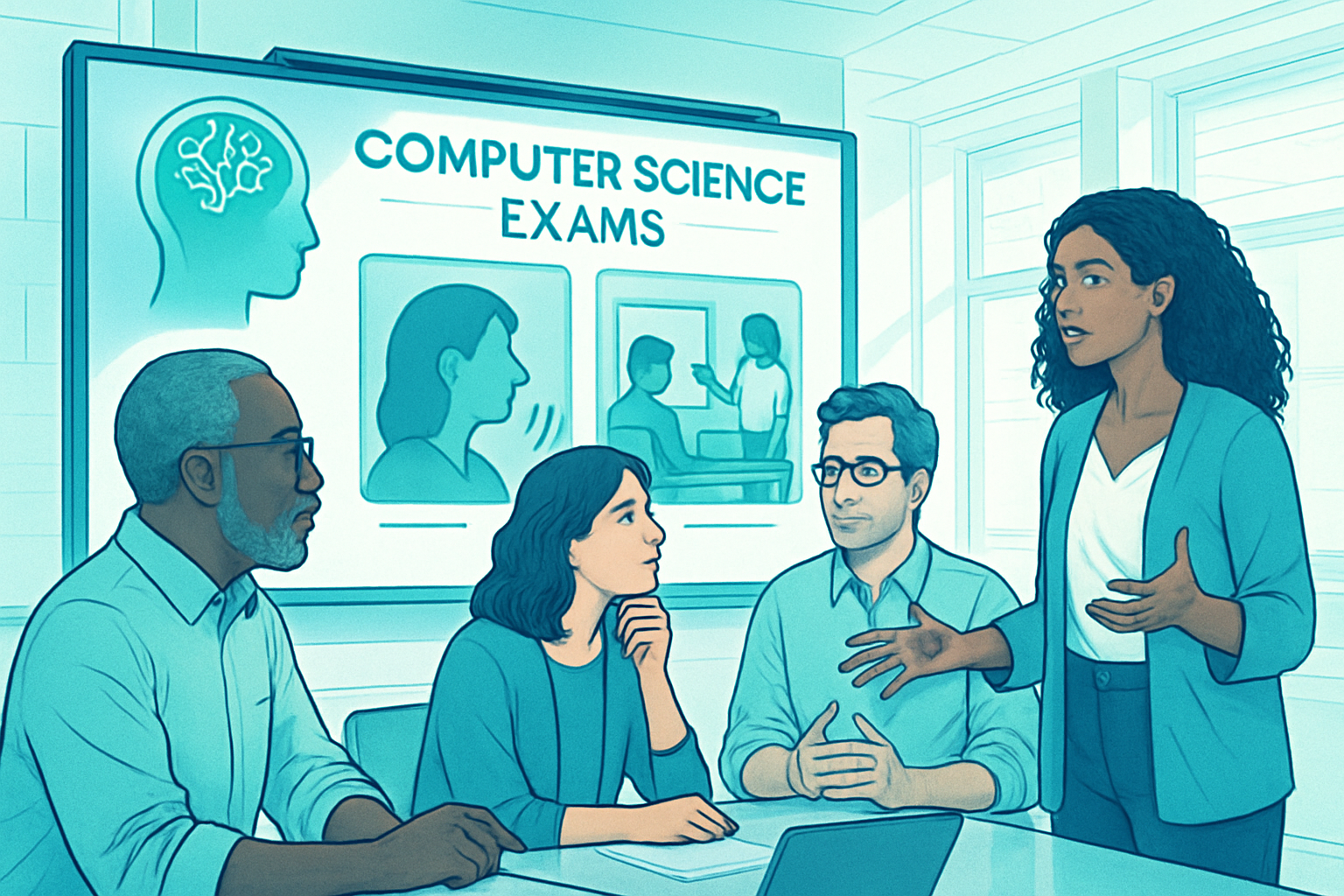
AI and Education: Exams Reimagined by Teachers
A survey conducted among over 700 computer science teachers in 49 countries, carried out by an ACM working group, revealed that 69% believe that AI has changed the skills required for software development.
Sixty-four percent have already shifted their teaching focus from writing code to understanding code, debugging, and problem-solving.
Assessment methods are evolving even more rapidly: 68% of respondents have adjusted their testing methods, incorporating more proctored in-person exams, oral exams, code defense sessions, and project-based work.
A global survey shows that most teachers have already modified their teaching and assessment methods due to AI. Oral exams, code comprehension, and project-based work are gaining popularity. However, nearly half of the respondents claim they lack concrete examples to integrate AI into their courses.
AI coding tools like ChatGPT and GitHub Copilot can solve typical programming assignments in introductory courses, often reaching the level of an average student. A new study provides an overview of how computer science teachers worldwide are responding. It was conducted by the "ACM Working Group on Generative AI and Programming Assessment," a group of experts established by the education committee of the international computing society ACM.
The working group surveyed 763 teachers from 49 countries between May and October 2025. Approximately 500 nearly complete questionnaires were analyzed. The results show that 69% believe that AI has changed the skills required for software development. The primary concern among teachers is the growing dependence of students on technology (87%), followed by cheating and plagiarism (72%).
Changes in Teaching
Sixty-four percent of respondents have already changed their teaching methods. A thematic analysis of open-ended responses indicates a clear direction: moving away from writing code from scratch towards understanding code, debugging, and problem-solving. Thirty-nine responses also mentioned teaching the use of AI and prompt engineering as explicit subjects. Others demonstrate AI tools in the classroom to showcase both their capabilities and limitations.
"We know that students are likely to use AI tools when they enter the job market," said Steven Gordon, a professor at Ohio State University and the lead author of the report. "The key is to produce competent programming graduates who understand both the capabilities and limitations of AI."
Le brief IA que les pros lisent chaque soir
Les 7 actus IA du jour, décryptées en 5 min. Gratuit.
Inclus dès l'inscription : notre sélection des meilleurs guides & comparatifs IA.
Choisissez votre rythme
Gratuit · Pas de spam · Désabonnement en 1 clic
Oral and Project-Based Assessments
The changes in assessment are even more striking. Sixty-eight percent of respondents have adjusted their testing methods. The most common changes include more proctored in-person exams (56 mentions), a reduction in the weight of assignments (38), oral exams and code defense sessions (36), and paper tests (35). Project-based assessments (34) are also on the rise. Some teachers now require students to disclose their use of AI and submit logs of their interactions with AI tools.
Institutional policies remain a patchwork. Forty-five percent of respondents reported that their institution has guidelines on AI usage, while 39% indicated the opposite. Policies vary from total bans to explicit permissions or encouragements, as long as the use is documented.
The Lack of Best Practice Examples for AI Integration
The main obstacle, cited by 48% of respondents, is the lack of proven best practices. Twenty-eight percent claim they do not have enough expertise in AI, while 20% do not see the need to integrate it into their teaching. Regarding professional development, 74% want training on effective teaching methods, and 66% seek help in redesigning assessments.
The results should be interpreted with caution. Participants were primarily recruited through ACM and SIGCSE mailing lists and national teacher directories. Respondents are predominantly from North America (227) and Europe (106), while Asia (57), South America (10), Oceania (9), and Africa (3) are much less represented. Among those who indicated their type of institution, 77% work in universities, with little representation from K-12 schools and vocational training programs. The results are also based on self-reported data.
The ACM study is available for free online. The working group has also set up a website collecting practical examples and resources for teachers.
Studies Show AI Use Improves Grades but Harms Real Learning
Several recent studies support the concerns raised by respondents. A study by Anthropic found that software developers who learned a new Python library with the help of AI scored 17% lower on a follow-up knowledge test compared to a control group without access to AI. A small subset that fully delegated coding to AI completed tasks the fastest but averaged only 39% on the knowledge test.
Similar patterns appear beyond computer science. A longitudinal study in China tracking over 26,000 students showed that AI use increased homework grades by 18% and reduced completion time by 30%. However, on closed exams six months later, scores dropped by 20%. In subsequent entrance exams, the decline was 18% and 24%, depending on the test.
An analysis from UC Berkeley covering over 500,000 grades revealed a significant increase in top grades following the release of ChatGPT, particularly in writing-focused courses and programming assignments. This spike was most pronounced in courses where unproctored assignments heavily influenced the final grade. This is exactly the type of assessment that many teachers are now weighing less, according to the ACM report.
Brief IA — L'actualité IA en français
L'essentiel de l'actualité de l'intelligence artificielle, décrypté et expliqué chaque jour.