Molière Resurrected by AI: A New Play in Versailles
Le brief IA que les pros lisent chaque soir
Les 7 actus IA du jour, décryptées en 5 min. Gratuit.
Inclus dès l'inscription : notre sélection des meilleurs guides & comparatifs IA.
Choisis ton rythme
Gratuit · Pas de spam · Désabonnement en 1 clic
A Unique Theatrical Work Thanks to AI
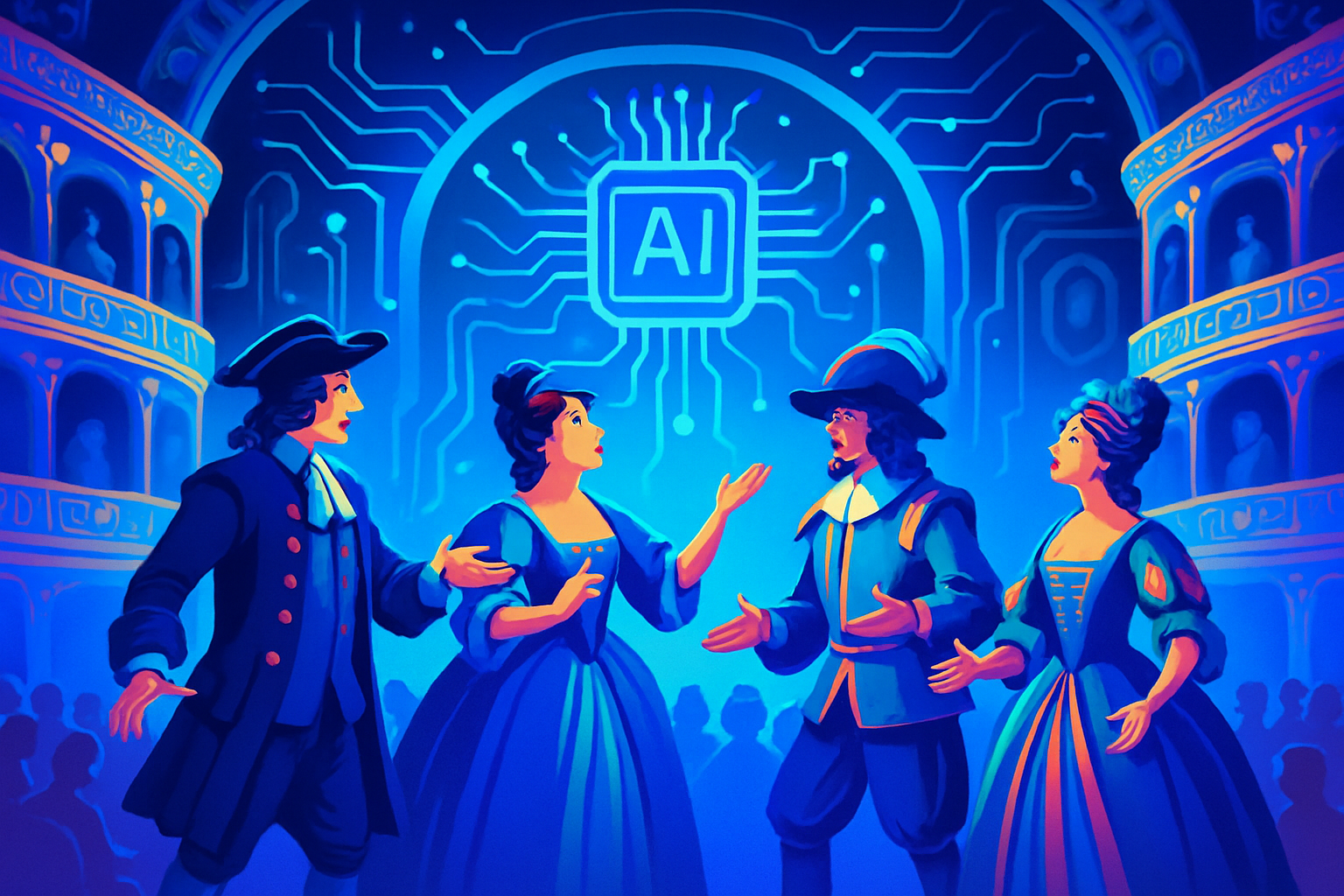
The Royal Opera of Versailles is set to host a one-of-a-kind theatrical work, L’Astrologue ou Les faux présages, on May 5 and 6. This original play is the result of a collaboration between the collective Obvious and the Théâtre Molière Sorbonne, utilizing AI models to imagine what Molière might have written had he survived 1673.
An Ambitious and Well-Funded Project
The project has received private funding of 1.5 million euros, with notable contributions from figures such as Reid Hoffman and Eric Schmidt. The initiative, dubbed Molière Ex Machina, has brought together experts in artificial intelligence and academics to produce a complete play, from costumes to baroque sets.
A Captivating Plot
The plot of the play features a credulous and stubborn bourgeois manipulated by an astrologer, who suggests he marry his daughter to a bankrupt wigmaker. The future bride, far from being passive, refuses this sordid deal and, with the help of her lover and a clever maid, attempts to escape her fate.
A Hybrid Method to Recreate Molière's Style
To get closer to Molière's universe, the team developed a hybrid method, training Mistral AI on 17th-century texts and "theatrical genetics." The model was fed texts from Racine, Italian theater, and other contemporary works to master Old French, according to Pierre Fautrel, co-founder of Obvious.
For over two years, the team has been striving to imagine the play that Jean-Baptiste Poquelin could have written had he survived 1673, thanks to algorithms. The project was born during a roundtable on AI and creation at Sorbonne Université, where Pierre-Marie Chauvin connected the Obvious collective with the Théâtre Molière Sorbonne.
Algorithms Serving Art
The creation does not stop at the text. NotaGen and Flux AI were tasked with the music, costumes, and sets, relying on baroque scores and period sketches. No element was hand-drawn; everything was generated by algorithms while respecting 17th-century techniques.
Numerama attended the final rehearsals of L’Astrologue ou Les faux présages at the National Institute for Teaching and Education in Paris, ahead of a ten-day residency at 3 Pierrots in Saint-Cloud.
A Collective Effort for Historical Consistency
About a hundred people, including thirty experts in diction, musicology, and astrology, participated in proofreading the text to ensure its coherence. The director and two actors also contributed to correcting the final errors, such as the anachronistic expression "tomber des nues."
Investors attended the rehearsals, and the team raised 1.5 million euros from private donors. Mickaël Bouffard hopes this project will broaden the audience, while Antoine Gheerbrant fears it may be perceived solely as a technological experiment, to the detriment of Molière's essence.
Brief IA — L'actualité IA en français
L'essentiel de l'actualité de l'intelligence artificielle, décrypté et expliqué chaque jour.