Insilico Medicine: AI Revolutionizes Healthcare in China
Insilico Medicine Accelerates Drug Discovery with AI in China
Insilico Medicine, a publicly traded company in Hong Kong, has significantly reduced the time required to develop certain drug candidates by using a combination of artificial intelligence and laboratory research in China. According to Alex Zhavoronkov, the company's CEO, this approach has brought the development time down to about one year.
Insilico's fastest program achieved candidate nomination in just nine months, while the usual timeframe is around 13 months. Zhavoronkov emphasizes that traditional methods typically take about four and a half years to reach the same stage of development.
It is important to note that these timelines only pertain to the early discovery phase and candidate selection, not the entire process of bringing a drug to market. Subsequent steps, such as clinical trials, manufacturing, and regulatory review, remain distinct.
AI at the Heart of Candidate Selection
Insilico Medicine employs generative artificial intelligence to identify biological targets, design potential drug molecules, and evaluate which compounds should undergo laboratory testing.
The company claims that its programs generally allow for the nomination of preclinical candidates within 12 to 18 months after researchers have synthesized and tested between 60 and 200 molecules. This workflow combines AI-generated designs with review by researchers and experimental validation.
Laboratory experiments remain essential to confirm the biological activity and drug properties of the compounds selected by the models. Insilico has indicated that its AI-supported process allows for candidate nomination after testing a more limited set of synthesized molecules, although it has not provided a direct comparison with equivalent programs developed without AI.
Since 2021, Insilico has generated 31 preclinical candidates. Thirteen of these programs have received experimental drug approvals, allowing them to progress to human studies, according to the company's pipeline disclosures.
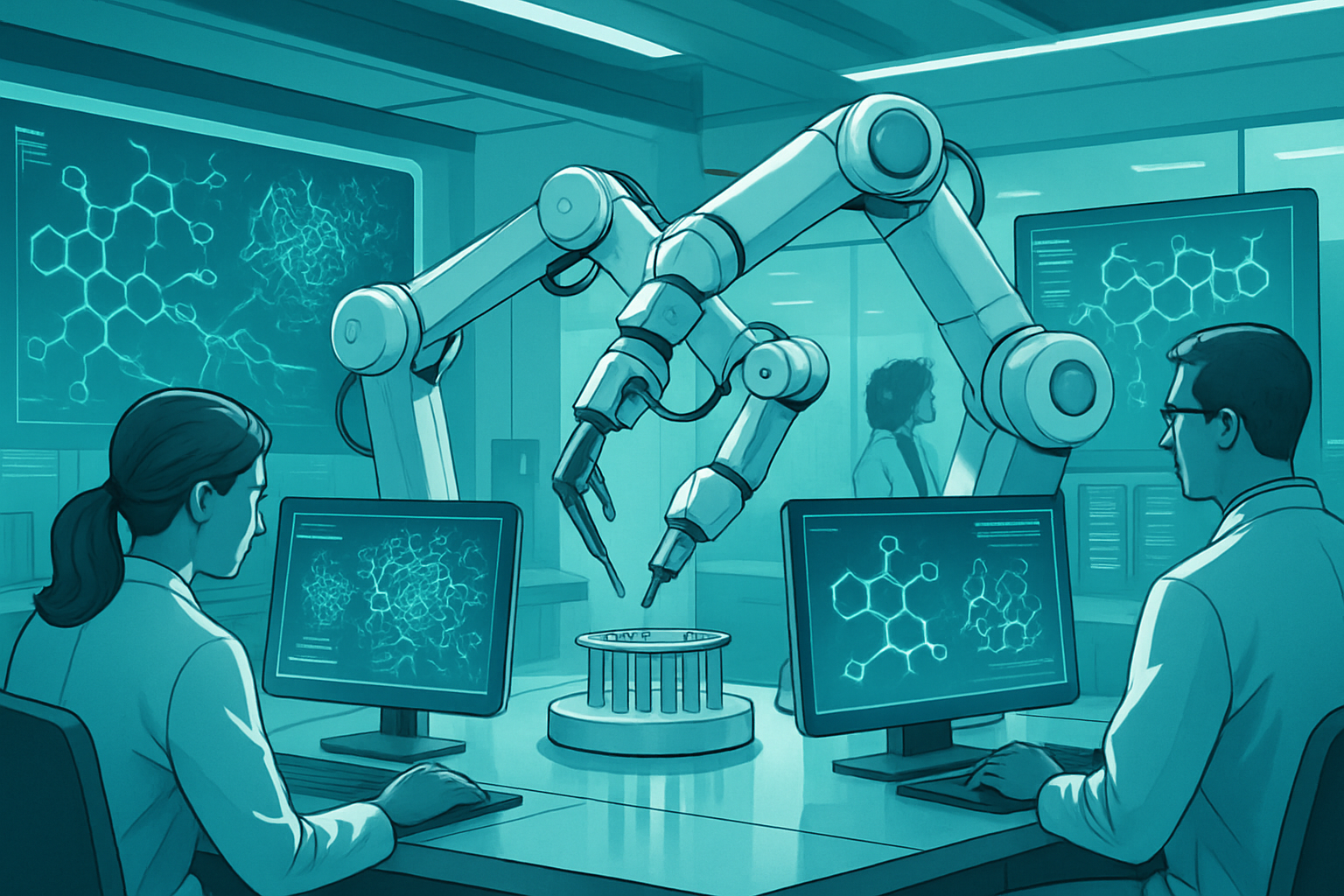
The company conducts AI research in Montreal and Abu Dhabi, while much of its experimental validation and laboratory scaling work takes place in China. Its facility in Shanghai has automated certain parts of biological sampling and compound screening.
Teams located outside of China focus on the development and evaluation of the company's AI models, while researchers in Shanghai handle biological testing, screening, and scaling.
China: A Fertile Ground for Innovation
Zhavoronkov attributes part of the reduced development timelines to the research infrastructure, operating costs, and regulatory environment in China. He states that pharmaceutical companies with research laboratories in China can cut the development timelines of traditional candidates by about two years.
China has expanded its role beyond merely manufacturing generic drug ingredients and now plays a more significant role in the development of new drugs. International drug manufacturers are also collaborating with Chinese laboratories, contract research organizations, clinical trial centers, and biotechnology companies.
A Pfizer executive stated that clinical development in China could be completed three times faster and at about half the cost of equivalent work in Europe. Drug candidates typically take five to seven years to reach the Chinese market, compared to at least eight to ten years in Western markets, according to Reuters.
Le brief IA que les pros lisent chaque soir
Les 7 actus IA du jour, décryptées en 5 min. Gratuit.
Inclus dès l'inscription : notre sélection des meilleurs guides & comparatifs IA.
Choisissez votre rythme
Gratuit · Pas de spam · Désabonnement en 1 clic
China introduced a 30-business-day review pathway in 2025 for eligible Class I innovative drug clinical trial applications. Applications requiring expert consultation or involving complex technical issues may be transferred to a 60-business-day review period.
Insilico and Its Strategic Partnerships
Insilico has entered into research and development agreements with pharmaceutical companies such as Eli Lilly and Japan's Takeda.
The company and Taiwan-based Bora Pharmaceuticals have also announced a proposed strategic alliance that could exceed $2.5 billion if definitive agreements are signed and the collaboration is fully implemented.
Although Insilico operates research facilities in China, Zhavoronkov stated that over 90% of its revenue comes from Western pharmaceutical companies. He did not disclose how much revenue the company generates in China.
Western licensing agreements are more lucrative for Insilico because China's national insurance system offers lower reimbursement rates for highly innovative drugs, Zhavoronkov noted. The company also limits sales of most of its software in China due to geopolitical concerns, he added. It plans to expand its research operations in Shanghai.
Rentosertib: A Promising Candidate
Insilico announced and registered a Phase III trial of Rentosertib in July 2026. This oral medication is being studied for idiopathic pulmonary fibrosis, a disease that causes progressive scarring of the lungs.
The company used AI to identify the drug's biological target and generate and optimize its molecular structure.
The Phase III study is designed to include 320 participants across 47 centers in China. It will compare Rentosertib to a placebo over 52 weeks, with the primary endpoint being the annual rate of decline in forced vital capacity, a standard measure of lung function.
The trial was listed as not yet recruiting when its registration on ClinicalTrials.gov was updated on July 7. Enrollment was expected to begin in August 2026, with an estimated primary completion date in October 2029.
Rentosertib previously completed a smaller Phase IIa study. The Phase III trial will test the treatment on a larger group of patients over a longer period.
Candidate nomination remains an early stage of development. Drugs must still complete preclinical testing, human trials, manufacturing validation, and regulatory review before they can be approved for sale.
Industry data has not established whether AI-designed drugs are more likely to succeed in later trials.
A 2024 analysis of AI-native biotechnology pipelines reported Phase I success rates between 80% and 90%. The same study found a Phase II success rate of about 40%, generally consistent with the historical industry comparison used by researchers.
Researchers stated that the number of Phase II programs was too small to determine whether AI improves clinical success at a later stage. The analysis was based on publicly reported pipelines and did not compare AI-supported drug programs with otherwise identical conventional programs.
Insilico reported having produced 31 preclinical candidates and obtained 13 experimental drug approvals. Rentosertib is its first program to reach the Phase III stage, while none of the company's experimental drugs have received commercial approval.
The Impact of Automation on Biotechnology Jobs
AI and laboratory robotics are also changing staffing requirements within Insilico.
Zhavoronkov estimated that the company could automate or replace about 40% of its software-side staff. He did not describe this figure as an announced workforce reduction nor apply it to the entire biotechnology industry.
Insilico employs around 400 people. Laboratory scientists and software engineers are being trained to manage AI evaluation systems, automated equipment, and robotics, Zhavoronkov stated.
Training focuses on AI references and robotic systems as the company automates more research and software functions, he added.
Brief IA — L'actualité IA en français
L'essentiel de l'actualité de l'intelligence artificielle, décrypté et expliqué chaque jour.