Global AI Investments Reach $510 Billion
Le brief IA que les pros lisent chaque soir
Les 7 actus IA du jour, décryptées en 5 min. Gratuit.
Inclus dès l'inscription : notre sélection des meilleurs guides & comparatifs IA.
Choisis ton rythme
Gratuit · Pas de spam · Désabonnement en 1 clic
A Historic Record for Global Venture Capital
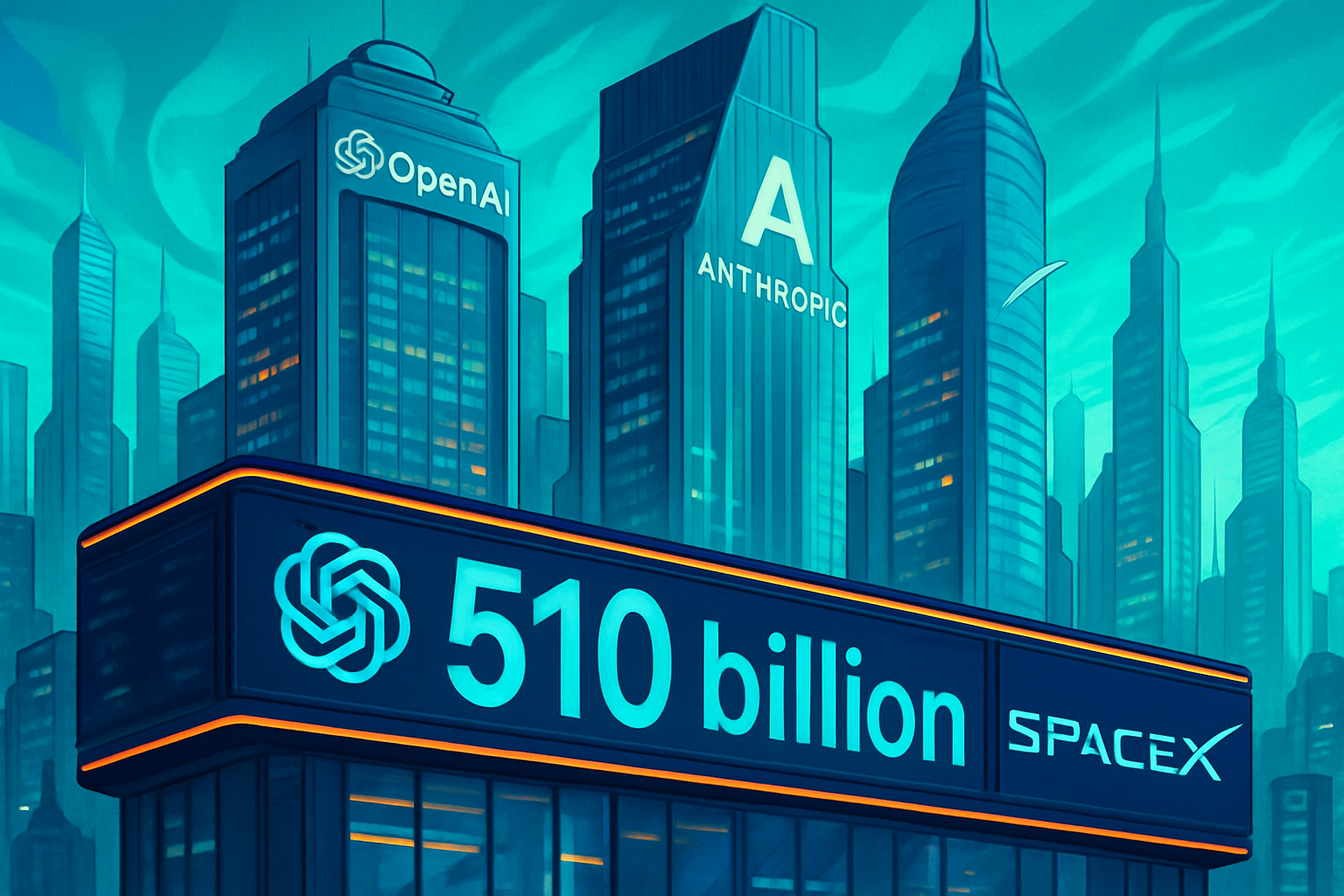
The first half of 2026 saw global venture capital investments reach an unprecedented level of $510 billion, according to data from Crunchbase. This figure far exceeds the $440 billion invested throughout all of 2025, thus establishing a new record for startup investments over a six-month period.
This spectacular surge is accompanied by a notable concentration of capital in a limited number of companies. At the same time, initial public offerings (IPOs) and acquisitions have experienced a strong rebound, with the second quarter marking one of the most dynamic periods for exits supported by venture capital in years.
The Impact of AI Giants
Two companies, OpenAI and Anthropic, alone attracted $217 billion, accounting for 43% of all startup funding during the first half of the year. This concentration illustrates how a few pioneers in artificial intelligence are redefining the dynamics of venture capital. Furthermore, significant funding has been realized in sectors such as AI infrastructure, defense, robotics, and healthcare, accompanied by record activity in IPOs and mergers and acquisitions (M&A). This indicates that the investment boom in AI extends well beyond a few leading research labs.
An Exceptional Second Quarter
The second quarter of 2026 has established itself as the second-largest quarter ever recorded for global venture capital investment, just behind the first quarter. Investors injected $205 billion into more than 5,000 startups during this quarter, following an investment of $305 billion in the first quarter.
A Surge in Exits in Q2
The record funding in the first half surpassed the previous six-month peak of $375 billion reached in the second half of 2021. The second quarter also marked a turning point in terms of liquidity. IPOs and startup acquisitions accelerated alongside venture capital investment, producing the strongest exit market since the 2021 boom, according to Crunchbase.
The largest IPO ever conducted for a venture-backed company and the largest startup acquisition both took place in Q2. SpaceX, by going public, reached a valuation of $1.77 trillion, raising $75 billion. Less than a week later, SpaceX confirmed its intention to acquire Anysphere, the maker of the AI coding tool Cursor, for $60 billion.
Capital Concentration
Despite the resurgence of exits, venture capital investment during the AI boom remains marked by extraordinary concentration in terms of companies, industries, and geography. Nearly one-third of global venture capital funding in Q2 went to a single company: Anthropic. This leading research lab raised $65 billion last quarter, surpassing OpenAI in the Crunchbase Unicorn Board rankings.
The United States also dominated global funding, with two-thirds of startup capital in Q2 going to U.S.-based companies, down from 83% in Q1, but in line with proportions from Q2 2025. Additionally, over 70% of global startup capital in Q2 was invested in AI-focused companies, compared to just below 50% a year earlier.
Beyond Anthropic
Although Anthropic represented a significant share of global funding, the quarter also produced a substantial group of other mega-rounds. A total of 16 companies raised billion-dollar rounds during the quarter, totaling $108.6 billion, or 53% of the second quarter's funding, according to Crunchbase data.
Among these fundraising efforts, seven are pioneering labs, including the Chinese companies DeepSeek, StepFun, and Moonshot AI, the British company Ineffable Intelligence, as well as the American labs Prometheus and Isomorphic Labs. Eight of the companies in the Q2 group are based in the United States, while Asia and Europe each have four.
In addition to foundation model companies, large funding rounds have been raised by startups working in defense, AI infrastructure, robotics, and healthcare.
Late-Stage Funding
Late-stage funding totaled $134 billion in Q2, down from Q1 but up 141% compared to Q2 2025, according to Crunchbase data.
Early-Stage Funding
Early-stage funding totaled $12 billion in Q2, according to Crunchbase data. Of this, $2.8 billion was allocated to startup rounds of $100 million and more, with $5 billion in startup rounds of $10 million and less.
Seed-stage investments also remained high, although the market continues to show an increasing gap between a few exceptionally large financings and the broader population of traditional seed rounds. The number of companies raising Series A and B rounds of $100 million has increased over the last two quarters, with 91 companies globally raising large rounds in Q2.
Record Exit Market Returns
Exit amounts in Q2 were the highest ever recorded for venture-backed companies, both for acquisitions and IPOs, according to Crunchbase data. A total of 32 companies went public at valuations exceeding $1 billion in Q2. After SpaceX, the two largest IPOs were chip maker Cerebras Systems and quantum company Quantinuum.
Twenty-four companies were also acquired at prices equal to or exceeding $1 billion in Q2, totaling $113 billion in value — the highest quarter ever recorded — according to Crunchbase data.
A New Venture Capital Cycle Emerges
The first half of 2026 has set a new benchmark for global venture capital investment, but this record comes with a significant caveat: an unprecedented share of capital has been directed toward only two companies. OpenAI and Anthropic together attracted more than 40% of all venture capital funding during the first half, highlighting the extent to which the current market is centered on the largest players in the race for cutting-edge AI.
However, the broader venture capital ecosystem shows signs of strength. Startup funding has increased at every stage of investment, public markets have reopened, and billion-dollar financings have extended beyond foundation model developers to adjacent sectors such as AI infrastructure, defense, robotics, and healthcare.
Perhaps the most significant change is the return of liquidity, through both IPOs and M&A. If these trends continue, 2026 could be memorable not only as the year when venture capital funding reached a new peak but also as the beginning of a cycle in which record private investments and a functional exit market mutually reinforce each other.
Brief IA — L'actualité IA en français
L'essentiel de l'actualité de l'intelligence artificielle, décrypté et expliqué chaque jour.