Armenia and NVIDIA: A Bold Bet on AI Sovereignty
Armenia's Bet on AI: Computational Sovereignty
Armenia, although neither a large country nor particularly wealthy, has recently attracted international attention. Known for its consumption of artificial intelligence products, it has also become a topic of discussion for its technological advancements. Among these advancements is the rumor that Armenia would be manufacturing chips for NVIDIA. However, it is crucial to clarify that Armenia is not transforming into a chip manufacturer like Taiwan. NVIDIA's Blackwell chips will not be produced in Hrazdan or Yerevan. NVIDIA has confirmed that these GPUs are manufactured through a custom TSMC 4NP process, integrating Armenia into the global semiconductor supply chain, but not as a production site.
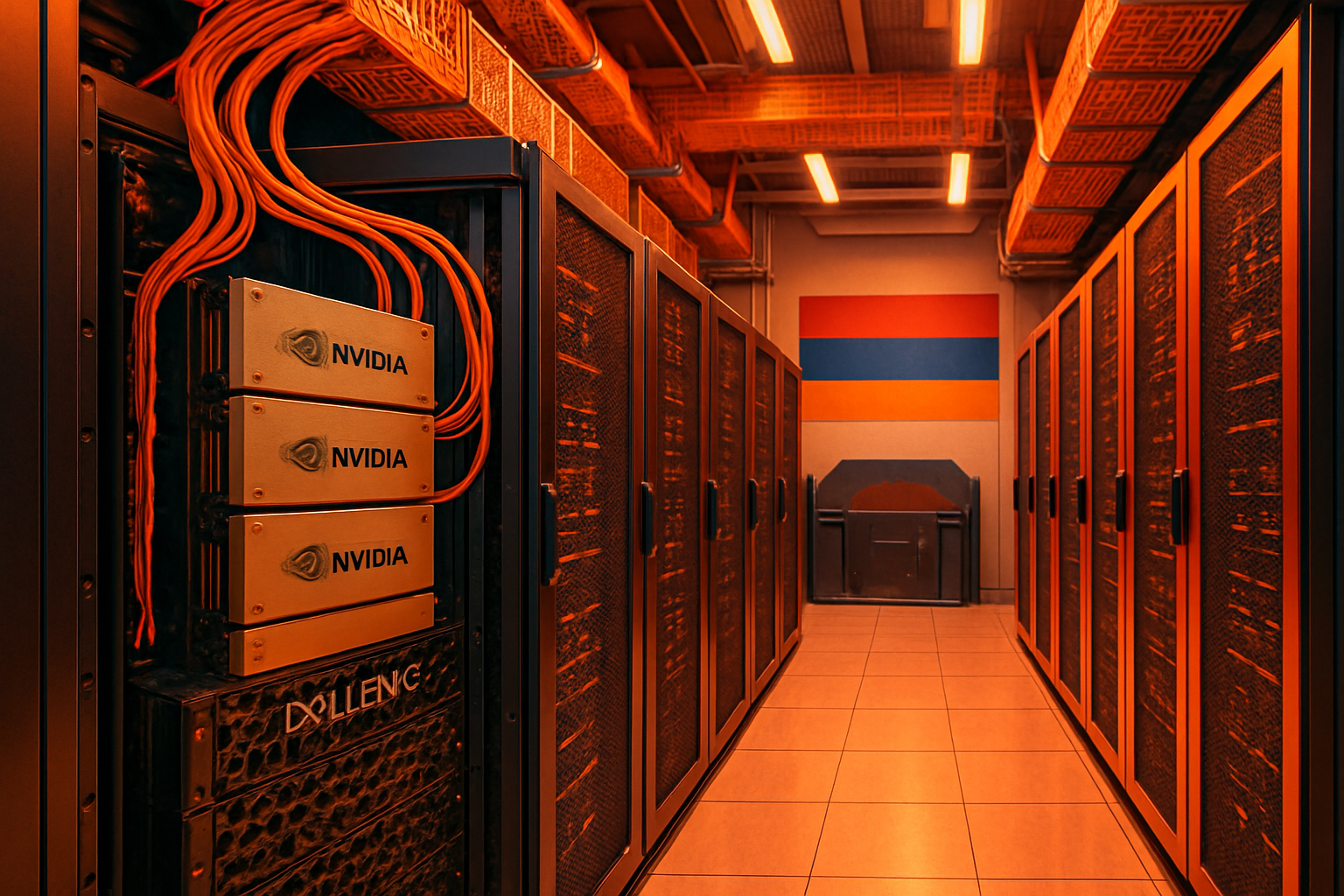
Armenia has chosen a different path: it aspires to become a regional computing hub for artificial intelligence. This project relies on high-end infrastructure imported from NVIDIA, chip transfers approved by the United States, and local capabilities in telecommunications and energy. The idea is to provide small countries with sovereign access to AI computing power. The project is centered around Firebird, an American company specializing in AI infrastructure and cloud services, operating between San Francisco and Yerevan. According to the Armenian Ministry of High-Tech Industry, the first phase of the Firebird AI center near Hrazdan is scheduled for 2026, with an investment of $500 million, over 6,000 NVIDIA Blackwell GPUs, 18 MW of capacity, and up to 110.6 exaflops of FP4 Tensor computing. The second phase is even more ambitious, with a total investment of around $4 billion and over 41,000 additional GPUs, which could place Armenia on the global AI computing map.
The Real Story Behind the Infrastructure
The confusion surrounding chip manufacturing is understandable, as the term "chips" is often used in this context. U.S. export approval was necessary for the project, and NVIDIA's Blackwell GPUs are a central element. Dell Technologies is also involved on the server side. A memorandum of understanding on AI and semiconductor innovation was signed between the United States and Armenia on August 8, 2025. This protocol covers secure semiconductor supply chains, the development of integrated circuits and electronics, and the commercialization of AI. However, this does not mean that Armenia is building chip manufacturing plants. In reality, Armenia's role focuses on AI infrastructure, cloud services, electronics and integrated circuit development, as well as research and development adjacent to semiconductors.
NVIDIA now describes large AI infrastructures as "AI factories," systems that produce intelligence rather than physical goods. For example, NVIDIA's GB300 NVL72 platform is a rack-scale system combining 72 Blackwell Ultra GPUs and 36 Arm-based Grace CPUs, designed for high-density training and inference. Dell, the infrastructure partner, offers the PowerEdge XE9712 with NVIDIA GB300 NVL72 as an enterprise AI platform at rack scale, optimized for high-throughput reasoning inference. Thus, the Armenian project does not concern chip manufacturing but rather the hosting of the machines necessary for large-scale AI development.
An independent regional report supports this interpretation. Eurasianet reported in November 2025 that U.S. regulators had approved the transfer of advanced NVIDIA chips for Armenia's AI hub, while also noting the role of Dell's PowerEdge servers and the political significance of the approval process. OC Media, citing Bloomberg, reported that the project involves a 100 MW data center using NVIDIA Blackwell chips and Dell AI servers, with the first phase scheduled for 2026. OC Media also reported that part of the importance lies in export controls: Armenia had previously been affected by U.S. restrictions on high-performance AI chip exports to certain countries, making the approval a strategic as well as commercial milestone.
Le brief IA que les pros lisent chaque soir
Les 7 actus IA du jour, décryptées en 5 min. Gratuit.
Inclus dès l'inscription : notre sélection des meilleurs guides & comparatifs IA.
Choisissez votre rythme
Gratuit · Pas de spam · Désabonnement en 1 clic
Why Armenia Wants So Much AI Computing Power
For Armenia, the stakes are strategic. The country already has a solid technological base, particularly in software engineering, mathematics, electronic design automation, and entrepreneurship linked to the diaspora. For instance, Synopsys Armenia employs over 1,000 people in Yerevan and Gyumri, focusing on R&D and product support for electronic design automation and semiconductor intellectual property. While Armenia is not a giant in chip manufacturing, it is well integrated into the semiconductor value chain.
The Firebird project aims to add a crucial dimension: massive computing. Without powerful computers, local talent relies on foreign cloud providers. Research without GPUs remains theoretical, and startups without advanced local infrastructure must adapt to foreign platforms and policies. This is why the term "computational sovereignty" is more appropriate than "chip production." The goal is not to replace existing semiconductor powers but to ensure that access to AI infrastructure becomes a national priority, just as broadband or energy networks have been in the past.
There is also a public sector AI layer. Armenia has signed a cooperation agreement with Mistral AI, and Mistral's client page indicates that the partnership with the Armenian Ministry of High-Tech Industry focuses on AI assistants, public services, and government functions, paying attention to open and adaptable models that fit Armenia's language, infrastructure, and use cases. This makes the country's AI momentum less like a mere data center announcement and more like a broader attempt to connect infrastructure, public services, startups, universities, and international partnerships.
Challenges After the Announcement
However, obstacles lie ahead. AI factories require massive amounts of energy, capital, and are politically charged. A 100 MW data center would consume as much electricity as a city of about 120,000 people and could require significant cooling capacity, but the Armenian Ministry of High-Tech Industry claims that the Firebird center is equipped with a closed-loop cooling system that only requires a water change every few years. This reflects Armenia's energy situation: the U.S. International Trade Administration reports that Armenia has adequate current electricity production capacity with rising consumption and still relies on a mix of nuclear, hydroelectric, and thermal production.
There is also a risk of execution. Firebird is young, the capital figures are significant, and the gap between an announced AI factory and a fully operational and commercially viable AI computing hub is enormous. The project will require customers, reliable power supply, cooling, network resilience, stability of export controls, operational expertise, and a local ecosystem capable of absorbing some of the computing capacity. The ministry reports that Team Telecom Armenia is installing next-generation fiber optic infrastructure with bandwidth of up to 1 Tbps, while OC Media indicates that the project could include part of the computing capacity allocated to domestic companies, with the rest sold to U.S.-based companies operating in the region. What is important in these details is that the use of GPUs will impact local benefits – who will obtain them, at what price, and for what type of work.
The most accurate way to describe Armenia's AI moment, then, is not "NVIDIA produces chips in Armenia." Rather, it is: Armenia is trying to transform imported advanced chips into domestic strategic capacity. If Firebird, Dell, NVIDIA-related infrastructure, U.S. export approvals, local telecommunications investments, and public sector AI partnerships materialize as planned, Armenia could become one of the most unusual AI infrastructure stories in the coming years: a small landlocked country using computers as a development strategy. The bet is bold. Armenia is not trying to become the next chip factory. It is trying to become a place where the next generation of AI systems can be trained, hosted, and commercialized.
Brief IA — L'actualité IA en français
L'essentiel de l'actualité de l'intelligence artificielle, décrypté et expliqué chaque jour.