Agentic AI Revolutionizes Modern Scientific Computing
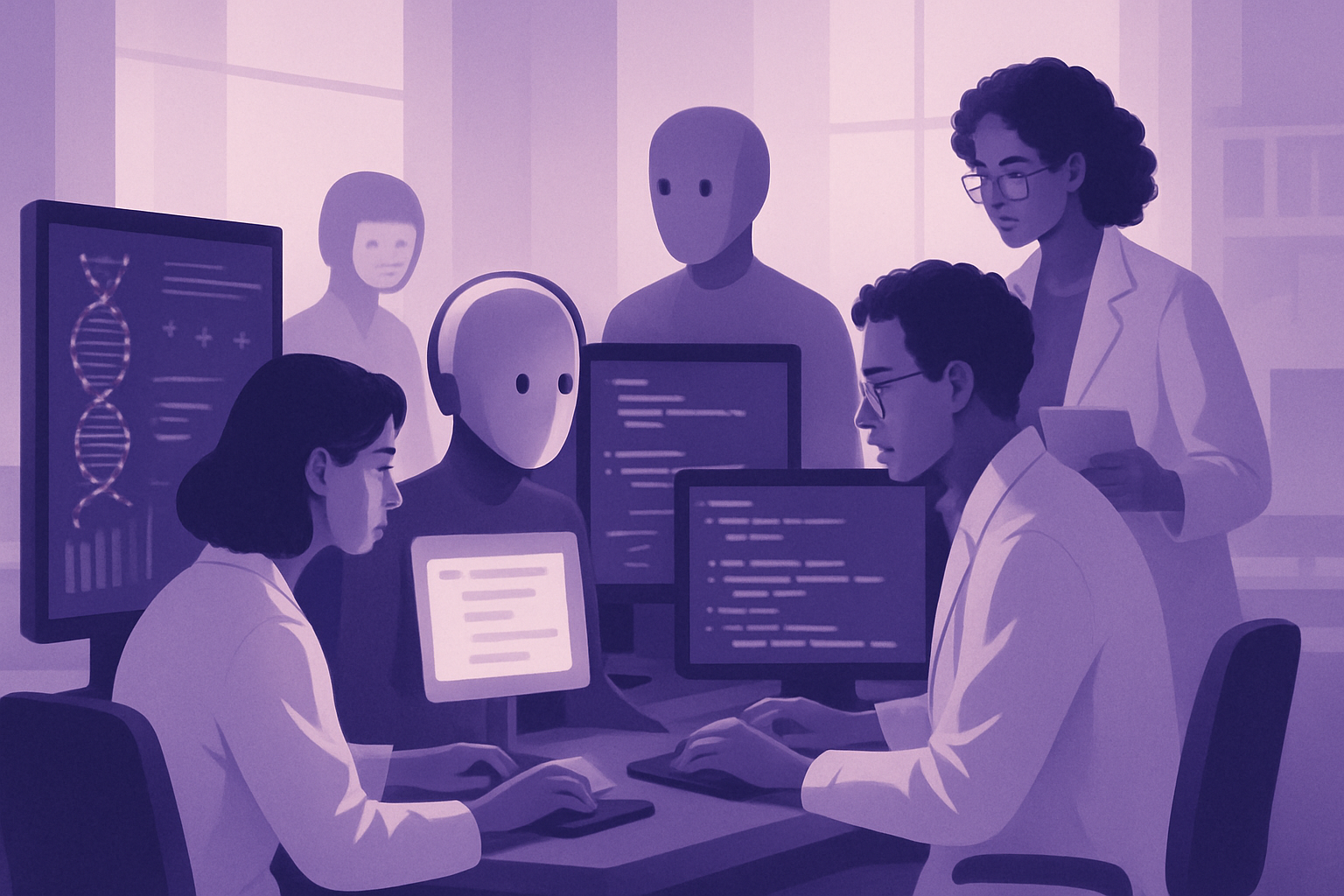
Scientific Computing Facing Its Challenges
Scientific computing is a crucial foundation for contemporary research, both in academia and industry. However, the software used to process and analyze scientific data struggles to keep pace with the rapid production of new data. A large portion of these widely adopted research tools were initially designed as supplementary codes to research articles. These codes were often developed by small academic teams that lacked engineering experience and time to ensure adequate packaging, testing, optimization, or long-term support. This situation has led to a scientific infrastructure that relies on workflows that are often slow and fragile, requiring constant maintenance. These constraints significantly slow down the pace of scientific discoveries.
The Impact of AI Agents
AI agents are beginning to transform this dynamic. By reducing the costs associated with engineering work and taking on tedious implementation tasks, these agents enable researchers to prototype ideas more quickly, engage in projects once deemed impractical, and more easily maintain software over the long term. As a result, scientific software becomes more efficient and better maintained, allowing researchers to devote more time to scientific discovery.
An exploratory field report has been shared, covering eight scientific computing projects assisted by agents, primarily in the life sciences. Among these projects, five use Codex exclusively, while three combine Codex and Claude Code. This report compiles case studies written by the teams behind each project and identifies recurring themes. The projects range from routine maintenance and targeted optimization to large-scale language migrations and native redesigns for GPUs. Contributors report that the agents have significantly accelerated software development and maintenance, helping small teams accomplish work that would otherwise have required much more time or specialized engineering support. However, they also highlight the ongoing challenge of establishing clear accountability and long-term management of the resulting tools.
Changing Role of Researchers
Contributors consistently describe a shift in the role of researchers, moving from implementation to verification and orchestration: specifying what to build, defining how to measure validity, and deciding when a project is ready to launch. In this emerging model, researchers remain in control of scientific direction and quality standards but benefit from increased velocity through agent assistance.
Case Studies
Modernizing a Library for Parsing Genomic Data
A notable example is the modernization of cyvcf2, a Python library used for reading and writing genomic variant files. Thanks to GPT-5.5, the legacy build and packaging system of the library has been replaced with a modern, unified process designed to simplify installation, testing, and publishing of the library.
With coding agents, it is quite easy to move quickly; for now, to go far in science, there remains a need for expert guidance, understanding, taste, and care. — Brent Pedersen
Recurring Themes
Although the projects vary widely in scope, they demonstrate that coding agents make engineering work and expertise less burdensome in scientific computing. Now, the bottleneck is the validation of an AI agent's results, which still depends on human judgment.
Le brief IA que les pros lisent chaque soir
Les 7 actus IA du jour, décryptées en 5 min. Gratuit.
Inclus dès l'inscription : notre sélection des meilleurs guides & comparatifs IA.
Choisissez votre rythme
Gratuit · Pas de spam · Désabonnement en 1 clic
Across the case studies, agents effectively managed specific and well-defined requests but could not reliably judge whether their work was scientifically valid or met expectations. Indeed, agents often expressed confidence even when their work contained obvious errors. Human reviewers thus had to find reliable ways to validate the results. The strongest approaches used an external reference or a measurable acceptance criterion, such as exact agreement on outcomes, parity with an existing tool, appropriate statistical behavior, or pre-established responses using simulated data.
Another recurring theme was that projects generally progressed in stages using feedback-based iterations rather than as one-off approaches. Contributors broke down broad goals into smaller changes and then used intermediate benchmarks and testing systems to evaluate and refine the agents' work. Agents often produced initial implementations quickly, but resolving edge cases and subtle numerical differences took much longer. Completing the "last mile" of an implementation often required the most work.
Overall, these case studies suggest that agents allow researchers to spend less time on implementation and more time directing scientific work. People define the goal, break complex projects into manageable pieces, and judge whether the results are scientifically valid. By alleviating long-standing engineering constraints, agents expand what researchers can build while allowing them to focus on the scientific questions and decisions that matter most.
Long-Term Management Remains Essential
The maintenance gap in research software has long slowed iteration and limited reproducibility and reliability. Published studies on "research code" and omics tools have revealed that published software often fails to install correctly in a new computing environment or to function as documented, forcing researchers to spend considerable time on setup and debugging. Even routine improvements can save researchers time and reduce computing demands, while refactoring and performance-based rewrites can offer more significant gains.
However, lower implementation costs also make it easier to produce many similar rewrites, fragmenting users and dispersing the expert attention needed to maintain a reliable tool. This makes long-term management and accountability essential. Mature scientific software involves undocumented conventions, compatibility requirements, and user trust that mere source code translation cannot reproduce.
The case studies illustrate several possible paths forward. Changes made to MHCflurry and cyvcf2 have been integrated into their original projects, while rustar-aligner has been placed under new community management because the original project had been abandoned. When coordination with existing maintainers is possible, it should begin as early as possible. When a separate implementation is necessary, it should have a clear owner and a credible maintenance plan. Without this, today's modern rewrite can become tomorrow's abandoned code rather than a reliable scientific infrastructure.
Towards More Sustainable Scientific Software
This field report is retrospective and exploratory, but the case studies point to a practical shift in how scientific software is developed. Coding agents like Codex can significantly reduce the cost of maintenance, migration, optimization, and new implementations. Their long-term scientific value still depends on human decisions about what to build, how to verify it, and who will maintain it. The deeper change is not simply that researchers can produce more software, but that they can focus more of their efforts on defining, validating, and managing the tools.
These case studies show that agents can already accelerate the pace of iteration in scientific computing. As coding agents improve, researchers will be able to spend less time maintaining analysis pipelines and more time advancing their fields.
Brief IA — L'actualité IA en français
L'essentiel de l'actualité de l'intelligence artificielle, décrypté et expliqué chaque jour.