AI Deciphers 2000-Year-Old Vesuvius Papyrus
Le brief IA que les pros lisent chaque soir
Les 7 actus IA du jour, décryptées en 5 min. Gratuit.
Inclus dès l'inscription : notre sélection des meilleurs guides & comparatifs IA.
Choisis ton rythme
Gratuit · Pas de spam · Désabonnement en 1 clic
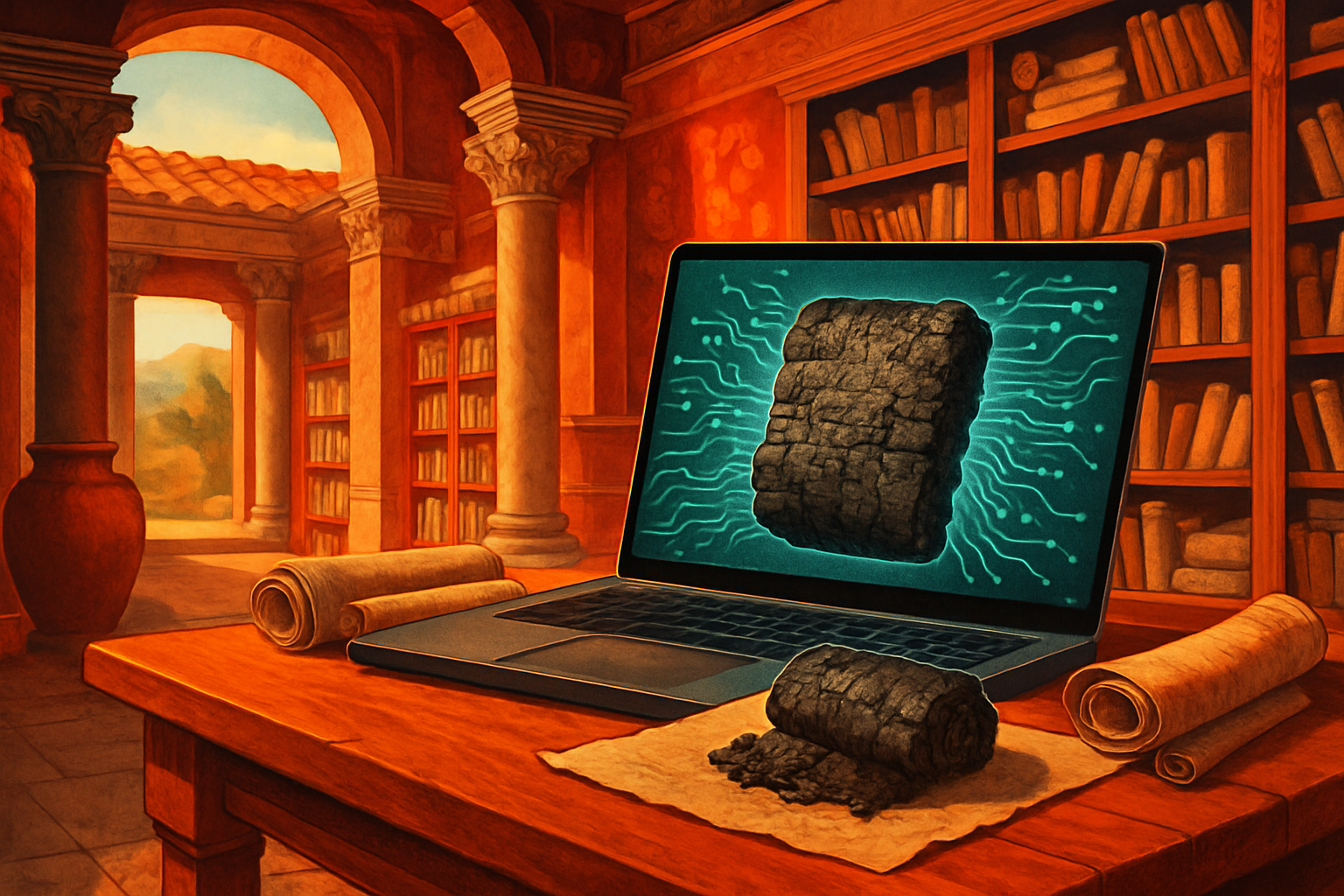
Artificial intelligence (AI) has recently reached a new milestone in the field of archaeology and heritage preservation. Thanks to its advanced capabilities, it has successfully read a papyrus scroll that was reduced to ashes during the eruption of Vesuvius. This feat was accomplished without even needing to physically unroll the document, thereby revealing a text that had remained hidden for nearly 2000 years.
A Unique Papyrus
The scroll in question, known as PHerc 1667, is one of the oldest manuscripts found in the library of a lavish Roman villa in Herculaneum. This document dates back to a period between the 2nd and the end of the 3rd century BC. The villa was buried under the ashes and intense heat of the Vesuvius eruption in AD 79, the same catastrophe that also destroyed the city of Pompeii. Over time, the papyrus deteriorated, breaking into two and undergoing numerous unsuccessful unrolling attempts that damaged its outer layers. Today, only about half of its original size remains, measuring just 8 centimeters high and 2 centimeters wide.
The content of the manuscript focuses on Stoic philosophy, addressing topics such as ethics, art, and human behavior. This text provides valuable insight into Stoic thought of the time, enriching our understanding of this philosophical school.
A Significant Advancement for the Study of Ancient Manuscripts
Federica Nicolardi, a papyrologist at the University of Naples Federico II, expressed her admiration for this achievement of AI. Although the scroll is not complete, researchers have managed to reveal twenty columns of text. These columns span over a meter of parchment, and the ability to virtually unroll them demonstrates that this technology allows for the exploration of ancient manuscripts without causing further damage.
This discovery will be presented at a conference in Naples, highlighting a new victory for the Vesuvius Challenge, an international competition launched in 2023 to decipher the carbonized manuscripts of Herculaneum. Furthermore, researchers are on the verge of completing the virtual unrolling of another scroll titled "Philodemus, On the God, Book 8." This advancement reveals for the first time that the treatise "On the God" was composed of multiple books, whereas until now, only the first volume was known.
Brief IA — L'actualité IA en français
L'essentiel de l'actualité de l'intelligence artificielle, décrypté et expliqué chaque jour.