AI and the Asymmetry of Misinformation: An Exponential Challenge
Le brief IA que les pros lisent chaque soir
Les 7 actus IA du jour, décryptées en 5 min. Gratuit.
Inclus dès l'inscription : notre sélection des meilleurs guides & comparatifs IA.
Choisis ton rythme
Gratuit · Pas de spam · Désabonnement en 1 clic
The Principle of Asymmetry of Nonsense
Artificial intelligence has transformed the dynamics of misinformation production, making this task almost costless. Historically, it took ten times more effort to refute a false claim than to create one. With generative AI, this production cost has been reduced to zero. The solution to this problem is not to multiply fact-checking efforts, but to rethink the very design of information systems.
In 2013, Alberto Brandolini, an Italian programmer, made a famous observation after watching a political talk show: "The amount of energy needed to refute bullshit is an order of magnitude greater than that required to produce it." This idea, known as Brandolini's Law or the principle of asymmetry of nonsense, illustrates the gap between the ease of producing false information and the difficulty of refuting it. Brandolini quantified this gap as being on the order of magnitude of about ten to one. This principle now applies to machines, where an AI model can generate an incorrect response in an instant, while a human takes hours to verify it.
What Happens When Asymmetry Worsens
In the past, producing a lie required some effort: it had to be written, disseminated, or even spoken in person. Both production and refutation were time-consuming human tasks, maintaining a certain balance. Although this balance was imperfect, it was still manageable. Today, this balance is disrupted.
This article explores the consequences of the collapse of the costs of producing false information, while the costs of refutation remain unchanged. It presents a design challenge for creators of information systems. While it is impossible to completely eliminate asymmetry, it is possible to moderate it in the systems we control.
What It Is
A simple statement can require an entire afternoon of verification.
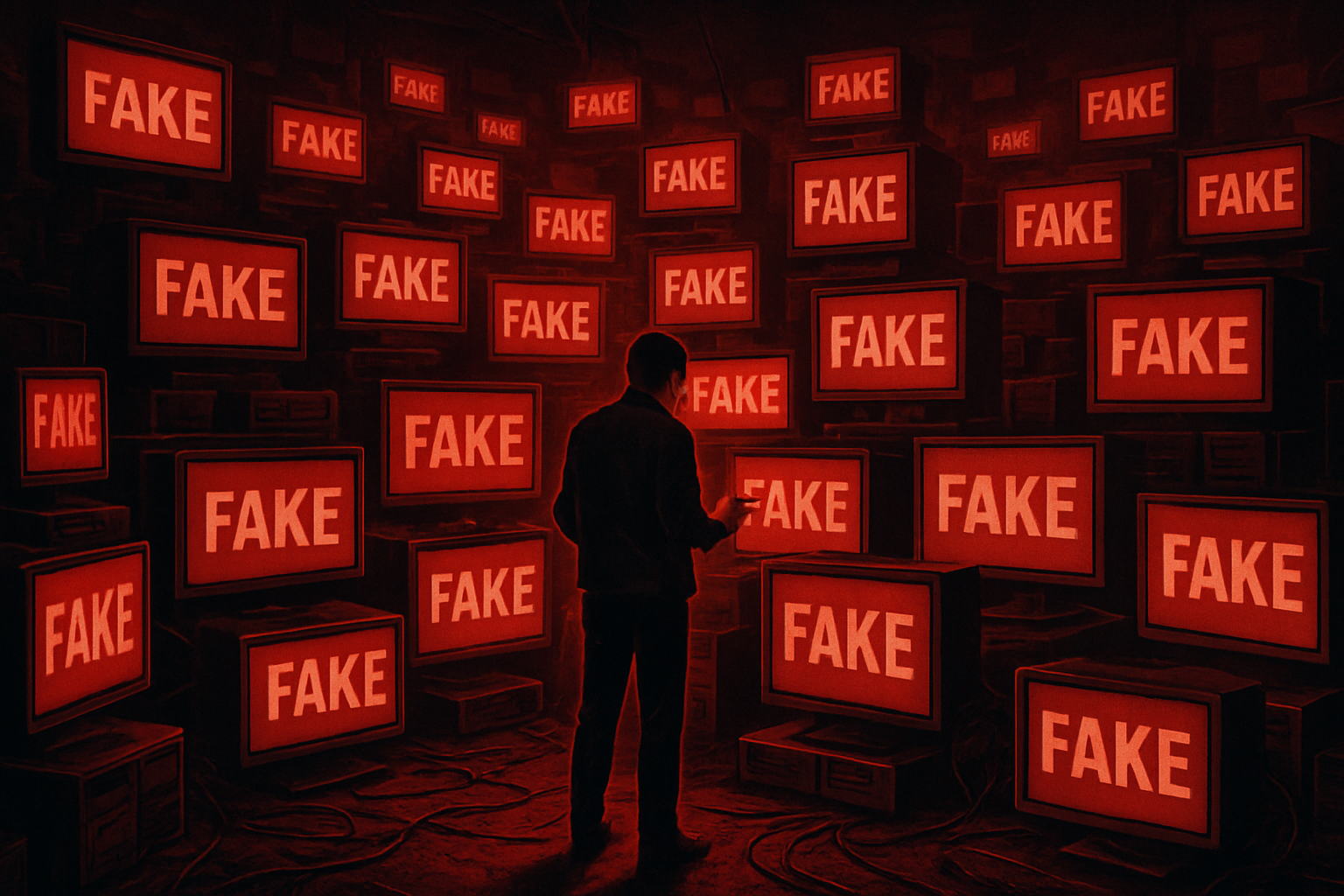
The rule: Cheap to produce, expensive to refute.
Brandolini's Law, stripped of its colloquial language, is an observation about the asymmetric cost of producing and refuting information. Making a false or careless claim is inexpensive because it does not require a solid foundation. In contrast, refuting such a claim takes time and evidence. A simple nonsensical statement may require a paragraph, a graph, and several hours to be demystified.
This asymmetry concerns not only time but also cognitive load, attention, and trust, all of which are limited. A simple false idea is often easier to remember than a correct but complex one. That’s why a simplistic claim like "the Earth is flat" can fit on a sticker, while its refutation requires explanations in physics, astronomy, and a good dose of patience.
What AI Has Changed: Production Has Become Free
The element that should worry designers is that generative AI has altered the cost of producing information, making it nearly zero.
According to NewsGuard, which monitors unreliable news sites generated by AI in sixteen languages, there were 3,006 such sites in March 2026, up from 2,089 in October of the previous year. This growth is not an isolated phenomenon. The team found that this category of sites is increasing by 300 to 500 new sites per month. One analyst even demonstrated that it is possible to create a functional content farm for about $100, which was once the domain of entire newsrooms.
This phenomenon has been described in more positive contexts — when execution becomes cheap, the rituals surrounding rare actions lose their meaning. At best, this means a designer can ship a prototype quickly. At worst, it allows a propagandist to spread hundreds of fake local newspapers in no time. The cost of producing plausible content has dropped, and misinformation has followed the same path.
What AI Has Not Changed: Refutation Remains Human
One might hope that detection tools would keep pace with production, but that is not the case, and the reason is structural.
A meta-analysis encompassing 56 studies and over 86,000 participants found that the average accuracy of humans in detecting deepfakes is 55.54%, barely better than chance. Another study by iProov showed that only 0.1% of participants correctly identified each real and fake clip presented to them. One in a thousand.
The machines we hoped would save us have not fared any better. NewsGuard tested three leading chatbots on videos created with OpenAI's Sora and found that the tools failed to recognize the clips as AI-generated in 78 to 95% of cases — including OpenAI's own ChatGPT, which failed to flag the OpenAI model.
Production can be parallelized across thousands of servers. Refutation happens one human at a time.
Why It Matters
The damage is not limited to falsehoods. It is the doubt cast on everything that is real.
Cheap lies, costly doubt.
The obvious cost of cheap production is the lies that circulate; the deeper cost is what these falsehoods do to everything around them.
When anyone can create a convincing video, voice clip, or article in minutes, people stop trusting the real ones too. An authentic recording starts to carry an asterisk instead of the AI label, and malicious actors can sweep away authentic evidence as "probably AI-generated," leading everyone to slip into a low-level doubt about everything — the screenshot, the quote, the photo that would have once settled an argument.
Analysts at the World Economic Forum put it simply: knowing that convincing fakes exist is enough to make people doubt what they see, including the truth.
Asymmetry not only increases the cost of refuting a lie. It raises the cost of believing in anything.
How We Fix It
The rare and precious signal is the proof that a human was there.
First, treat it as a design problem.
It would be easy to classify this under politics, journalism, or someone else's department.
Brief IA — L'actualité IA en français
L'essentiel de l'actualité de l'intelligence artificielle, décrypté et expliqué chaque jour.