AI and Coding: Engineers Caught Between Enthusiasm and Doubt
Le brief IA que les pros lisent chaque soir
Les 7 actus IA du jour, décryptées en 5 min. Gratuit.
Inclus dès l'inscription : notre sélection des meilleurs guides & comparatifs IA.
Choisis ton rythme
Gratuit · Pas de spam · Désabonnement en 1 clic
AI in Coding: A Divide Among Software Engineers
A New Work Ecosystem
The emergence of powerful tools such as Claude from Anthropic and Codex from OpenAI has profoundly transformed the landscape of software development. For many developers, coding, once at the heart of their profession, is becoming a secondary task. This transformation affects millions of developers worldwide, who must now adapt to a new professional reality. The battle for token budgets, enthusiasm for AI's productivity potential, and the feeling of being overwhelmed by the rapid pace of technological change have become commonplace. A survey conducted by Stack Overflow in 2025 reveals that nearly 60% of developers have a positive perception of AI-based coding tools. However, with the rapid evolution of technology, opinions have become more nuanced.
Perspectives of Engineers
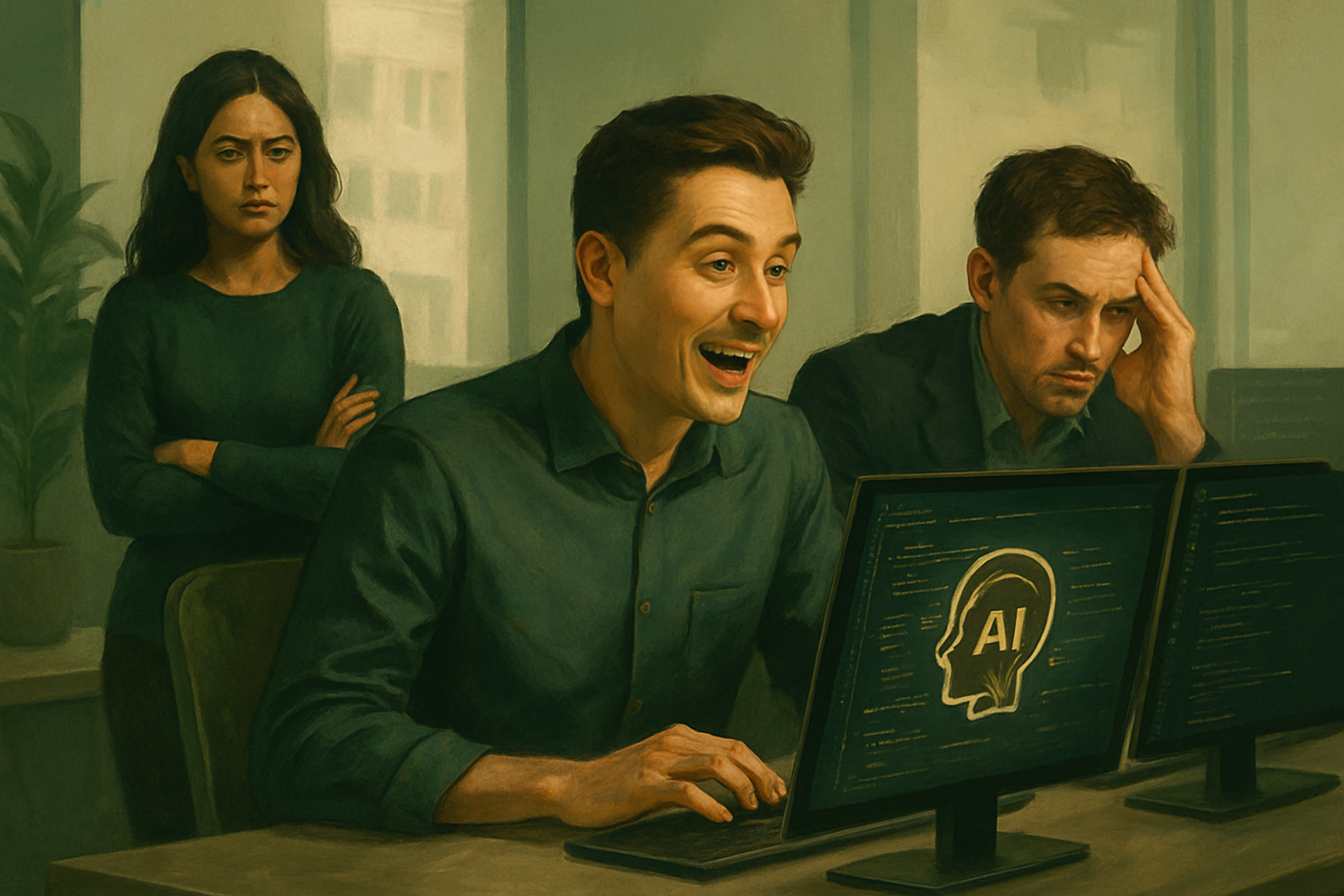
Business Insider conducted interviews with seven software engineers and early-career developers to understand the current upheavals in the industry. Their viewpoints fall into three distinct categories:
- AI enthusiasts, who welcome these technological changes.
- Skeptics, who are concerned about the potential impacts of AI on their profession.
- Those who fall somewhere in between, oscillating between optimism and concern.
The AI Advocate Laid Off
Dmitry Olev, a 47-year-old software engineer residing in Los Angeles, recently lost his job at a major tech company. However, he does not hold AI responsible for his layoff. For him, this event is part of an industrial evolution he has observed throughout his career. Olev views AI as a new wave of productivity enhancement and regularly uses this technology for brainstorming, prototyping, code generation, and learning. He compares himself to a conductor, emphasizing that while AI can perform much of the work, it is the engineer who remains in control of the process direction, evaluating results, and making decisions. Despite his layoff, Olev remains optimistic about his future prospects and is seeking a new position that will allow him to continue working with AI.
The Developer Leaving the Industry
Cristina Estupiñán spent nearly ten years in software development in Silicon Valley before AI disrupted the sector. At 33, she began to feel disenchanted with technology during her job search after being laid off. She found that almost all companies were now AI-focused, and recruiters seemed to insist that she express enthusiasm for this technology. Estupiñán is concerned about the environmental and social impacts of AI and is put off by the increased workplace surveillance it brings. Although she acknowledges the usefulness of certain AI tools, she ultimately decided to change careers and move into the healthcare sector after receiving a rejection letter from a European company.
The Creative Turned Builder
Dan Krzyzanowski, a developer at Jellyvision in Chicago, has always been more interested in what AI allows him to create than in the art of coding itself. At 32, he appreciates that AI eliminates what he calls the "boring elements" of software engineering, allowing him to focus on building. Krzyzanowski emphasizes that developers still need to have strong technical foundations, as AI-generated code often requires debugging and architectural evaluation.
The AI Convert
Maahir Sharma, a 24-year-old software engineer based in Dublin, began delegating most of his coding tasks to AI in late 2025. Although he initially felt a sense of loss, he realized that coding was never the ultimate goal. His work now involves understanding the product and the needs of customers, enabling him to develop features they truly want.
The Anxious Graduate
Mackenzie McAllister, 22, grew up in a family of software engineers and chose computer science in college, drawn by the promise of job security. However, with the emergence of AI, she found that she had sometimes relied too heavily on this technology, leaving her less confident in certain fundamental concepts. After graduating, she redirected her career toward data analysis, feeling underprepared for technical interviews.
The Conflicted Founder
Artur Sapek, a 33-year-old software developer based in Massachusetts, created his own word processing tool, Revise.io. Like many developers, he describes his relationship with technology as complicated. As a founder, he sees AI as a powerful tool that can enhance human capabilities and significantly increase productivity.
Brief IA — L'actualité IA en français
L'essentiel de l'actualité de l'intelligence artificielle, décrypté et expliqué chaque jour.