AI Unveils the Secrets of Herculaneum Papyrus in 2023
Le brief IA que les pros lisent chaque soir
Les 7 actus IA du jour, décryptées en 5 min. Gratuit.
Inclus dès l'inscription : notre sélection des meilleurs guides & comparatifs IA.
Choisis ton rythme
Gratuit · Pas de spam · Désabonnement en 1 clic
AI Unveils the Secrets of Herculaneum Papyrus in 2023
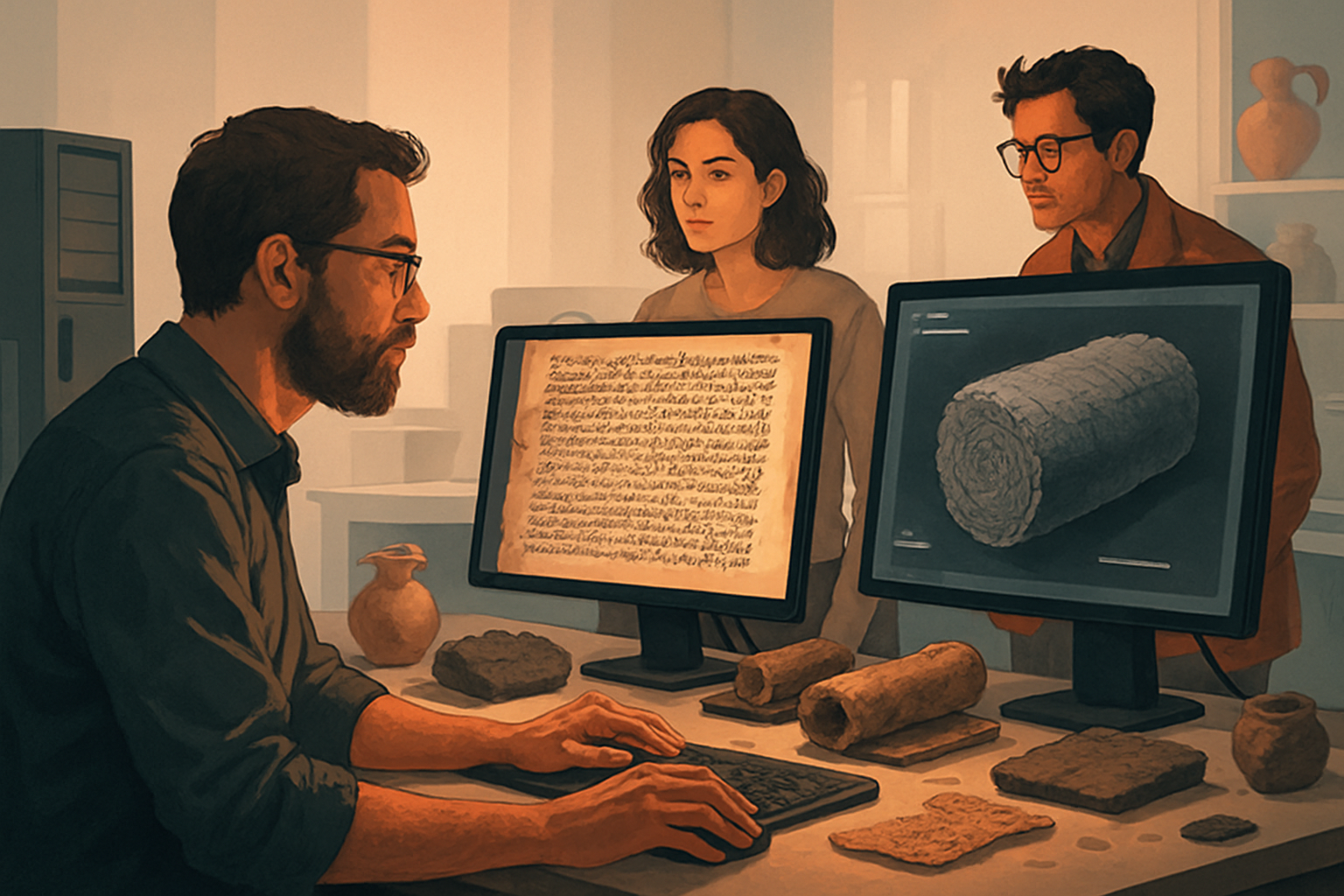
In 2023, an artificial intelligence successfully read a word from a still-rolled Herculaneum papyrus for the first time. Since then, teams from the Vesuvius Challenge have deciphered a complete scroll, extracted dozens of new columns from two others, and received European funding of €11.5 million to continue the project.
The method developed by Brent Seales, a computer scientist at the University of Kentucky, utilizes X-ray tomography and artificial intelligence. The model maps the internal layers of the compressed scroll and reconstructs the flat surface without physical contact.
In 2023, Brent Seales co-founded the Vesuvius Challenge, an international competition with a prize of one million dollars, alongside investors Nat Friedman and Daniel Gross, after publishing his initial results on unrolled scrolls. Two years later, he returned to work on still-closed scrolls.
AI Deciphers a Complete Scroll for the First Time
The scroll, designated PHerc. 1667, originally measured 4.8 cm in diameter. Previous attempts, involving layers scraped off in the 19th century and fragments torn away in the 1960s and 1980s, reduced it to less than 2 cm and destroyed more than half of the original text. Nevertheless, a segment of approximately 1.40 meters in length remains, containing twenty columns of ancient Greek accessible for the first time in nearly two millennia.
Federica Nicolardi, lead papyrologist of the Vesuvius Challenge and associate professor at the University of Naples Federico II, dates the writing to the 2nd or 3rd century BCE, making it one of the oldest scrolls in the library. The title and author have been lost with the destroyed layers, but specialists suspect that the text originates from Chrysippus, the founding philosopher of Stoicism, whose writings were previously known only through citations by other authors. According to Thomas Coward, a classicist at the University of Bristol, “Having access to a source text rather than citations and summaries, which can be altered or interpreted by other authors, is very important.”
For the broader historical context, researchers identified in the scroll PHerc. 139 a previously unknown title, Philodemus, On the Gods, Book 8, revealing that a work known to historians actually contained multiple books. A third scroll, PHerc. 172, provided over 70 additional columns from the same Philodemus, drawn from his treatise On Vices. Philodemus was an Epicurean philosopher active in the 1st century BCE.
A European Consortium Funds Systematic Reading of the 1,800 Scrolls
A year ago, Brent Seales, Vincent Christlein, head of the computer vision group at Friedrich-Alexander University Erlangen-Nuremberg, and Federica Nicolardi received a Synergy Grant from the European Research Council. Funded with €11.5 million, it supports the project “UnLost: Uncovering Lost Knowledge from the Ancient Library of Herculaneum.” The consortium brings together papyrologists and computer scientists to apply the AI process to the entire collection.
“The technology really feels like magic, but it’s not,” Brent Seales stated at a press conference. “It’s a remarkable way to achieve a higher goal: the restoration of lost voices from the ancient world.” The Vesuvius Challenge is now offering a prize of one million euros to the first person or team capable of deciphering an additional complete scroll by June 2027. The methods used will need to be shared publicly.
Brief IA — L'actualité IA en français
L'essentiel de l'actualité de l'intelligence artificielle, décrypté et expliqué chaque jour.