AI Replaces Colleagues: A Workplace Disruption
Le brief IA que les pros lisent chaque soir
Les 7 actus IA du jour, décryptées en 5 min. Gratuit.
Inclus dès l'inscription : notre sélection des meilleurs guides & comparatifs IA.
Choisis ton rythme
Gratuit · Pas de spam · Désabonnement en 1 clic
The Rise of AI in Professional Interactions
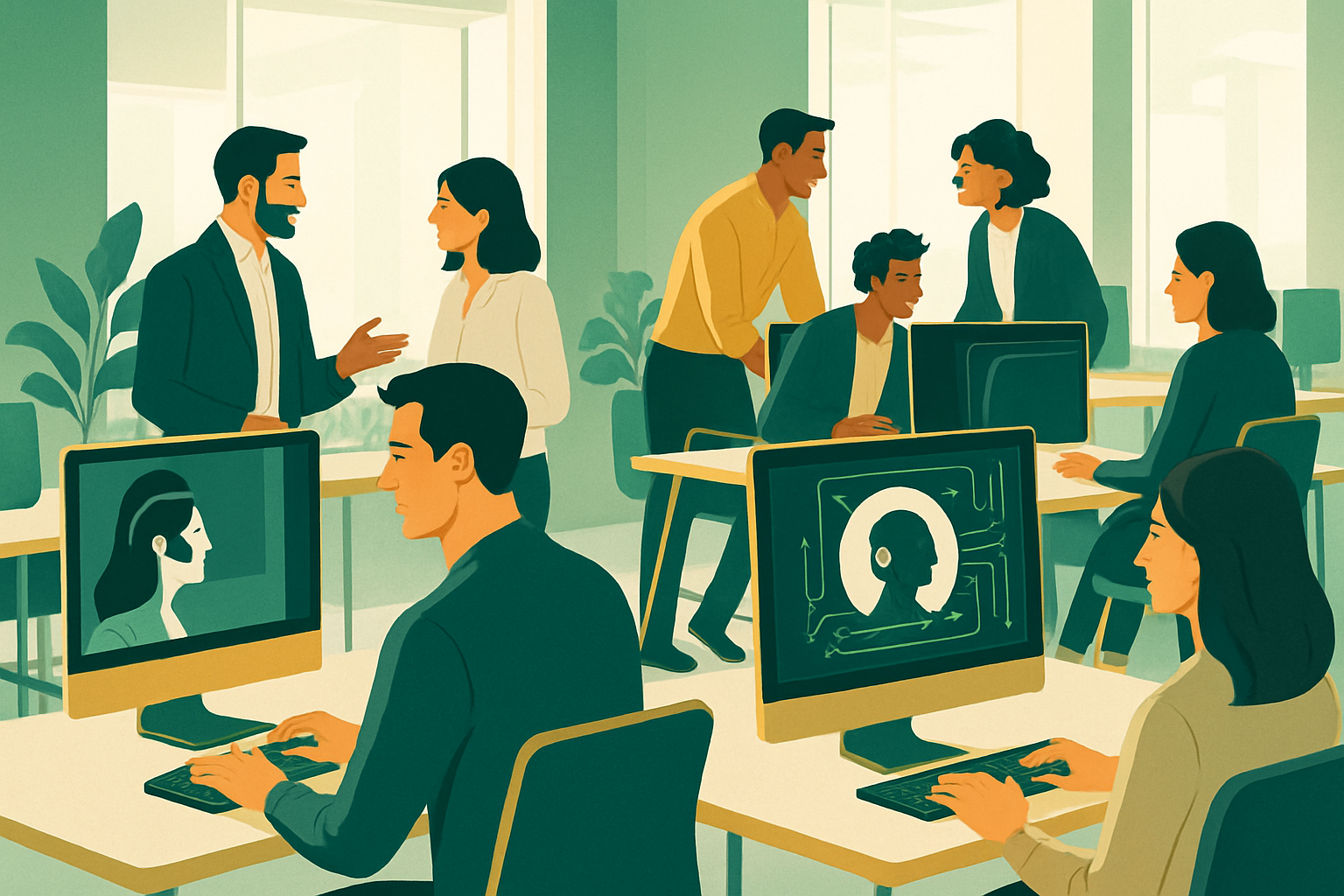
A series of recent studies highlights a growing trend in the workplace: employees are increasingly turning to artificial intelligence for answers to their questions, rather than seeking help from their colleagues. This evolution, while facilitating certain tasks, could have negative repercussions on work dynamics and interpersonal relationships within teams.
Key Findings
- AI is becoming a substitute for human interactions in the professional environment.
- Researchers are concerned about the impact of this trend on employee loneliness.
- Paradoxically, AI could also be used to foster exchanges between colleagues.
Maria Goyal, a 25-year-old professional working at a marketing agency in Colorado, perfectly illustrates this phenomenon. When faced with a question, her colleagues often encourage her to "ask Claude," an artificial intelligence. Over the course of a year, she has observed a growing integration of AI into her professional life, which has made her feel more isolated and less inclined to seek the opinions of her more experienced colleagues. "It prevents me from deepening my knowledge because I just let a robot do the work for me," she shared during a phone interview with ZDNET.
Goyal is not alone in this situation. Several recent studies indicate that AI is profoundly changing the way interactions occur at work, often replacing daily exchanges between colleagues.
Key Data
- A survey conducted in July by MyIQ, a cognitive assessment platform, revealed that about 75% of AI users prefer to ask their questions to chatbots rather than their colleagues.
- In May, a study by Workday showed that Generation Z is 12 times more likely than Generation X to feel "completely disconnected" from their colleagues.
- In July, Adobe for Business reported that 68% of workers felt more comfortable asking an obvious question to a chatbot rather than to a colleague.
Adam Mendler, a leadership expert and instructor at the University of California, Los Angeles, emphasized: "AI offers a great opportunity, but it also poses a challenge. We must absolutely ensure that we maintain human interactions, and as leaders, we need to create opportunities to foster these connections."
Workplace Isolation
Survey data emerges at a time when feelings of loneliness have never been higher among Americans. According to estimates from the CDC, about one in three adults feels isolated, a trend exacerbated by factors such as social isolation. In the professional context, this figure is one in five employees globally. The rise of remote work following the COVID-19 pandemic has not helped improve the situation.
While it is still too early to determine whether this evolution in relationships between colleagues and superiors will lead to a more isolated, less supported, or less productive workforce, researchers warn that it is crucial to act to prevent such effects.
Missed Opportunities
Goyal's experience highlights one of the major concerns of experts regarding the decrease in daily interactions with colleagues: the missed opportunities to build trust and acquire essential knowledge for the smooth functioning of teams. Constance Noonan Hadley, founder and chief scientist at the Institute for the Future of Work, has studied topics such as the future of work, employee loneliness, and team dynamics for over two decades. She emphasizes that asking a colleague a question, receiving a friendly and helpful answer, and potentially being able to reciprocate is of great value.
The MyIQ study also highlighted all the additional information that can be integrated into such interactions. "A question might solve an immediate problem, but it could also reveal who has expertise, how another person approaches uncertainty, and which colleagues are willing to help. AI can provide a practical answer while removing much of that social information," the report states.
Goyal, for example, worries about not having the opportunity to demonstrate her skills and learn as much from her colleagues as she could. "I think it's an underestimation of the importance of those moments, and it's hard to convince people of their value until they're gone," Hadley said.
Consequences for Professional Growth
The lack of career progression can also lead to anxiety among workers, who may feel that their expertise is fragile and easily replaceable by AI. "If more and more questions are directed to AI rather than to their more experienced colleagues, organizations may need to rethink how they support learning at work," said Sophie de Villiers, public relations manager for MyIQ.
For team leaders, the decrease in the flow of questions from their subordinates can also have an isolating effect, while limiting their understanding of their own teams. Mendler added: "Anyone in a senior position focuses on building teams, recruiting, retaining, and developing talent. The less you interact with talent, the harder it will be to recruit, retain, and develop that talent."
Costs of Workplace Loneliness
It is important to note that researchers have found that lonely employees can actually cost companies money. Workplace loneliness has been linked to absenteeism, higher turnover rates, increased healthcare costs, and lower productivity. Gallup estimates that low employee engagement (a measure of workers' psychological attachment to their work, their team, and their employer) cost the global economy about $10 trillion in lost productivity last year.
Benefits of AI
However, survey data also shows advantages to asking questions to a chatbot rather than a colleague. The MyIQ study revealed that 71% of respondents felt more autonomous, and 62% felt more comfortable making decisions on their own compared to the previous year. Up to 86% of those surveyed by Workday felt more productive. Meanwhile, Adobe found that the impact of agentic AI meant that remote workers were 35% more likely than on-site workers to experience a decrease in impostor syndrome and mental load.
Balancing AI and Human Interactions
Allison Clair, founder and president of the communication firm AJC Communications & Advisory, acknowledges that turning to AI sometimes makes her feel more isolated, but it also presents undeniable benefits. Clair is not always in the same time zone as her clients, and her team often works asynchronously. "I often turn to AI to say, 'Hey, help me clarify this,'" she said, noting that she feels more productive by reducing some of the superfluous discussions that might arise at work.
However, Clair is aware that not all questions should be entrusted to AI, and she makes sure to schedule an in-person visit with a client at least once a week and to set aside time for more open discussions with her team. "I've definitely noticed that I need to establish those moments to talk with the people who work for me and get that face-to-face time, and ask how their week went and how their weekend was," she added.
Preserving Human Connections
In a recent article for the Harvard Business Review, Hadley and her co-author Sarah L. Wright discussed ways companies can ensure that AI does not degrade workplace connections, including monitoring the social impact of adoption, creating guidelines on when AI can or should replace human interaction, designing AI to actually encourage human interactions (for example, an AI assistant could direct an employee to a human before answering a question), or using AI to support relationship-building activities, such as planning events like a monthly team outing.
For Goyal, she envisions more opportunities for open dialogue at work, with AI functioning more as a complement to that collaboration. As Clair said: "Work is also about relationships and people, and I don't think it's possible to replace the everyday aspect of that."
Brief IA — L'actualité IA en français
L'essentiel de l'actualité de l'intelligence artificielle, décrypté et expliqué chaque jour.