AI Transforms Industry: Towards Tangible ROI
Le brief IA que les pros lisent chaque soir
Les 7 actus IA du jour, décryptées en 5 min. Gratuit.
Inclus dès l'inscription : notre sélection des meilleurs guides & comparatifs IA.
Choisis ton rythme
Gratuit · Pas de spam · Désabonnement en 1 clic
Industrial AI: A Turning Point Towards Value Creation
In the industrial sector, artificial intelligence is no longer just an option among others, but a strategic necessity. At the Tech for Industry event, the crucial question of prioritizing AI investments was highlighted. Companies must now identify AI applications that deliver real added value. Four areas stand out as essential for boosting productivity, enhancing resilience, and improving competitiveness.
The manufacturing industry is at a crossroads where expectations for AI are as high as the questions it raises. In a context of volatile markets, geopolitical changes, and economic pressures, the issue is no longer whether to invest in AI, but rather how and where these investments can generate value quickly and tangibly.
Challenges and Opportunities for the Manufacturing Sector
Today, the manufacturing sector faces major challenges. Supply chains are constantly disrupted, leading to rising costs. At the same time, automation, advanced analytics, and AI technologies have reached sufficient maturity to be deployed at scale. The challenge for manufacturers is to identify the processes where these technologies can have the most impact on costs, productivity, and resilience. Four areas prove particularly promising:
- Production Planning
- Equipment Maintenance
- Operations Automation
- Quality Control
Optimizing Planning to Anticipate Uncertainties
Production planning is often the first lever for improvement. In many factories, production processes still rely on static rules and manual adjustments. When an unforeseen event occurs, such as a delivery delay or a breakdown, teams must react urgently. AI-powered planning systems transform this dynamic. By integrating real-time constraints related to equipment, production lines, and human resources, they allow for automatic adjustment of priorities and optimization of flows. With digital twins, it is also possible to simulate various scenarios before implementation. Some companies have managed to reduce their waste by nearly 10% per ton of production while improving equipment efficiency.
From Reactive Maintenance to Predictive Maintenance
Maintenance is another key area where AI can make a significant difference. Many manufacturers still operate on a reactive basis, where interventions are triggered after a breakdown or according to fixed schedules that do not reflect the actual state of the equipment. By combining AI with data from industrial sensors and the Internet of Things, it becomes possible to detect early signs of failure and intervene at the optimal moment. This predictive maintenance approach improves asset availability, reduces unplanned downtime, and optimizes maintenance resources.
Intelligent Automation: A Lever for Productivity
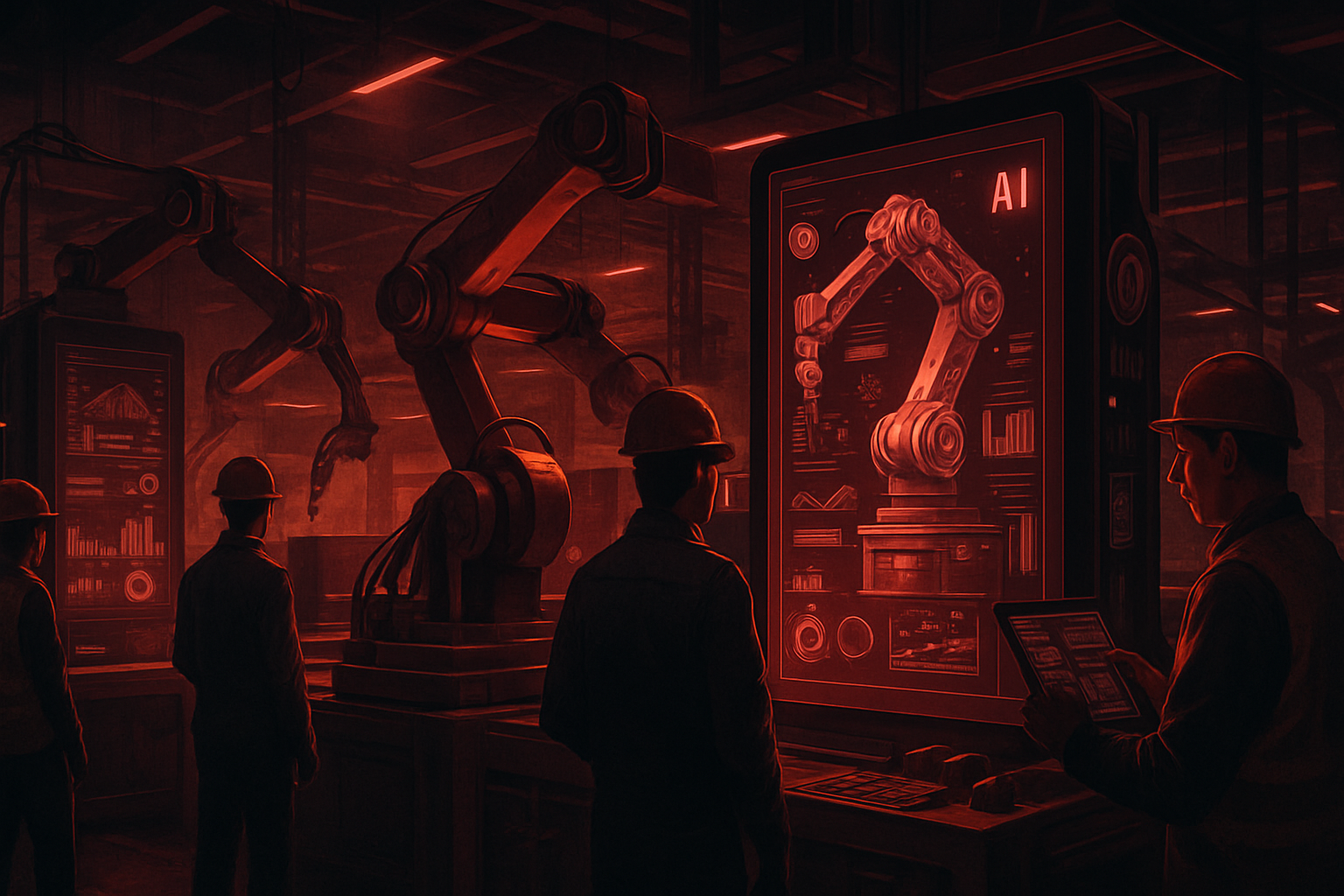
Advanced automation is also a powerful driver of performance. Collaborative robots, machine vision systems, and autonomous solutions no longer just replace repetitive tasks. They enable the creation of more flexible production environments that can quickly adapt to changing demand. The observed gains are significant, with productivity increases of up to 20% in certain industrial contexts.
Predictive Quality Control to Avoid Costs
Quality control also benefits from advancements in AI. Thanks to computer vision and machine learning algorithms, defects can be detected with unmatched precision, often before they affect the final product. Beyond reducing waste and costs associated with poor quality, this approach enhances customer satisfaction and contributes to companies' sustainability goals.
Towards Total System Integration
True transformation occurs when these various use cases are integrated within a connected operational system. By combining industrial data, cloud platforms, AI, and digital twins, manufacturers can build smart value chains capable of continuously adapting to real conditions.
Tangible Results for Manufacturers
The results observed on the ground confirm this dynamic. For a major global manufacturer of industrial equipment, implementing an AI-driven platform improved visibility into operations, synchronized production processes, and optimized decisions throughout the value chain. The outcome: several tens of millions of dollars in annual savings, a significant increase in productivity, and a substantial reduction in production lead times.
AI has the potential to solve concrete operational problems and generate measurable benefits. Manufacturers who succeed will be those who prioritize a pragmatic, targeted, and results-oriented approach. Because in industry, as elsewhere, performance does not come from multiplying AI use cases, but from their ability to sustainably transform operations.
The Future of AI in Industry
The next step is already underway: physical AI and AI agents. Intelligence will no longer just analyze our data; it will act and physically coordinate at the heart of our factories. Successfully integrating these new technologies on the ground will be crucial for multiplying our efficiency. The stakes are clear: by mastering this shift, we will ensure the competitiveness of our production lines and, by extension, our industrial sovereignty.
Brief IA — L'actualité IA en français
L'essentiel de l'actualité de l'intelligence artificielle, décrypté et expliqué chaque jour.