AI Engineering: A Frenzied Race Towards the Future of Graphs
The Rapid Evolution of AI Engineering
In 2026, a developer posed a question that quickly captivated millions: "Are we still talking about loops, or have we already moved on to graphs?" This concise inquiry generated massive interest, sparking debates over various definitions and even inspiring a fictional study that circulated widely. This question illustrates the industry's tendency to frequently rename concepts, a phenomenon observed since 2022 with an almost quarterly regularity.
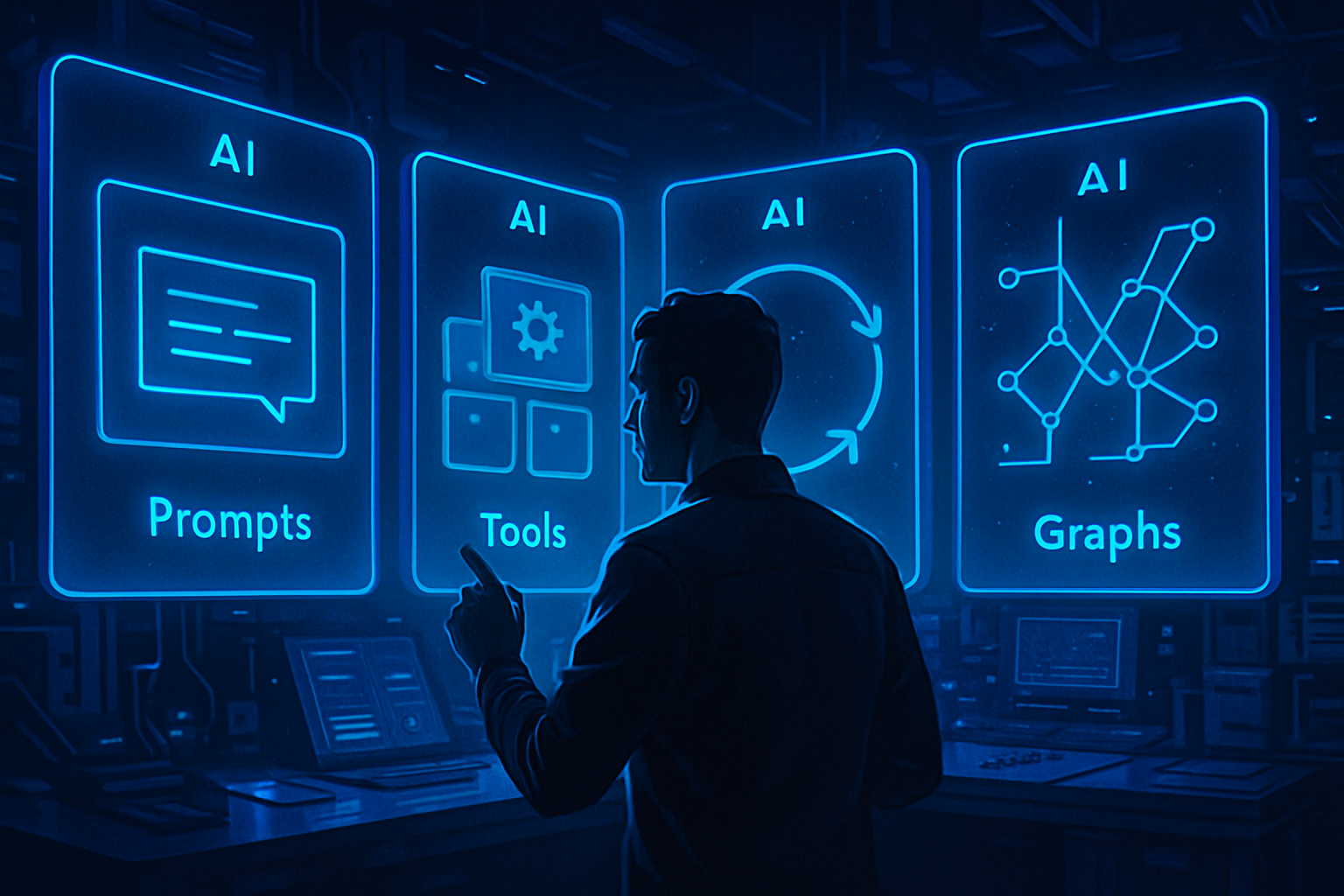
AI engineering was initially known as prompt engineering. It then evolved into terms such as context engineering, tool engineering, loops, and more recently, graphs. Between each transition, a phase of using tools and agents was observed. In four years, six names have been used to describe what, in essence, remains a constant task: ensuring that a machine understands and executes our intentions.
This guide explores these six names, allowing newcomers to follow each step. The underlying question is whether these disciplines are truly distinct or if they represent a single idea evolving from a simple phrase to a complex system. The central idea is that, despite the name changes, the goal remains the same: to expand the unit of work from designing a phrase to engineering a network of interconnected programs, or graphs. At each stage, the complexity of the work shifts from the model itself to the structure surrounding it.
The Six Phases of Evolution
Prompt Engineering
Prompt engineering involves formulating precise instructions for a model so that it executes the desired task. A prompt is essentially the text submitted to the model, and at this stage, it represents the entirety of the interaction: the input and output words. In 2022, with the arrival of ChatGPT, the public discovered large language models (LLMs), programs trained on vast amounts of text to predict the continuation of a sequence. Once trained, these models cannot access new information or interact directly with the outside world.
The formulation of the text became crucial, as it determines the quality of the model's responses. A famous example showed that by adding a simple instruction to reason step by step, the models' performance on arithmetic and logic problems improved significantly. This technique, known as chain of thought prompting, was developed by Google in 2022. It demonstrated that the model, while static, could produce better responses simply by changing how questions were posed to it.
Le brief IA que les pros lisent chaque soir
Les 7 actus IA du jour, décryptées en 5 min. Gratuit.
Inclus dès l'inscription : notre sélection des meilleurs guides & comparatifs IA.
Choisissez votre rythme
Gratuit · Pas de spam · Désabonnement en 1 clic
Techniques such as few-shot prompting, which involves providing a few examples before the main question, or assigning a role to guide the model's tone, emerged. These methods do not affect the model itself but modify how requests are formulated. This discovery revealed that the bottleneck was not just the model, but also the interface with it. This led to the following question: if the formulation of the request can unlock so many capabilities, what else could be improved around this request?
Use of Tools and Agents
The next phase in the evolution of AI engineering was not marked by a specific name or launch date, which is why it is often overlooked in timelines. However, it represents a major shift: the moment when the model began to act beyond simple conversation. In 2023, two concepts emerged simultaneously. The first is tool use, or function calling, which allows the model to invoke external capabilities such as web searches, calculators, or database queries.
The second concept is that of the agent, a model integrated into a loop where it can reason, act via a tool, observe the results, and then reason again. This framework, known as ReAct (reason and act), was introduced by researchers in 2022 and gained traction in 2023. It is an iterative process where the model writes a thought, chooses an action, observes the result, and continues until the task is accomplished.
Context and Loop Engineering
The evolution continued with context engineering, where the focus is on understanding and managing the contextual information surrounding a task. This phase improved the relevance of responses by taking into account surrounding data and previous interactions. Loop engineering, on the other hand, introduced mechanisms allowing the model to reevaluate and adjust its actions based on the results obtained, thus creating a more dynamic and adaptive system.
Graph Engineering
Finally, graph engineering represents the current phase, where models are designed to interact within complex networks of interconnected programs. This approach enables smooth communication between different systems, facilitating more sophisticated and integrated tasks. Graphs provide a structure that allows for efficient management of interactions and data flows between the various components of an AI system.
In conclusion, although the names and approaches have evolved, the fundamental goal of AI engineering remains constant: to enhance the interaction between humans and machines to accomplish tasks more effectively and intuitively.
Brief IA — L'actualité IA en français
L'essentiel de l'actualité de l'intelligence artificielle, décrypté et expliqué chaque jour.