The EU Launches Its Open-Source AI, Challenging Global Giants
Le brief IA que les pros lisent chaque soir
Les 7 actus IA du jour, décryptées en 5 min. Gratuit.
Inclus dès l'inscription : notre sélection des meilleurs guides & comparatifs IA.
Choisis ton rythme
Gratuit · Pas de spam · Désabonnement en 1 clic
The EU Launches Its Open-Source AI, Challenging Global Giants
For months, Europe has watched the United States and China develop models that will shape the digital economy of the century. On June 19, the European Commission decided to take action.
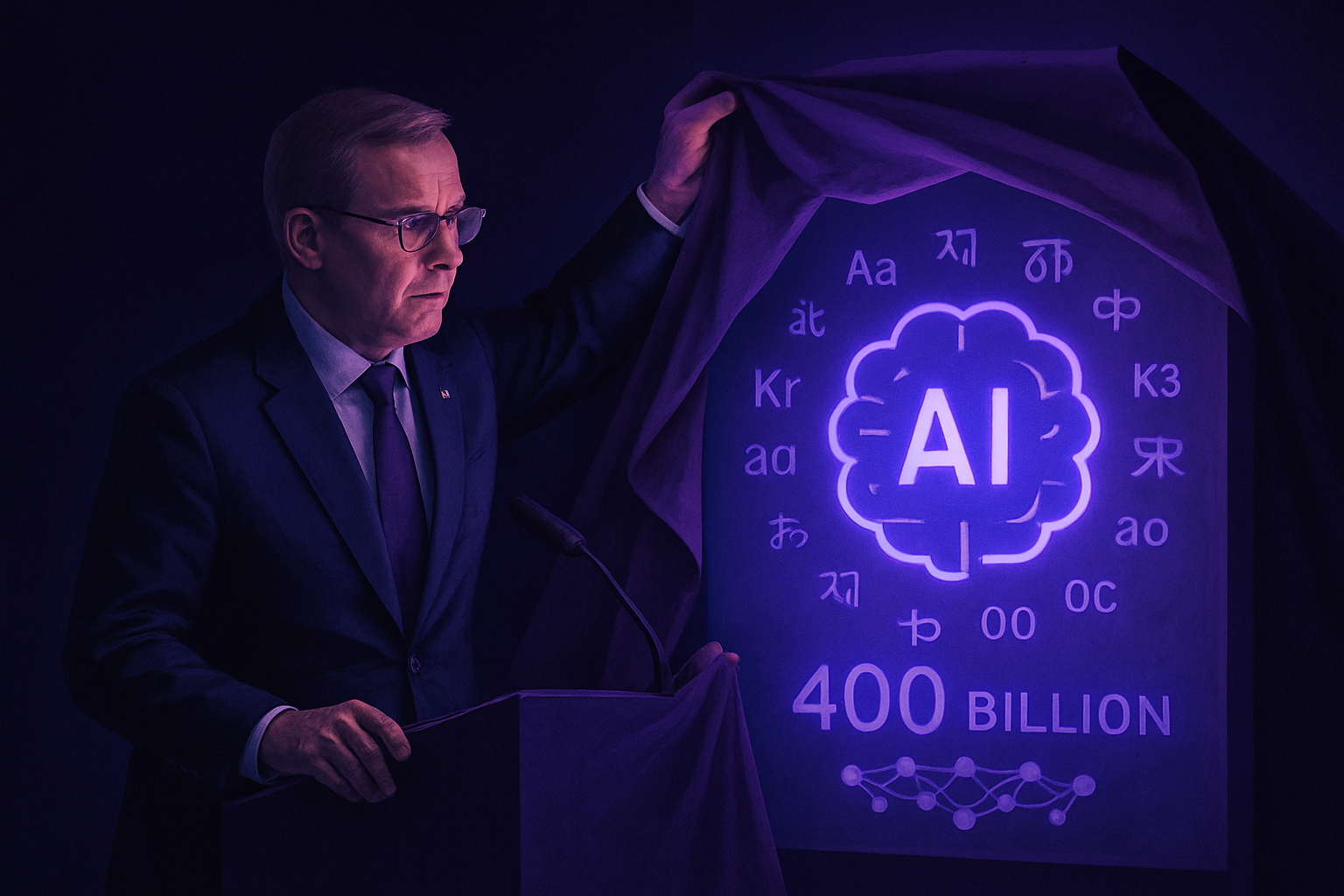
It is the EUROPA consortium, led by Domyn, that has won the challenge. On that day, Brussels announced the winner of its Frontier AI Grand Challenge: the EUROPA consortium, headed by Domyn, an Italian startup previously known as iGenius. The mission assigned is both precise and ambitious: to build a frontier model in open source, capable of exceeding 400 billion parameters, covering the 24 official languages of the Union, and trained on European supercomputers. The goal is to ensure uninterrupted access.
Why Domyn and Not Mistral
The question deserves to be asked. Mistral, the French champion of sovereign AI, has built much of its identity on this type of positioning. It has signed partnerships with the Ministry of Armed Forces, the Caisse des Dépôts, the European Patent Office, and many sensitive institutions on the continent. Yet, it is Domyn that won the challenge launched in February 2026, four months before the announcement of the results, a timeline that seems almost magical for a European procedure.
Some contextual elements help to understand this decision. Domyn is not unknown to companies in the financial sector and European administrations: founded in 2016 by Uljan Sharka, an entrepreneur of Albanian origin, the Milan-based company specialized from the outset in models deployed "on-site," on the client's infrastructure, without relying on third-party clouds. This is exactly the narrative that Brussels wanted to hear. Furthermore, Domyn has formed a strong consortium that includes the German Fraunhofer-Gesellschaft, the largest applied research network in Europe, and can rely on a Blackwell cluster of 5,760 chips specific to its structure, in addition to the EuroHPC resources allocated by the Commission.
These EuroHPC resources are crucial: the winner is allocated up to 2.5% of the total computing capacity of the EuroHPC network for one year, on supercomputers optimized for AI. For a continent whose main handicap in the AI race has always been computing infrastructure rather than researchers, this is a significant prize to win. Henna Virkkunen, Executive Vice President of the Commission responsible for technological sovereignty, expressed the unambiguous ambition: "Europe can be a leader in advanced AI on its own terms."
A Decision Accelerated by Panic Over American Restrictions
The challenge was launched in February 2026, shortly after the first signals of tightening American export controls on AI models. Italy and the Czech Republic restricted remote access to DeepSeek models. Anthropic's Mythos 5 and Fable 5 models were temporarily taken offline for foreign nationals. Additionally, GPT-5.6 has just been rolled out in phases at the request of the White House.
In this context, the rhetoric of sovereignty takes on a very concrete form: if your courts, hospitals, and ministries use models hosted elsewhere and accessible under conditions set by a foreign government, your real margin for maneuver is limited. EUROPA directly addresses this structural vulnerability, and its coverage of the 24 official languages is essential for the model to be usable by administrations, from Maltese to Lithuanian, without the working language affecting the quality of the available AI.
What Remains to Be Proven
Domyn's CEO, Uljan Sharka, told Reuters that the model would be delivered in open source in a year. This is the only reasonable timeline to announce when the European Commission entrusts you with the flagship AI project of the continent, and it would be fair to consider it an ambition rather than a contractually guaranteed schedule. Training a model of over 400 billion parameters, covering 24 languages, in one year, on shared infrastructure, through a consortium that must coordinate institutions from several countries: this is a bet that requires vigilance, not enthusiasm. The very definition of what "open source" means for such a model (sharing weights? training data? under what license?) has not yet been publicly established.
What the Commission has done, however, is symbolically important and structurally significant: for the first time, it is directly funding the model layer, and not just regulation.
Brief IA — L'actualité IA en français
L'essentiel de l'actualité de l'intelligence artificielle, décrypté et expliqué chaque jour.