The DOJ Defends Fair Use for AI Training
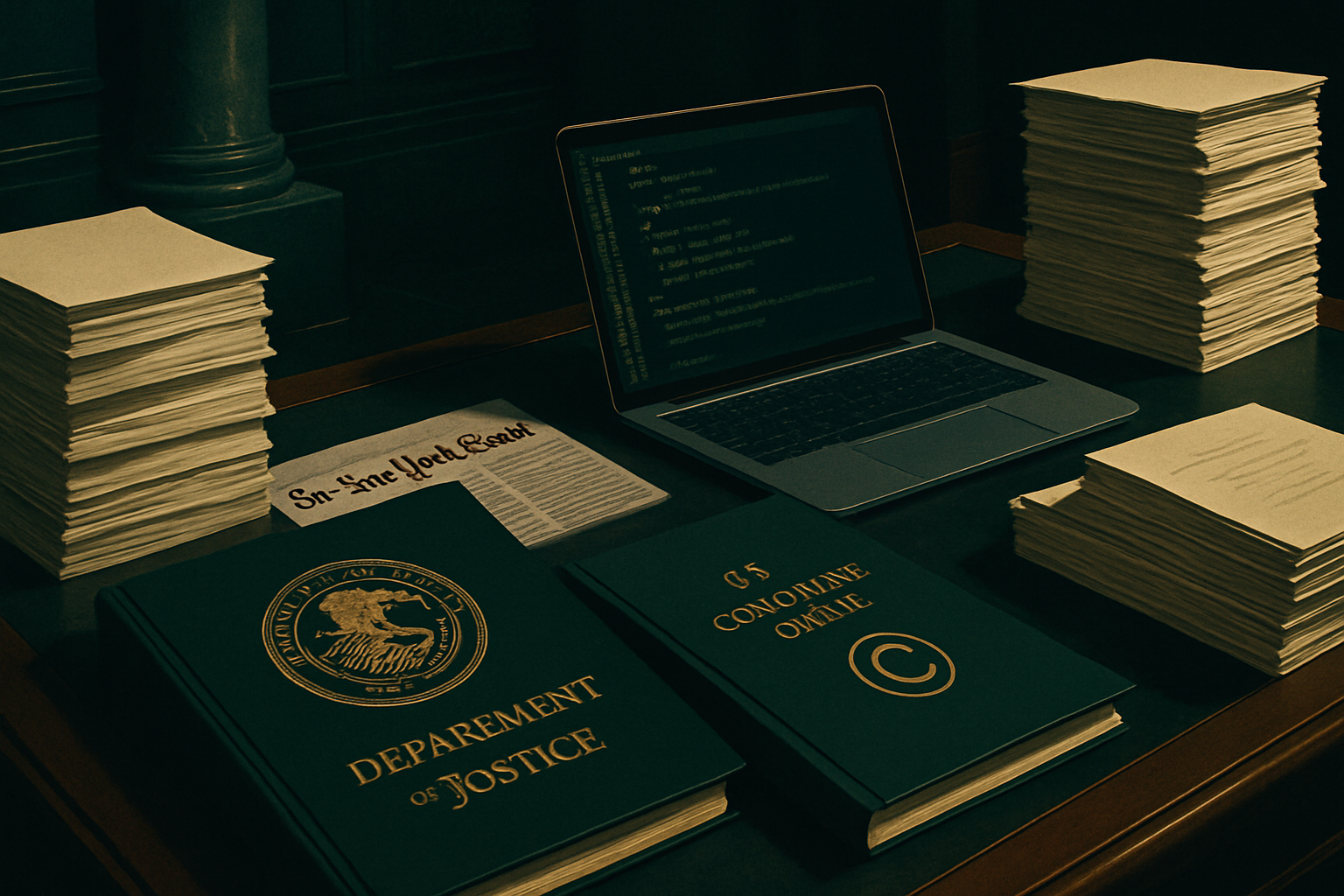
In the dispute between The New York Times and OpenAI and Microsoft, the U.S. Department of Justice argues that training models on protected works may fall under fair use. This position contrasts with that of the Copyright Office, which advocates for a more restrictive approach and places case-by-case analysis at the center of the debate.
The DOJ Refutes the Authority of the Copyright Office Report
The Department of Justice asserts that the evaluation written by former Register Shira Perlmutter has no binding legal authority and that it ignored the case law requiring a case-by-case assessment of uses and market harms. In its filing, it emphasizes that the fair use analysis depends on the specific facts of each case and considers any blanket liability that would render AI model training prohibited without a license to be problematic and legally incorrect. Conversely, the Copyright Office argues in a report that AI operates with perfect copies and at a speed and scale that surpass human creation, and that commercial applications competing with existing works exceed the scope of fair use. Shira Perlmutter contests her dismissal, which occurred shortly after the publication of her report, according to a DOJ memo. Democrat Joe Morelle claims that this termination followed her refusal to legitimize training on protected works, a position he attributes to a Donald Trump ally, Elon Musk.
Fair Use and Training: The Line Defended by Justice
The Department of Justice explains that the copying done during training does not equate to the output provided by the model and does not, in itself, constitute a copyright violation. It warns against harm theories that conflate these two stages and asserts that the texts copied for learning are not made public, while the outputs often lack substantial similarity to the originals. The department also argues for the creative and social value of large language models and contends that imposing liability on training would stifle creativity protected by copyright. It notes that humans produce original works based on LLMs.
Le brief IA que les pros lisent chaque soir
Les 7 actus IA du jour, décryptées en 5 min. Gratuit.
Inclus dès l'inscription : notre sélection des meilleurs guides & comparatifs IA.
Choisissez votre rythme
Gratuit · Pas de spam · Désabonnement en 1 clic
Analogies and Case Law Invoked by Justice
To illustrate its reasoning, the Justice Department references Joan Didion, who, as a teenager, copied texts from Hemingway to understand their mechanics. Drawing on the logic of a Kadrey ruling, it argues that considering learning and subsequent publication as a single use would lead to liabilities that would not be justified. The Justice Department also mentions a prior decision that deemed it inconceivable to impose a payment on the grounds that an author uses a book to create a new work in an unprecedented way.
The Framework of the Dispute: The New York Times' Complaint
The New York Times filed a lawsuit against OpenAI and Microsoft in late 2023 in a federal court in Manhattan, accusing them of using millions of articles without permission to train models like GPT-4 and to develop competing products as sources of information. The newspaper is seeking billions of dollars in damages and the destruction of models trained on its content. The case has evolved since and is widely seen as a test of how jurisdictions will approach the relationship between copyright and AI training.
The Scale in Debate and the Use of LLMs in Newsrooms
The Copyright Office has highlighted the scale gap between the learning done by an isolated author and the exploitation by multi-billion dollar companies for competing consumer products. It is also mentioned that writers at The New York Times would use LLMs to draft and edit articles, although a cited source essentially supports the opposing thesis.
Brief IA — L'actualité IA en français
L'essentiel de l'actualité de l'intelligence artificielle, décrypté et expliqué chaque jour.