AI agents arbitrate between linear and branching reasoning
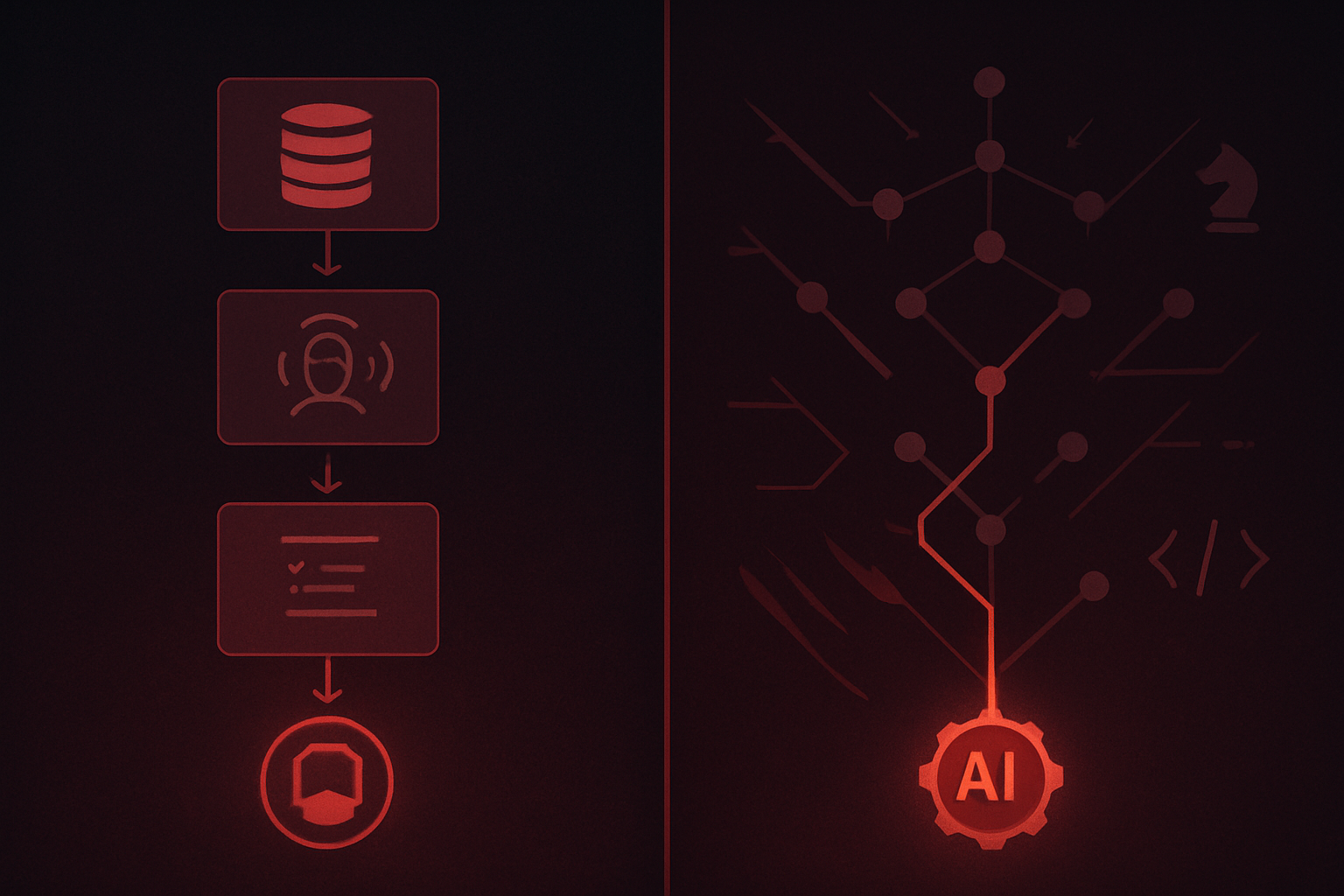
Two approaches structure the reasoning of models: a linear progression that is often sufficient, and a more costly branched exploration that can correct errors. Their trade-off directly influences latency, budget, and agent decisions.
The Cost of Reasoning Influences Latency and Capacity
The Tree of Thoughts incurs significantly higher expenses than the Chain of Thought. While the latter relies on a single prompt and a single response, the former multiplies calls to the model for the same problem, generating branches, evaluating them, and pursuing the most promising ones. For difficult cases, this can lead to hundreds of calls. This additional cost grows with the complexity of the tree, in terms of time, money, and tokens. In concrete systems, these discrepancies translate into effects on latency, budget, and task volume, with the Tree of Thoughts potentially being several orders of magnitude more expensive than the Chain of Thought.
In an Agent, Reasoning Governs Irreversible Actions
In an agent, the reasoning framework not only determines a response but also a sequence of actions. The agent selects tools, their order, and parameters, interprets intermediate results, and adjusts its behavior, with effects that cannot be undone. The Chain of Thought serves as the default layer for most tasks, providing a structured and transparent process without notable overhead for deciding, for example, which database to query, understanding a user's intent, or performing a calculation before acting. It is fast, inexpensive, and covers the majority of decisions. The Tree of Thoughts is reserved for situations where multiple approaches must be compared before committing, when the cost of an error is high, or when the problem space is genuinely complex. In practice, well-designed agent systems combine both.
Three Concrete Criteria to Decide Between the Two
The first criterion is the structure of the path to the solution. When it is well-defined and follows a sequential progression, the Chain of Thought proves sufficient in almost all cases. In situations where it is necessary to consider and weigh different strategies, resorting to the Tree of Thoughts is justified despite the additional cost. The second criterion concerns the impact of an error made early in the process: an inaccuracy at the beginning of a summary is unlikely to lead to serious consequences, whereas in a planning context where early choices influence subsequent ones, an uncorrected mistake can be very detrimental, highlighting the value of the self-correcting capability inherent in the Tree of Thoughts. Finally, resource constraints weigh heavily, with the Tree of Thoughts potentially being several orders of magnitude more expensive than the Chain of Thought.
Le brief IA que les pros lisent chaque soir
Les 7 actus IA du jour, décryptées en 5 min. Gratuit.
Inclus dès l'inscription : notre sélection des meilleurs guides & comparatifs IA.
Choisissez votre rythme
Gratuit · Pas de spam · Désabonnement en 1 clic
How Each Method Reasons and What It Changes
Both approaches insert intermediate reasoning steps before the answer, improving performance in mathematics, logic, and multi-step planning. The Chain of Thought, triggered by a simple prompt like "Let's think step by step," unfolds a linear, transparent, and verifiable reasoning process but is susceptible to error propagation without the possibility of backtracking. It yields good results for standard exercises, deductions, and summaries, with its limitations appearing when the problem is ambiguous, offers multiple plausible paths, or when the cost of an initial error is high. The Tree of Thoughts, on the other hand, makes reasoning non-linear by generating multiple continuations, evaluating them, and choosing which to explore, with the possibility of revisiting dead ends. Scoring and search mechanisms guide the exploration of a space of paths rather than a single trajectory, allowing for the abandonment of incorrect branches or revisiting initially deemed less promising paths.
Typical Examples in Engineering and Strategy
When the right approach is uncertain, the Tree of Thoughts proves suitable. An engineering agent can, for example, generate three implementation strategies, weigh their trade-offs, implement the most promising one, test it, and then revert to the second if the first fails. A strategic planning agent can explore several options, simulate their consequences, and retain the one that best meets the objective. In these situations, committing to a single path from the outset is risky, and the additional cost of branched exploration is justified by the difficulty of the problem.
Why These Techniques Exist and What They Correct
Language models, trained to predict the next token, tend to deliver a direct answer. This is often sufficient for simple queries but regularly fails on multi-step tasks, where initial errors accumulate. The Chain of Thought and the Tree of Thoughts aim to enforce reasoning before the conclusion. They share this goal but differ in their structure, costs, strengths, and modes of failure, in response to the limitations observed when the model operates without intermediate steps.
Brief IA — L'actualité IA en français
L'essentiel de l'actualité de l'intelligence artificielle, décrypté et expliqué chaque jour.