Meta: Zuckerberg Advocates for Superintelligence for All
Le brief IA que les pros lisent chaque soir
Les 7 actus IA du jour, décryptées en 5 min. Gratuit.
Inclus dès l'inscription : notre sélection des meilleurs guides & comparatifs IA.
Choisis ton rythme
Gratuit · Pas de spam · Désabonnement en 1 clic
Meta and Zuckerberg's Vision of Superintelligence
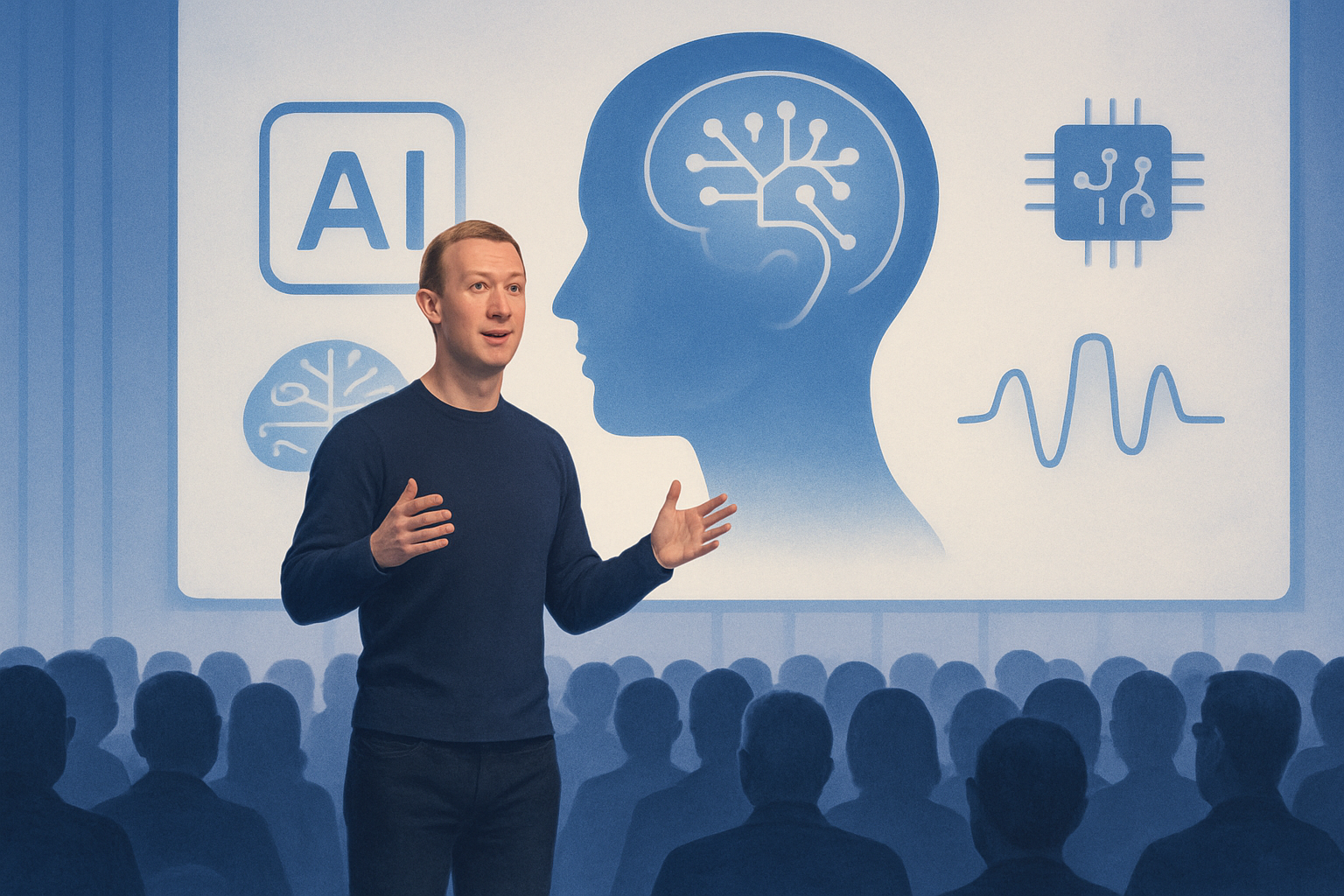
Mark Zuckerberg, the CEO of Meta, recently shared his vision of superintelligence in an opinion piece published in the Wall Street Journal. He argues that this revolutionary technology should be accessible to all individuals, not just a handful of powerful institutions.
In his article, Zuckerberg does not announce any specific product, nor does he provide technical details or launch dates. Instead, he reflects on the future of artificial intelligence, posing the crucial question of who will have access to this technology once it is fully developed.
Zuckerberg presents a clear dichotomy: either superintelligence is concentrated in the hands of a few large institutions, or it is distributed as a tool that each individual can control. He calls this latter approach "personal superintelligence" and commits Meta to work in this direction, based on three key principles: individual empowerment, invention as the main driver, and a balance of power to ensure safety.
A Critique of the AI Industry
Zuckerberg's article focuses more on critiquing the current mindset of the AI industry than on Meta's technical work. He expresses surprise at the fatalistic discourse of many AI developers, who seem convinced that AI could eliminate the majority of jobs and diminish the importance of humanity.
Zuckerberg challenges this pessimistic view and criticizes the idea that concentrating power in a few hands would be justified by the potential dangers of AI. He describes this approach as "dangerous" and emphasizes that history has shown that granting absolute power to a few enlightened individuals has never led to safe or positive outcomes.
Although Zuckerberg does not explicitly name the AI labs he criticizes, it is clear that his message aims to position Meta as a company advocating for a broad distribution of superintelligence, in contrast to a perceived trend towards centralization.
To illustrate his point, Zuckerberg proposes a thought experiment: imagine a single person having access to a superintelligent lawyer, thus gaining an unfair advantage in court, even if their position is incorrect. According to him, this would lead to a less equitable society. Conversely, if everyone had access to such a lawyer, justice would be administered more fairly and effectively.
Historical References and Economic Implications
Zuckerberg also uses historical references to support his argument. He cites famous examples of individual innovators, such as the Wright brothers, Thomas Edison, and Steve Jobs, to demonstrate that progress often stems from individual initiatives rather than established institutions.
The article also addresses the potential impact of AI on the economy. Zuckerberg warns against an imbalance that would favor automation at the expense of empowerment. He believes such a situation could have negative consequences for employment and the economy.
In contrast, he argues that the broad distribution of superintelligence could create more jobs, as it would allow more people to start businesses without requiring large capital investments. He envisions a future where the economy is dominated by small businesses rather than large corporations.
The Risks Associated with AI and Meta's Position
Zuckerberg distinguishes between different types of risks associated with AI, which is essential for understanding Meta's position. In terms of cybersecurity, he asserts that open access to powerful systems is the best way to ensure long-term security, drawing on the history of open-source software.
However, for biological risks, he calls for increased coordination between governments and other institutions for the responsible deployment of AI models. This distinction shows that while Meta is committed to broad distribution, it recognizes the need for external coordination for certain risks.
The article does not provide details on how "personal superintelligence" would be implemented, priced, or managed within Meta. It also does not address issues of data management or governance.
Zuckerberg concludes by reaffirming Meta's commitment to the principles of individual empowerment, invention, and a balance of power. While the article does not present a concrete roadmap, it clearly indicates where Zuckerberg wishes to steer the debate on the future of AI.
Brief IA — L'actualité IA en français
L'essentiel de l'actualité de l'intelligence artificielle, décrypté et expliqué chaque jour.