Microsoft and AI: Decoding the Human Brain
Le brief IA que les pros lisent chaque soir
Les 7 actus IA du jour, décryptées en 5 min. Gratuit.
Inclus dès l'inscription : notre sélection des meilleurs guides & comparatifs IA.
Choisis ton rythme
Gratuit · Pas de spam · Désabonnement en 1 clic
The Enigma of LLM Models and Their Untapped Potential
Large language models, or LLMs, have demonstrated an impressive ability to predict human brain responses to language. However, these models are essentially black boxes: they operate based on a multitude of learned parameters but do not provide clear and accessible scientific theories. This opacity poses a major challenge for those seeking to understand the underlying mechanisms of brain responses.
The Generative Causal Test: A Collaborative Innovation
To overcome this barrier, a collaboration between Microsoft Research and several American universities, including the University of California, Berkeley, the University of California, San Francisco, and Columbia University, has led to the creation of the Generative Causal Test (GCT). This test aims to transform complex brain predictions into simple and understandable verbal explanations. For example, it can reveal that certain areas of the cortex respond to concepts such as "food preparation" or "place names."
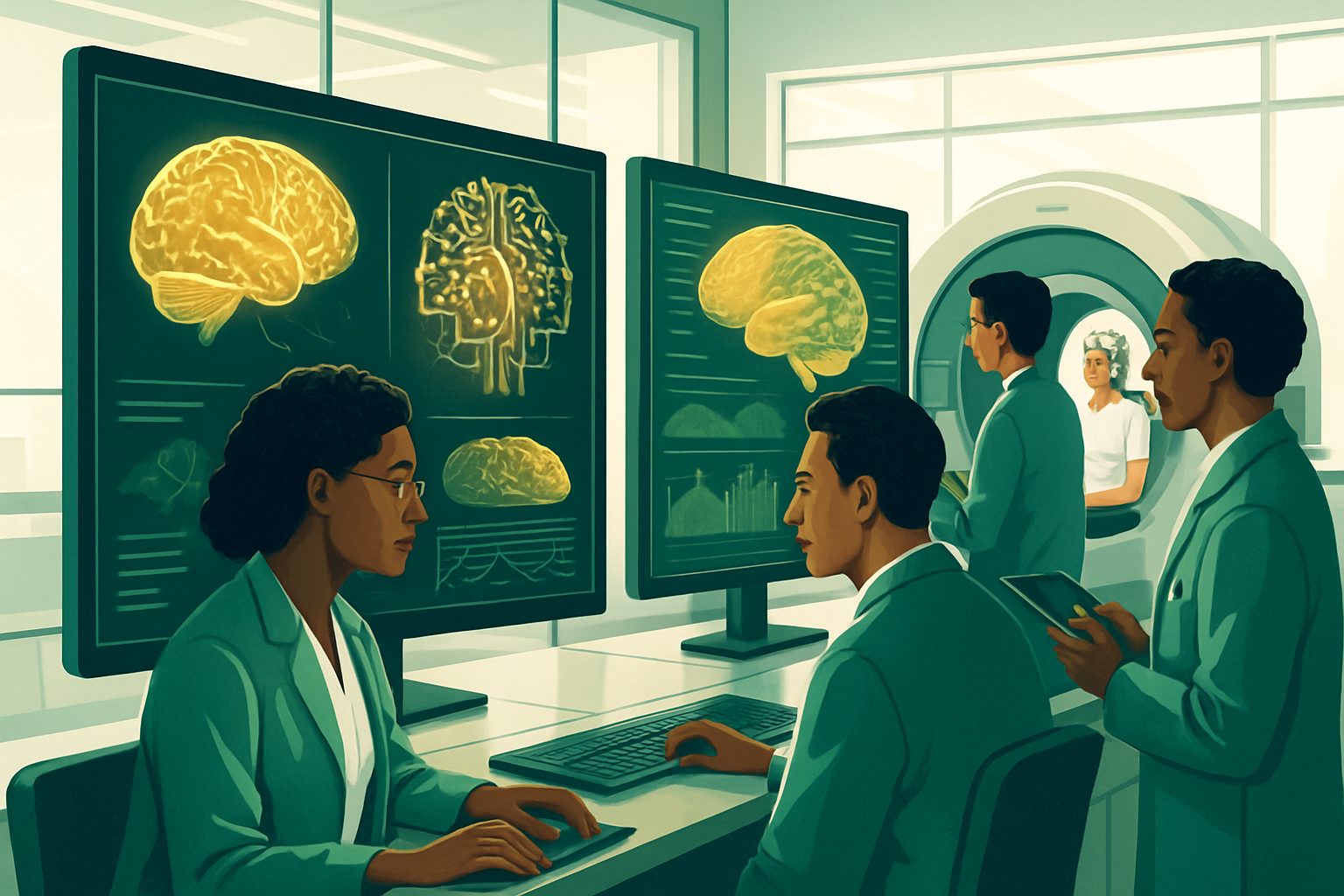
The GCT process is iterative: an LLM generates stories designed to stimulate a specific brain region. Participants, placed in a scanner, listen to these stories, and if the targeted region activates as expected, the explanation is validated.
Surprising Discoveries Through the GCT
During experiments conducted with the GCT, fascinating results emerged. Not only did the test confirm already known brain selectivities, but it also distinguished neighboring brain regions that were previously considered interchangeable. Furthermore, it highlighted small "micro-regions" in the prefrontal cortex, each specialized in concepts as varied as dialogue or time measurements.
Explainability Challenges in Neuroscience
For about a decade, LLMs have established themselves as leading tools for anticipating brain responses to language. By providing an LLM with the same story that a subject hears in an fMRI scanner, one can predict with astonishing accuracy the activity of specific areas of the cortex. However, this technical prowess comes with a downside: the inability to directly interpret these models. They consist of millions of inaccessible parameters, making it impossible to understand precisely what a brain region is reacting to.
Towards Testable Theories
In an article published in Nature Neuroscience, researchers proposed a solution to this explainability crisis. The Generative Causal Test (GCT) offers a framework for transforming predictive models into clear and testable theories. By using an LLM to write stories targeting specific brain areas, the GCT allows for experimental verification of the generated hypotheses.
The GCT process unfolds in two steps: first, it generates an explanation from a predictive model, and then it verifies that explanation. An LLM summarizes the trigger words into a concise phrase, such as "food preparation." Next, the GCT creates new stories to activate the brain region according to the explanation. If brain activity is higher for these stories than for a reference text, the explanation is validated.
Implications Beyond Neuroscience
The potential of the GCT far exceeds the realm of neuroscience. In the face of high-performing but opaque predictive models, the GCT demonstrates that it is possible to distill these models into readable and testable theories. For neuroscience, this means a faster and more hypothesis-rich method for mapping the brain cortex. This approach could also be applied to other scientific fields where predictive models surpass our current understanding.
In summary, the rise of black box models should not be seen as an obstacle to scientific understanding. With appropriate frameworks like the GCT, it is possible to reconcile prediction and explainability, allowing both to progress in concert.
Brief IA — L'actualité IA en français
L'essentiel de l'actualité de l'intelligence artificielle, décrypté et expliqué chaque jour.