Navier-Stokes: OpenAI Challenged on Authorship
Le brief IA que les pros lisent chaque soir
Les 7 actus IA du jour, décryptées en 5 min. Gratuit.
Inclus dès l'inscription : notre sélection des meilleurs guides & comparatifs IA.
Choisis ton rythme
Gratuit · Pas de spam · Désabonnement en 1 clic
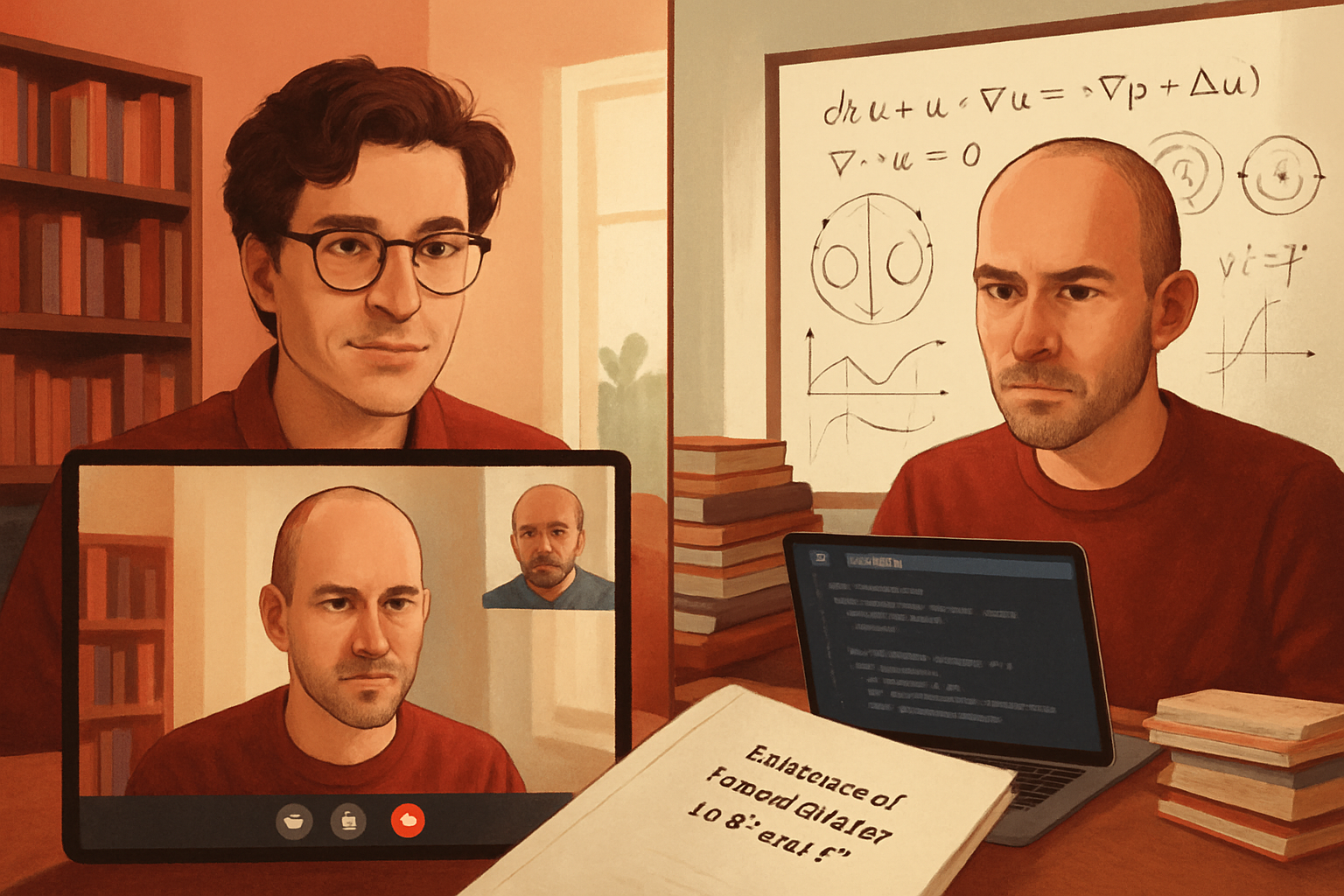
A mathematician from New York accuses OpenAI of developing a competing proof on Navier-Stokes and demanding the exclusion of a co-author employed by Anthropic. Questions remain regarding the use of Codex data, while a collective reminds of the rules for traceability of proofs produced with AI.
Default Codex Data and Traceability of Proofs in Question
According to OpenAI's documentation, the contents of individual accounts on ChatGPT and Codex are used by default to train models unless explicitly disabled, while professional accounts and API access are not used for this purpose by default. When asked, Sebastian Bubeck did not clarify whether the Codex exchanges of the research duo had assisted his team. Meanwhile, mathematicians from Cambridge, Oxford, Columbia, and ETH Zurich have signed the Leiden Declaration, an eleven-page document that raises concerns about risks to the discipline and points out a recurring flaw: AI publishers do not always mention prior human work that underpins the proofs, making independent verification difficult.
Ultimatum, Withdrawal Requested, and Tense Phone Exchanges
On September 6, Tristan Buckmaster and Sebastian Bubeck spoke several times after scheduling a meeting at 12:45 PM. Buckmaster discovered the existence of a document of about one hundred pages titled "Existence of Forced Blowup in R3 and T3." He was presented with two options: a publication the next day by OpenAI, or Buckmaster writing a solo paper on OpenAI's proof, excluding Levent Alpöge from the author list. Bubeck explicitly requested the exclusion of Alpöge on the grounds of his employment at Anthropic, stating he wanted him withdrawn and finding it annoying that he worked for a competitor. After Buckmaster's refusal, tensions escalated, with phrases like "Why would you ruin your career?" and "If you don't want me to be nice, I don't have to be." When solicited for a new call the following day, Buckmaster did not respond and published his version of events on his university's website.
The Scientific Track and the Timeline of the Competing Proof
The Navier-Stokes equation, which describes fluid motion, has remained without a complete proof of its behavior in space for a century and a half. It is one of the seven Millennium Prize Problems, each endowed with a million dollars by the Clay Institute. Since mid-August, Tristan Buckmaster and Levent Alpöge had been working, with the help of Codex, on a specific track. On September 3, after hearing a rumor about a discovery at Anthropic, Buckmaster contacted Sebastian Bubeck. Three days later, Sebastian Bubeck announced that his team had produced a competing proof in just a few days, materialized in a manuscript of about one hundred pages.
OpenAI's Position: Denial, Astra Model, and Announced Costs
Sebastian Bubeck, head of mathematical research at OpenAI, dismissed the accusations as "false and inflammatory," while assuring that he had followed academic standards and indicating that a more detailed statement would be published in the coming days. OpenAI highlights Astra, its internal model, which the company claims has made ten advancements in mathematics, including the revision of a bound on sphere packing that had remained unchanged since 1978. According to the company, this model consumed $2,000 worth of tokens, excluding the training phase and the researchers' work.
Brief IA — L'actualité IA en français
L'essentiel de l'actualité de l'intelligence artificielle, décrypté et expliqué chaque jour.