Neo Challenges Microsoft Office with $30 Million and AI
Le brief IA que les pros lisent chaque soir
Les 7 actus IA du jour, décryptées en 5 min. Gratuit.
Inclus dès l'inscription : notre sélection des meilleurs guides & comparatifs IA.
Choisis ton rythme
Gratuit · Pas de spam · Désabonnement en 1 clic
Bhavin Turakhia Bets Big on Neo, the AI Alternative to Microsoft Office
Indian entrepreneur Bhavin Turakhia has decided to make a bold move by personally investing $30 million in the launch of Neo, a productivity platform that aims to be a true alternative to Microsoft Office. This initiative is based on the belief that businesses are ready to adopt next-generation tools designed from the ground up around artificial intelligence.
Just a few years ago, the idea of competing with Microsoft Office might have seemed utopian. However, Bhavin Turakhia is convinced that the emergence of generative AI has changed the game. As the founder of Zeta, he has chosen to invest a portion of his fortune to create Neo, an office suite that integrates AI at the core of its functionalities. The goal is to offer a credible and innovative alternative to Microsoft Office.
AI at the Heart of Software Giants' Strategies
Major players in the industry, such as Microsoft, Google, and Salesforce, have all intensified the integration of AI into their professional software. This trend prompts companies to wonder if new players can provide more innovative and potentially less expensive solutions than current offerings, such as Microsoft 365 Copilot.
A Radically New Approach for Neo
Bhavin Turakhia criticizes established software publishers for their approach of adding AI features to software that was not designed for it. According to him, this method quickly reaches its limits, comparing this transformation to the attempt to convert an old phone into a modern smartphone. He believes that certain architectures need to be completely rethought.
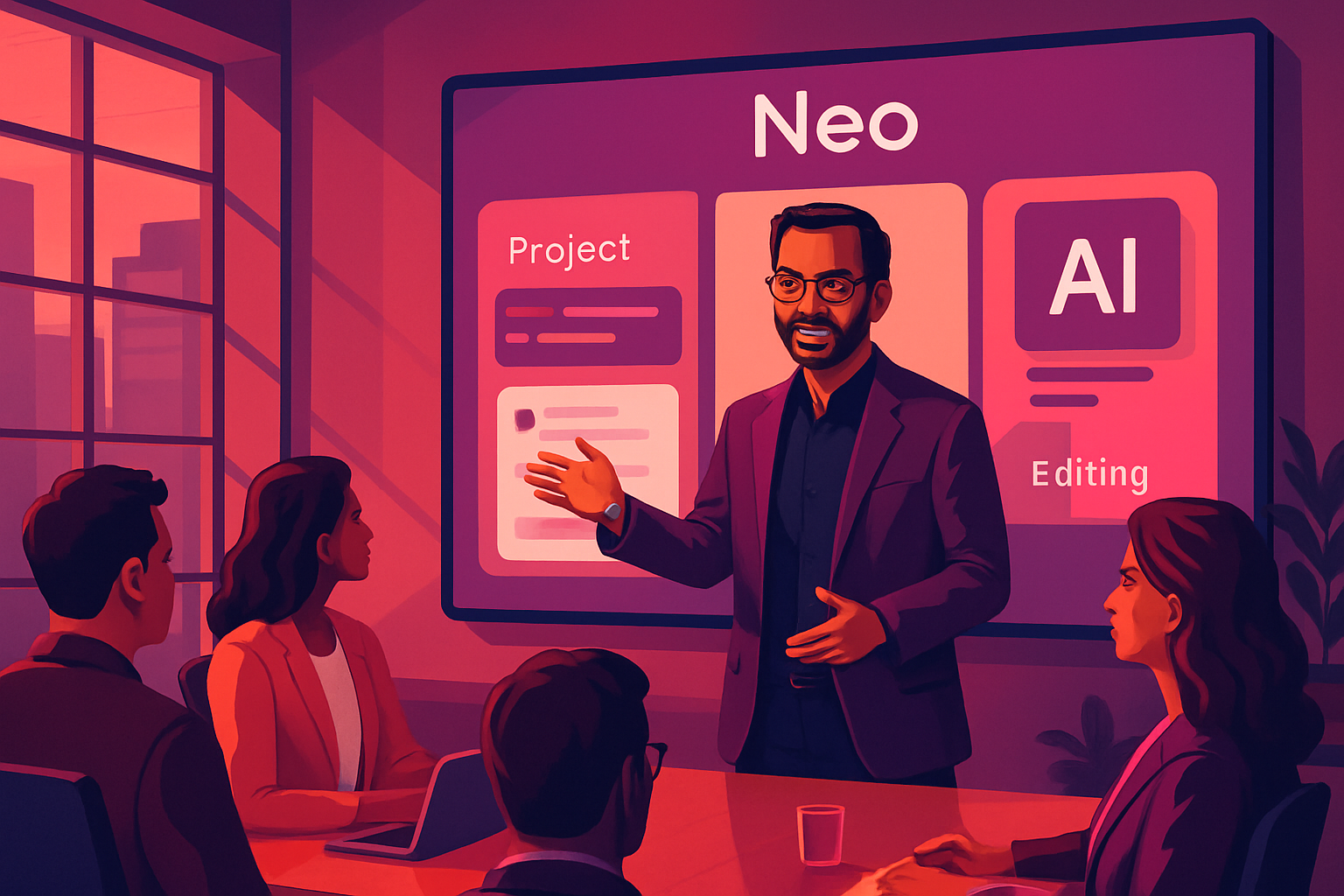
Neo stands out with its unique interface that combines project management, documents, file storage, and AI capabilities. The idea is not simply to add a chatbot to existing software but to make AI a central element of workflows.
Another distinctive feature of Neo is its independence from AI models. This means that companies can switch model providers without disrupting their work environment, a characteristic that could appeal to organizations looking to avoid technological dependency.
A Proven Funding Model
Over the past two decades, Bhavin Turakhia has funded several tech companies from his own resources before opening them up to investors. He is now applying the same strategy to Neo, convinced that AI represents a significant enough breakthrough to justify such a personal investment.
Neo Facing the Challenge of Replacing Traditional Tools
Despite its ambition, becoming a viable alternative to Microsoft Office represents a significant challenge. Microsoft has an installed base of hundreds of millions of users and an ecosystem deeply integrated into businesses, not to mention an offering enhanced by Microsoft 365 Copilot. Google Workspace follows a similar strategy, while players like Notion, Anthropic, OpenAI, and Superhuman are also innovating to attract knowledge workers.
In this highly competitive environment, Neo is not necessarily looking to dethrone Microsoft in the short term. Bhavin Turakhia believes that the market for professional software is large enough to accommodate multiple players. According to him, capturing just 2% to 5% of global spending on enterprise AI software would be enough to build a large-scale business.
The startup primarily targets SMEs as well as professionals in the technology, consulting, and services sectors. For several months, Neo has already been used within Bhavin Turakhia's various companies, including Zeta, to validate its functionality before a broader deployment.
Rapid Development Thanks to AI
Another notable aspect of Neo is the speed of its development. Bhavin Turakhia claims that the first version of the platform was designed in just three months thanks to intensive use of AI in software development. A similar project would have required over a year previously, with a much larger team of engineers.
Currently, the Bengaluru-based startup employs around 45 staff and plans to exceed 100 employees by the end of the year, primarily recruiting specialists in AI and software engineering.
Brief IA — L'actualité IA en français
L'essentiel de l'actualité de l'intelligence artificielle, décrypté et expliqué chaque jour.