Neo Labs: AI Tackles Mathematical and Scientific Challenges
Le brief IA que les pros lisent chaque soir
Les 7 actus IA du jour, décryptées en 5 min. Gratuit.
Inclus dès l'inscription : notre sélection des meilleurs guides & comparatifs IA.
Choisis ton rythme
Gratuit · Pas de spam · Désabonnement en 1 clic
Neo Labs: A New Era for AI and Mathematics
Artificial intelligence is often seen as a potential driver for scientific advancement. Laboratories like OpenAI, backed by substantial funding, are striving to demonstrate this capability. Among the fields where AI could make a notable difference, mathematics stands out. A new wave of startups, grouped under the name Neo Labs, embodies this momentum. These companies are often founded by former researchers from tech giants such as Anthropic, OpenAI, DeepMind, and Google Brain. These initiatives reflect a renewed ambition to explore the limits of AI in the scientific domain.
At the same time, economic reports on AI continue to captivate attention. The Bank for International Settlements (BIS) recently compared the rise of capital in the AI sector to four major economic bubbles of the past. By drawing parallels with the railroads of the 1840s and the internet bubble of the 1990s, the BIS highlighted unique anomalies in the AI investment cycle of 2025-2026, raising concerns about the sustainability of this growth.
According to the Exponential View report, the generative AI economy generated $110 billion in sales over the past twelve months. Extrapolating these figures, the annual revenue rate could exceed $175 billion, illustrating the scale of the phenomenon.
The Uncertain Impact on the Labor Market
The impact of AI on employment remains an open question. In the short term, the boom in AI investments raises questions about the sustainability of the current economic expansion, according to the BIS. The long-term effects on the labor market and the overall economic structure remain uncertain.
Neo Labs: A Sample of Promising Startups
Companies like Apple and Microsoft have recently raised their prices by 20% on hardware and electronics, partly due to disruptions in the HBM supply chain, exacerbated by the expansion of data centers. In this context, Neo Labs are emerging as a new category of AI startups benefiting from significant funding. Among them, Mirendil, Engram, General Intuition, Prometheus, and Trajectory stand out.
Mirendil is developing a "self-accelerating" AI capable of replicating the work of an AI researcher by training cutting-edge models specialized in AI research and development. Engram, a young startup just eight months old, focuses on creating a persistent memory infrastructure to enhance model efficiency and reduce costs.
General Intuition AI, a leading AI research lab, is working on building Large Action Models (LAM) and "world models" capable of perceiving, predicting, and acting in real-time. Prometheus, founded in November 2025 by Jeff Bezos and Vik Bajaj, focuses on developing AI models for physical tasks. Finally, Trajectory is building a platform for continuous learning, betting on a rapid iteration cycle to help businesses develop AI products that learn continuously.
The Importance of Neo Labs in 2026
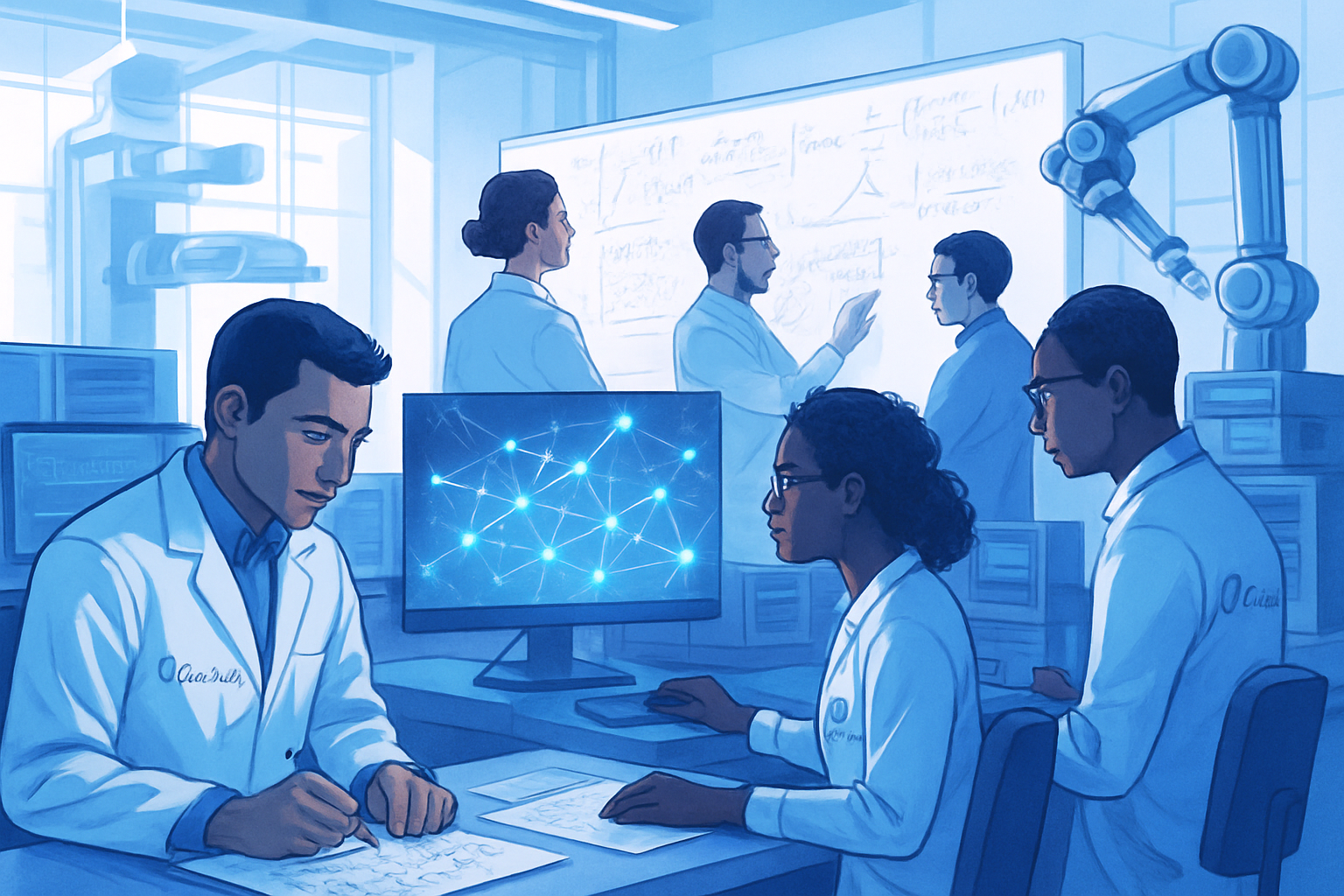
Tracking Neo Labs in AI is crucial for understanding how these entities tackle challenges perceived as impossible. It’s not just about language models, but about the fusion of world models, physical AI, and the evolution of agentic AI in the scientific field. There is optimism about how this could accelerate science, research and development, innovation, and AI laboratories.
Other AI Developments to Watch
Among other AI news, the virtual event "AI for Science" organized by Anthropic featured leaders from Anthropic and research institutions. AI is also playing a role in the discovery of new galaxies by astronomers. Additionally, Agility is poised to become the first humanoid robotics startup to go public. Finally, autonomous laboratories are transforming the way chemists work, even in so-called "hard" sciences.
A Persistent Mathematical Question
In 1946, Hungarian mathematician Paul Erdős posed a simple yet intriguing question: if one has n points on a plane, how many pairs of these points can be exactly one unit apart? This question, although seemingly simple, concerns behavior for very large n and seeks to establish a formula relating n to the maximum number of pairs at unit distance.
Erdős proposed both a ceiling and a floor for this question. He demonstrated that the number of pairs cannot exceed n^(3/2). For the floor, he found a strong but non-obvious construction. A simple integer lattice produces only about 2n unit pairs, barely more than the number of points themselves. This conjecture has remained unsolved for nearly eight decades, with the square lattice remaining the benchmark.
Brief IA — L'actualité IA en français
L'essentiel de l'actualité de l'intelligence artificielle, décrypté et expliqué chaque jour.