NVIDIA DLSS 5: Studios Regain Artistic Control
Le brief IA que les pros lisent chaque soir
Les 7 actus IA du jour, décryptées en 5 min. Gratuit.
Inclus dès l'inscription : notre sélection des meilleurs guides & comparatifs IA.
Choisis ton rythme
Gratuit · Pas de spam · Désabonnement en 1 clic
NVIDIA DLSS 5: Studios Regain Artistic Control
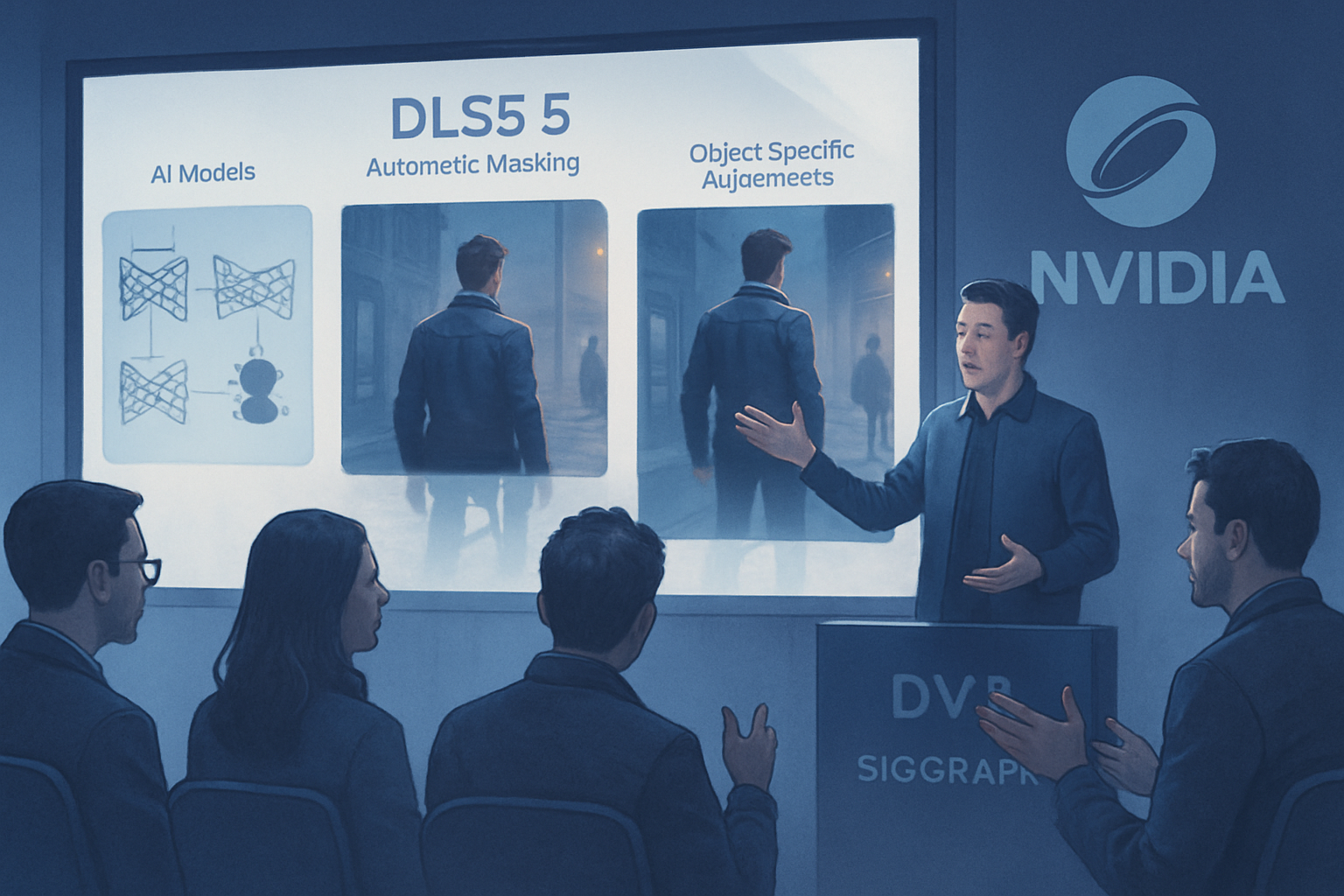
Criticized upon its announcement for altering character faces, the technology made a comeback at SIGGRAPH with a concrete response: three selectable AI models, automatic masks, and object-specific adjustments to ensure studios maintain control over their artistic direction.
When NVIDIA unveiled DLSS 5 in March at GTC, the reaction was not what they had hoped for. Clips from Hogwarts Legacy and Resident Evil Requiem showcased characters with smoothed complexions and noticeably altered features, prompting the community to quickly label it as "AI slop." Jensen Huang countered that the critics were "completely wrong," arguing that developers retained total control, but without demonstrating how. SIGGRAPH 2026 provided an opportunity to set the record straight: NVIDIA dedicated over 30 minutes to detailing the tools available to artists, including a demonstration of the sliders and masks designed to tame the AI.
Smoothed Faces, Troubled Artistic Direction: What Sparked the Outrage
The central complaint from players was not about the technical prowess itself. The idea of an AI that enhances lighting, materials, and shadows on the fly is appealing on paper. The problem was that the initial demos showcased an AI that did not merely refine; it reinterpreted. In clips from Resident Evil Requiem, Grace Ashcroft's face lost its dark circles and imperfections. Textures changed in appearance, and the lighting ambiance turned theatrical. In this context, it was hard to see anything other than a beauty filter applied indiscriminately.
The underlying technical issue was real: the initial demonstration at GTC ran on two RTX 5090 GPUs, one dedicated to game rendering and the other to the AI model. This discrepancy with market reality did not escape observers. NVIDIA had promised optimization for a single GPU before the expected launch in fall 2026, but without specifying whether all RTX 50 models would be included. The question of artistic control remained entirely open. This was precisely the gap NVIDIA promised to fill scene by scene, yet without providing further details.
Three Models, Two Sliders, Object Masks: The Tools Artists Demanded
DLSS 5 offers three distinct models (A, B, C), selectable not only by game but also by scene, environment, or cinematic. Two main sliders allow for effect adjustments: Structure Intensity affects high-frequency details (ambient occlusion, reflections, subsurface scattering), while Tone Intensity influences the overall lighting ambiance and colors. Edward Liu, NVIDIA's director of deep learning research, summarizes the central idea: "The game engine defines the world, and the generation enriches it."
In practical terms, a developer can choose to apply the effect only to a character without affecting the environment, or target specific objects with independent settings for each. The AI can automatically identify characters through masks generated by the model itself. This is a direct response to the criticisms: rather than a global filter, artists can disable DLSS 5 on faces, intensify the effect on materials, and ignore it on stylized textures. Bethesda, a launch partner, had sought to calm the waters back in March by clarifying that the clips presented were merely a "first glimpse" and that their artists would retain final control.
DLSS 5 is still slated for release in fall 2026, exclusively for GeForce RTX 50. The tools showcased at SIGGRAPH represent a serious response to the criticisms, and the granularity offered to studios is genuine. It remains to be seen whether artistic teams will have the time and resources to utilize them effectively: between a meticulous object-by-object integration and a global effect toggled with a single checkbox, the difference will ultimately be in their hands.
Brief IA — L'actualité IA en français
L'essentiel de l'actualité de l'intelligence artificielle, décrypté et expliqué chaque jour.