NVIDIA and Anthropic: Revolutionizing Scientific Research
Le brief IA que les pros lisent chaque soir
Les 7 actus IA du jour, décryptées en 5 min. Gratuit.
Inclus dès l'inscription : notre sélection des meilleurs guides & comparatifs IA.
Choisis ton rythme
Gratuit · Pas de spam · Désabonnement en 1 clic
A Strategic Collaboration Between NVIDIA and Anthropic
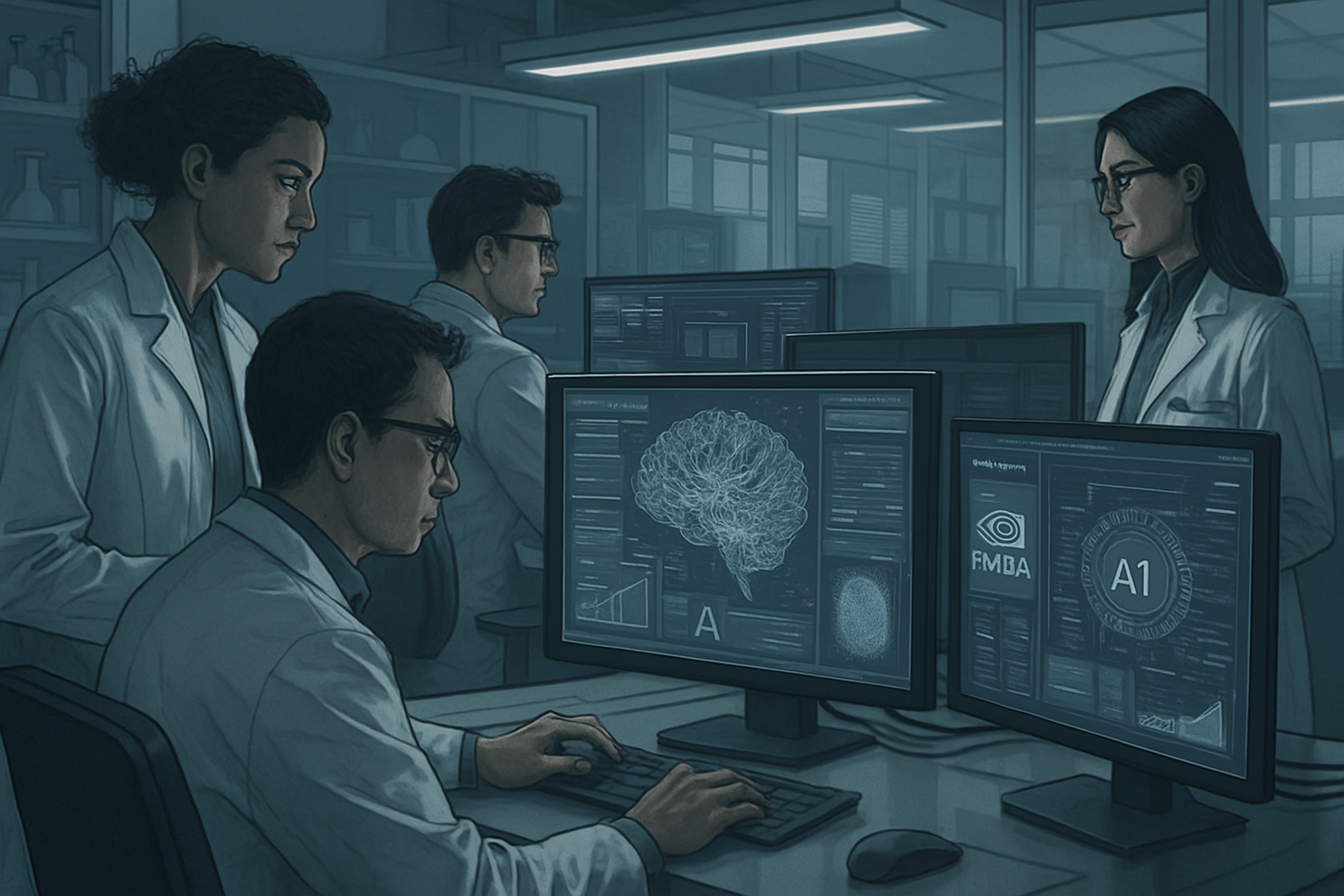
Anthropic has recently integrated the NVIDIA BioNeMo Agent Toolkit into its Claude Science workspace, aimed at scientific research. This integration seeks to accelerate research in computational life sciences. Claude Science, which is currently in public beta, provides researchers with an environment where they can interact with digital agents in natural language to carry out complex research projects. With this connection to NVIDIA's toolkit, users can access high-performance computing resources, transforming their intentions into concrete actions within the Claude environment.
NVIDIA is recognized for developing one of the most advanced GPU-accelerated computing infrastructures in the world. This infrastructure includes not only physical hardware but also software frameworks, operational libraries, scientific models, microservices, and specialized tools. This combination allows researchers to execute complex workflows with increased speed and efficiency.
Integration of NVIDIA Technologies in Scientific Research
The integration of NVIDIA's toolkit into Claude Science allows for the importation of accelerated models, computational libraries, and NIM microservices directly into the research environment. This adoption is already evident among the largest global pharmaceutical companies, with 18 of the top 20 industry leaders using NVIDIA BioNeMo in their production operations, demonstrating its widespread adoption and recognized effectiveness.
Claude Science simplifies the research process by translating intentions expressed in natural language into operational actions. Researchers no longer need to worry about manually configuring predictive models or managing complex software environments. For example, a scientist can simply describe a task such as analyzing a genomic sequence or predicting a protein structure, and Claude Science takes care of the rest, orchestrating the necessary actions using specialized agents.
Optimizing Workflows in Life Sciences
Claude Science's specialized agents are equipped to handle laboratory protocols and computational processes across various fields such as genomics, proteomics, single-cell analysis, chemometrics, and clinical research. The NVIDIA toolkit provides the necessary data context to ensure that each step of the process is properly aligned with NVIDIA's capabilities.
The toolkit consolidates accelerated functions into specific programming skills, allowing Claude Science to select the appropriate computational tool, format data inputs, and execute tasks on NVIDIA computing resources. The results are then returned for human review, establishing a rapid iterative loop between scientific reasoning and computational processing.
A concrete example of this system's application is the production of inhibitors for cancer targets. A scientist can identify a cancer antigen mutation and ask Claude to design potential inhibitors. Claude Science, in collaboration with the BioNeMo Agent Toolkit and NVIDIA NIM microservices, accelerates the prediction, optimization, and validation process of the inhibitors.
Accelerating Genomic and Single-Cell Analyses
The NVIDIA toolkit provides researchers with access to accelerated workflows and advanced open models, such as Evo 2, Boltz-2, and OpenFold3. These models are powered by NVIDIA software libraries, ensuring that each phase of the workflow is supported by an appropriate scientific model.
AI agents require specialized computational tools to perform their tasks. A complete workflow may include identifying compounds, generating conformers for the best structural candidates, analyzing genomic context, and comparing responses to perturbations. The NVIDIA BioNeMo Agent Toolkit provides the necessary tools for these agents to operate at full capacity.
For instance, genomic analysis via NVIDIA Parabricks is significantly accelerated, reducing processing time from several hours to just minutes. Similarly, the RAPIDS-singlecell tool cuts processing time from 52 minutes to 25 seconds for the analysis of 1.3 million cells, thereby transforming single-cell analysis into an integral part of the agent's reasoning process. Additionally, the nvMolKit speeds up chemometric tasks, such as similarity searching and conformer generation, by up to 3,000 times, providing rapid results as the agent iterates through vast chemical spaces.
Standardized Deployment with NIM Microservices
For research teams, having stable deployment mechanisms for advanced modeling pipelines is crucial. NVIDIA offers its biomolecular models as BioNeMo NIM microservices, which are enterprise-ready for inference and suitable for production environments.
These microservices are fully containerized, with a software stack optimized for high-performance inference. The autonomous agent can interact with a stable API to trigger these remote deployments, ensuring consistency in performance across different agent frameworks and research platforms.
The NVIDIA BioNeMo Agent Toolkit is designed to be open and architecture-independent, ensuring compatibility across various research environments. Teams can access the toolkit and its skills through NVIDIA's developer resources and GitHub repositories. During the beta phase, Anthropic is actively seeking feedback from researchers to improve software integrations and add additional domain specialists.
Brief IA — L'actualité IA en français
L'essentiel de l'actualité de l'intelligence artificielle, décrypté et expliqué chaque jour.