Nvidia and Bristol Myers: AI Transforms Medical Research
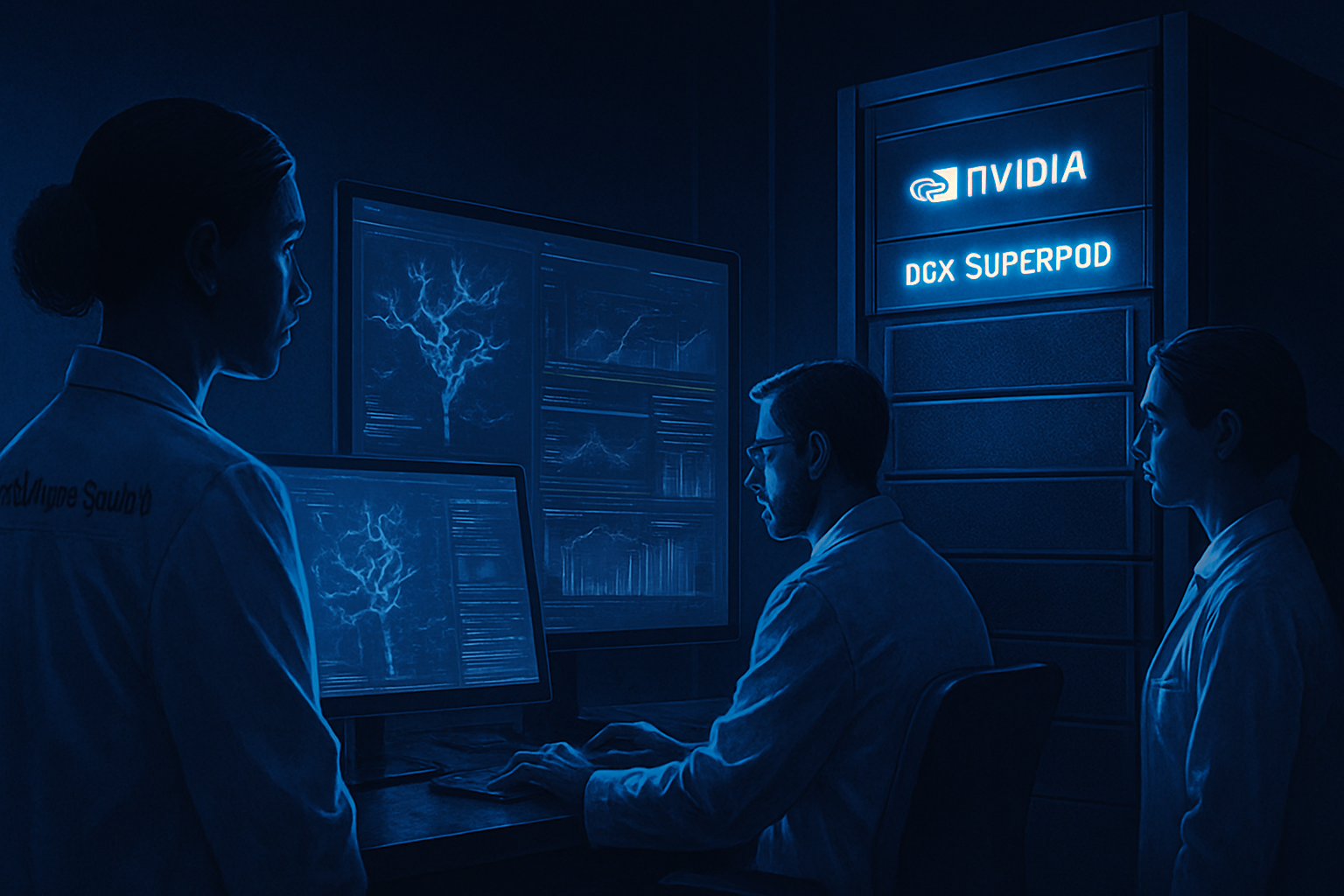
Bristol Myers Squibb Leverages Nvidia's AI for Medical Research
Bristol Myers Squibb (BMS), a giant in the pharmaceutical industry, has recently acquired an advanced artificial intelligence system, the Nvidia DGX SuperPOD. This system is based on the Vera Rubin architecture developed by Nvidia, a global leader in chip manufacturing. This acquisition aims to enhance BMS's capabilities in the discovery and development of new drugs.
This initiative marks a first in the life sciences field, as BMS is the first player in this sector to equip itself with a DGX SuperPOD based on Vera Rubin. Nvidia introduced this new architecture earlier this year as a successor to its previous AI computing systems.
Enhancing Computing Capabilities
The newly acquired cluster by BMS will include eight DGX Vera Rubin NVL72 systems. Each of these systems is designed at the rack scale, combining Nvidia Vera central processing units and Rubin graphics processing units.
This cutting-edge infrastructure will be used by BMS to train proprietary models and make predictions as part of its research programs. The work supported by this system will include the analysis of chemical compounds, proteins, and other crucial scientific data.
Although the financial details of this purchase have not been disclosed, it is clear that this acquisition significantly expands the existing Nvidia infrastructure at BMS. The company already had a SuperPOD, but it was considered outdated, being two to three generations behind the Vera Rubin technology.
BMS has utilized its current SuperPOD for about three years and plans to integrate it with the Vera Rubin system to create a shared computing environment. This environment will be accessible from various BMS research sites around the world.
The software stack of the SuperPOD is capable of scheduling training, prediction, and development workloads across the entire infrastructure. With this expanded environment, a greater number of scientists will be able to directly access computing resources.
Greg Meyers, BMS's Chief Digital and Technology Officer, emphasized that the demand for computing has significantly increased with the deployment of larger AI models within the research organization.
Erin Davis, Vice President of Business Insights and Research Technology at BMS, noted that the current infrastructure is already operating at full capacity. She attributed this growing demand to large-scale predictions involving large molecules and the development of internal foundational models.
Davis clarified that the new system will not be reserved for a small group of computational researchers. BMS plans to make it accessible to the entire research organization, thereby eliminating wait times and access limitations associated with the current infrastructure.
AI at the Heart of Drug Discovery
BMS has indicated that artificial intelligence plays a central role in the design of every small molecule program and in the majority of its large molecule programs. AI is applied to target identification, lead optimization, large molecule predictions, and the development of internal models.
Thanks to AI, target identification has reduced certain manual research tasks by several weeks. The workloads for large molecule predictions also require increased graphics processing capacity.
Robert Plenge, BMS's Head of Research, stated that the new system will allow scientists to evaluate a greater number of potential drug candidates at earlier stages of development.
"Perhaps before we could do 10, and now we can do dozens," he said.
Computational screening enables researchers to assess potential compounds before selecting a smaller group for synthesis and laboratory testing.
Le brief IA que les pros lisent chaque soir
Les 7 actus IA du jour, décryptées en 5 min. Gratuit.
Inclus dès l'inscription : notre sélection des meilleurs guides & comparatifs IA.
Choisissez votre rythme
Gratuit · Pas de spam · Désabonnement en 1 clic
BMS applies this approach through a method it calls "Predict First," which uses predictions generated by models to exclude molecules that do not meet the required properties before candidates are selected for synthesis.
Payal Sheth, Senior Vice President of Therapeutic Discovery Sciences at BMS, stated that researchers use predictions to identify molecules with the required combination of properties.
"We use predictions as a way to prioritize the synthesis of molecules with multi-parameter optimization," she explained. "This ensures that valuable laboratory experiments are aligned with the progressing molecules that have the highest probability of success."
This method reduces the number of compounds sent for laboratory testing, allowing researchers to focus experiments on molecules that meet the predicted requirements of a program.
BMS has also utilized AI to expand its CELMoD compound library, designed to selectively degrade cancer-causing proteins. The company is studying these compounds in the context of blood cancers and other diseases.
BMS stated that modeling work has helped researchers examine additional protein targets and potential compounds before deciding which candidates to pursue experimentally.
The company is also using AI tools to reduce the time required to produce drugs for clinical trials. Plenge mentioned that the process has already been reduced by 20% to 30% and could reach 50% in the coming years.
He cited an experimental treatment for sickle cell disease in early clinical development as an example of AI-supported research. Plenge stated that this treatment would likely not have been discovered without the company's AI tools.
The figures refer to the time needed to identify and produce candidates for clinical testing rather than their subsequent performance in trials.
The Vera Rubin system will also give researchers access to Nvidia's BioNeMo Agent Toolkit for biological and drug discovery applications.
BioNeMo provides tools for protein structure prediction, molecule generation, molecular docking, sequence analysis, and genomics. It can also connect multiple computational tools within the same research workflow.
BMS executives stated that human researchers will continue to review model results and decide which compounds or programs should advance.
Connecting Research Sites Worldwide
BMS is introducing tools aimed at reducing the specialized knowledge required to initiate complex computing tasks. The company stated that researchers will be able to start certain prediction requests using natural language instructions.
The environment will be managed by Nvidia Mission Control, whose functions include cluster provisioning, infrastructure monitoring, and workload management, according to BMS.
The unified infrastructure will allow data and results from models generated at one site to be used by teams elsewhere. BMS stated that datasets from a program in Lawrenceville, New Jersey, for example, can be integrated into models used by researchers in San Diego.
Sheth stated that the shared environment aims to preserve information from experiments and research programs across the organization.
"The computing infrastructure is what connects all our scientists together and ensures that our learnings are institutionalized," Sheth said.
The two SuperPODs will operate across a common data environment, allowing teams from different sites to access shared datasets and model results. BMS stated that the environment will include information from experiments, clinical results, and research partnerships.
The company plans to allocate the new computing capacity to the design of small and large molecules, clinical research, and digital twin applications. BMS did not provide details on the planned digital twin work or the amount of capacity allocated to each area.
Meyers stated that the Vera Rubin system will provide more computing capacity relative to its electricity consumption. BMS and Nvidia stated that the cluster of eight systems will offer up to ten times the performance per megawatt of the infrastructure it replaces.
"When you host these things, you have to pay an electricity bill," Meyers said. "Think of it as ten times more computing capacity per watt spent... Electricity isn't getting cheaper."
BMS did not provide a specific deployment date or identify where the new system will be hosted.
Brief IA — L'actualité IA en français
L'essentiel de l'actualité de l'intelligence artificielle, décrypté et expliqué chaque jour.