Nvidia Revolutionizes Medical Robotics with Physical AI
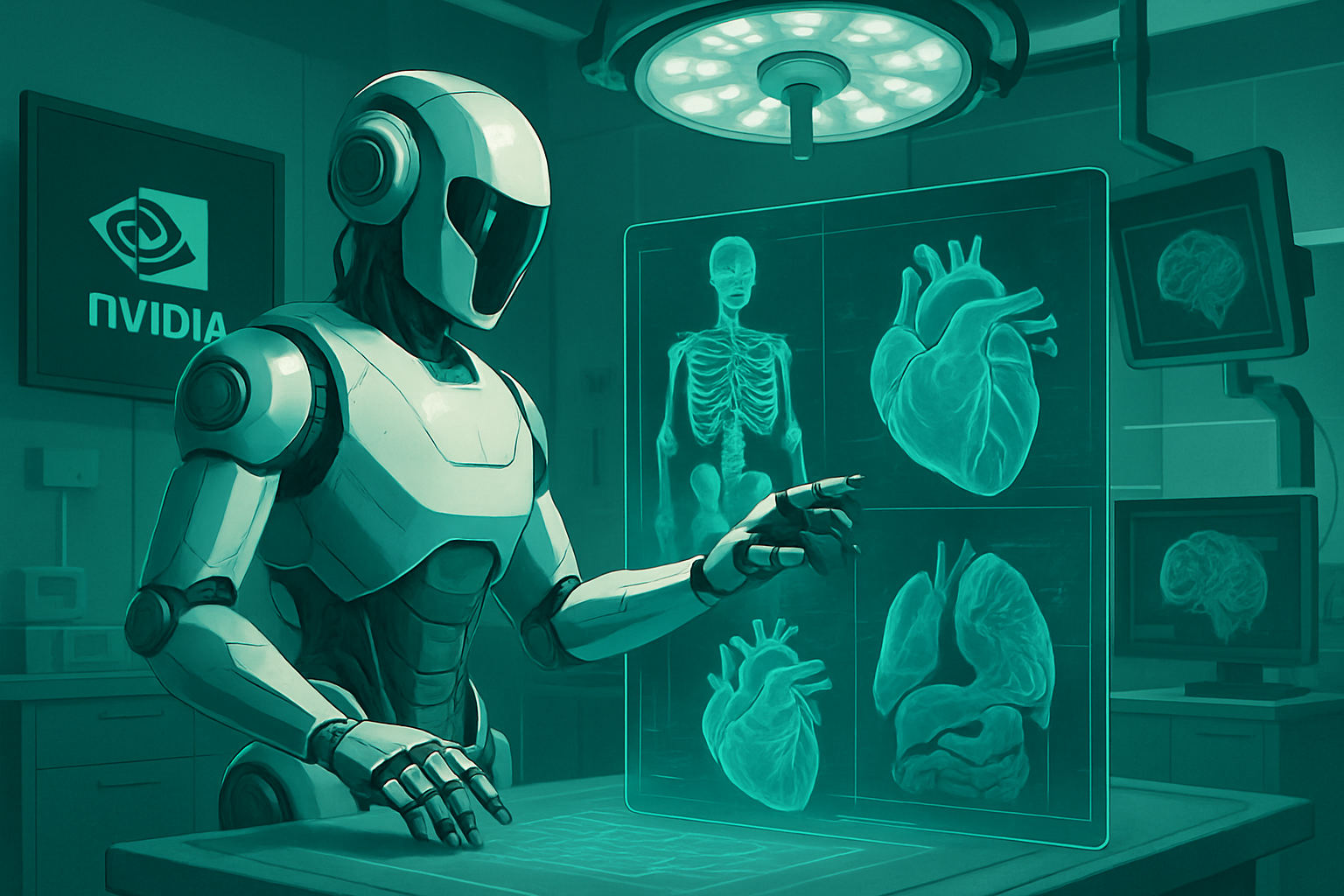
Nvidia and Physical AI in Medical Robotics
Nvidia recently unveiled an innovative framework for medical physics simulation that redefines how health robots learn. Unlike traditional AI systems that rely on text or images, physical AI focuses on learning through embodied experience, meaning through direct contact and physical interactions.
In the field of medical robotics, this approach is crucial. A language model can rely solely on text to learn, but a medical robot must understand the physical consequences of its actions, such as the pressure exerted by a robotic arm on soft tissue or the passage of a catheter through a blood vessel. These interactions require either a real physical environment or a simulation realistic enough to capture the nuances.
For health robotics, physical bodies operating in real procedures are rare, heavily regulated, and take time to generate the range of scenarios that a robot must actually observe. The medical physics simulation is Nvidia's attempt to computationally manufacture this embodied experience.
Medical Physics Simulation: A Necessary Advancement
In the healthcare sector, robots operating in real contexts are rare and subject to strict regulations. This limits their exposure to the various clinical scenarios they need to master. Nvidia aims to bridge this gap with its medical physics simulation, a tool that allows for the computational creation of embodied experiences.
This framework, integrated into Nvidia's Isaac for Healthcare platform, is designed to generate complex physical interactions that a surgical or diagnostic robot might encounter. For example, it can simulate a guidewire stuck in a vascular wall or a kidney stone in an atypical position. These scenarios, often rare in the operating room, can be recreated on demand through simulation.
Announced as an open-source addition to the company's Isaac for Healthcare platform, the framework generates the physical interactions that a surgical or diagnostic robot would otherwise need years of clinical exposure to encounter: a guidewire snagging on a calcified vascular wall, a kidney stone lodged at an unusual angle, or the response of soft tissues that only manifests in a small fraction of procedures.
Building Physical Intuition Before Intervention
Nvidia's framework combines two approaches to model the behavior of medical devices within the human body. Classical physics simulation deals with well-established mechanical rules, such as the bending of a catheter or the resistance of a vascular wall. In parallel, generative AI tackles the more complex aspects to code, such as the visual dynamics of scenes, through a component called Cosmos-H Dreams.
This combination allows robots to gain a comprehensive understanding of the physical and visual interactions necessary to generalize their learning. By leveraging the capabilities of GPUs and Nvidia's Warp and Newton libraries, the framework can run thousands of training environments simultaneously, significantly reducing learning time.
Le brief IA que les pros lisent chaque soir
Les 7 actus IA du jour, décryptées en 5 min. Gratuit.
Inclus dès l'inscription : notre sélection des meilleurs guides & comparatifs IA.
Choisissez votre rythme
Gratuit · Pas de spam · Désabonnement en 1 clic
Nvidia demonstrated that a benchmark with 8,192 parallel environments can reduce training time from five hours to less than two minutes. However, this advancement in speed does not guarantee clinical reliability, and it remains to be proven that these simulations correspond to real situations encountered in surgery.
A language model that underperforms on an extreme case produces a poor response, but a physical AI system that underperforms on an extreme case operates inside a patient. The parallel simulation approach is a real advancement in the speed at which developers can explore failure modes. However, whether these simulated failure modes correspond to what actually happens in an operating room is a separate question.
Early Testing of the Embodiment Approach
Several organizations have already begun testing Nvidia's physical AI approach, each at different levels. CMR Surgical and Cambridge Consultants were among the first to adopt this technology. CMR provided nearly 500 hours of anonymized clinical data from its Versius robotic surgical system, covering various medical procedures. This data is used to model the physics of interactions with soft tissues and create patient-specific simulations.
“Open-source models allow us to capitalize on shared knowledge, accelerate responsible innovation, and ultimately give us the potential to provide more consistent care and better outcomes for patients worldwide,” said Chris Fryer, CTO of CMR Surgical.
Johnson & Johnson MedTech is also using the framework to develop a digital twin of its endoluminal platform MONARCH, focusing on scenarios related to kidney stones. Meanwhile, XCath is developing endovascular autonomy policies to navigate blood vessels without human intervention.
Inner Logic generates synthetic data to validate device mechanics and aims to produce in silico evidence for regulatory submissions. Finally, Medtronic Structural Heart is exploring the use of simulated X-ray detection for research on catheter navigation.
Each of these initiatives is an exercise in training or a contribution of datasets. None are deployed systems operating on a patient with policies learned in this manner, and Nvidia does not claim otherwise.
The Importance of Open-Source in Physical AI
In the field of health robotics, transparency is crucial. Regulators and clinical review boards need to understand how a system arrives at its decisions. An open-source framework allows developers to verify the physical assumptions of the simulations and reproduce results across different anatomies.
This openness is essential for submitting evidence to regulatory bodies like the FDA. While open code facilitates external verification of the model's logic, it does not guarantee that the simulated physical behavior corresponds to reality. Further testing is needed to validate these simulations, and no company has yet published results confirming this correspondence.
Nvidia has created an infrastructure that could accelerate the development of surgical and diagnostic robots, enabling large-scale training. However, clinical validation remains a challenge to ensure these technologies can be safely deployed in operating rooms.
Brief IA — L'actualité IA en français
L'essentiel de l'actualité de l'intelligence artificielle, décrypté et expliqué chaque jour.