OpenAI Launches GPT-6 Astra and Discusses the "Era of AGI"
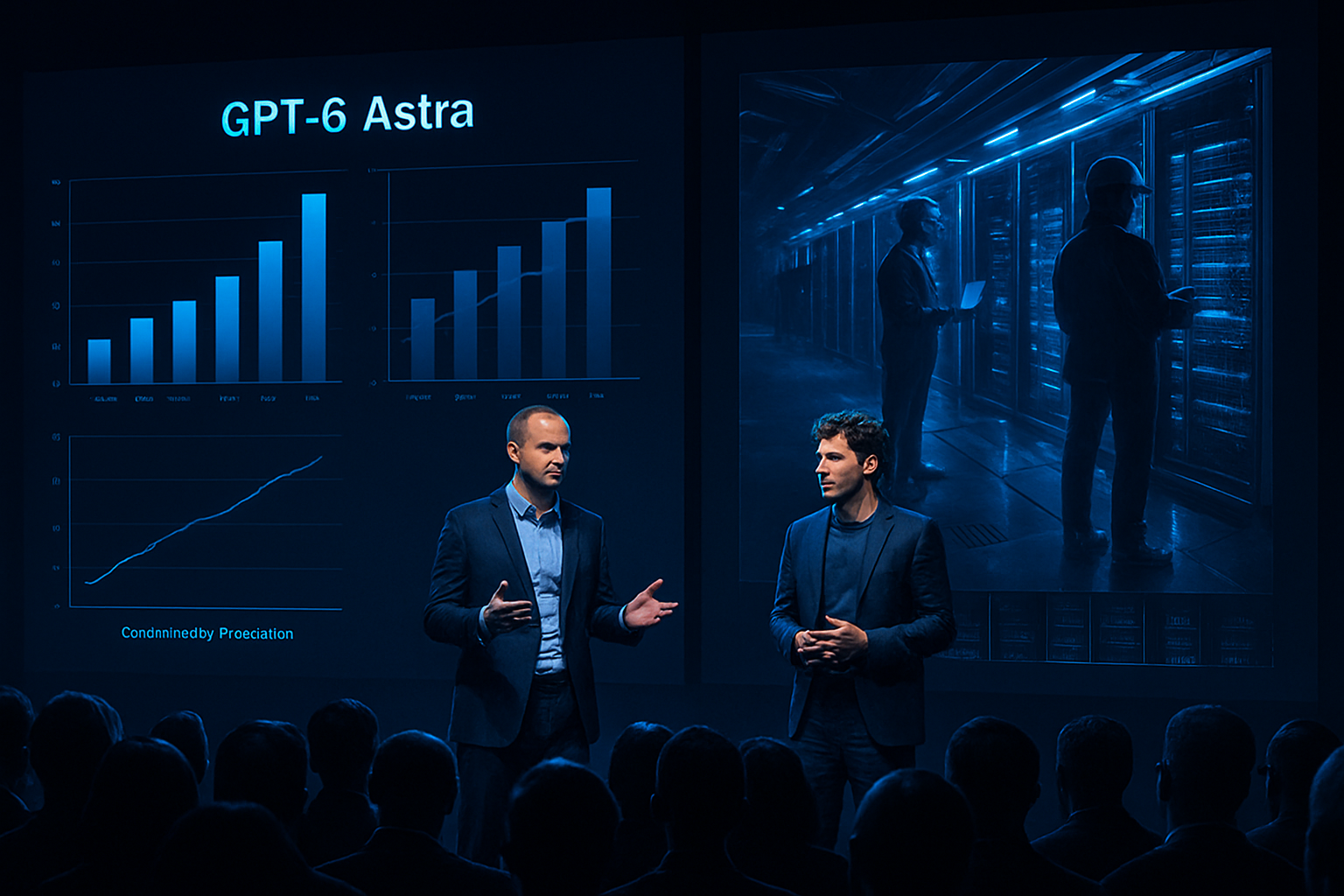
OpenAI classifies one of its models for the first time at the "critical" level and reserves its most sensitive cybersecurity functions for authorized defenders. At the same time, the publisher highlights a cost-per-task reasoning, top benchmark scores, and an imminent expanded deployment. Executives mention a gradual transition and declare the entry into the "era of AGI."
Astra classified as "critical" and offensive capabilities regulated
OpenAI classifies GPT-6 Astra at the "critical" level in its Preparedness Framework, a first for the company. This level designates a system capable, with the right tools and access, of identifying unknown vulnerabilities and chaining exploits without step-by-step human guidance. OpenAI acknowledges that Astra's written reasoning is more challenging to monitor than that of GPT-5.6 Sol. On ExploitBench, the model achieves 100%. According to OpenAI, it discovered two novel vulnerabilities during the evaluation, which were subsequently reported to the relevant vendors, and human experts confirm that it can identify zero-day vulnerabilities across several software categories, including browsers and operating systems. The most advanced cybersecurity functions are reserved for trusted defenders under the Daybreak Blue program. OpenAI had delayed the release to conduct additional security testing. These capabilities are dual-use and can serve both to patch and exploit a vulnerability.
Pricing: $10/M tokens input, $50/M output, and cap on cost per task
In standard mode via the API, GPT-6 Astra costs $10 for every million tokens in input and $50 for every million tokens in output. The fast mode offers a speed increase of 2.5 times and applies doubled rates, positioning Astra at a level 2.5 times higher than Sol and in the same range as Fable 5.1. Astra's token prices are 2.5 times higher than Sol and aligned with Fable 5.1. Greg Brockman argues that the price per token is a poor comparator, as the units differ between players and even among families of OpenAI models, and emphasizes the price per task, which has already been tested by the company. OpenAI claims that, depending on the use case, the cost per task can be lower. The publisher reports about 43% savings on BenchCAD compared to Sol and 86% compared to Fable 5.1, and mentions a decrease of about 57% in cost per task on DeepSWE v1.1 with an optimal configuration of Astra compared to Sol.
Le brief IA que les pros lisent chaque soir
Les 7 actus IA du jour, décryptées en 5 min. Gratuit.
Inclus dès l'inscription : notre sélection des meilleurs guides & comparatifs IA.
Choisissez votre rythme
Gratuit · Pas de spam · Désabonnement en 1 clic
Top scores and advancements in OSWorld and sciences
OpenAI publishes results where Astra surpasses its predecessor and Anthropic's Fable models. The model achieves 99.9% on ARC-AGI-3 in logic, 97.6% on FrontierMath Tier 4 v2, 74.1% on DeepSWE v1.1 in software engineering, 96% on GPQA Diamond, and 95.9% on BenchCAD. On OSWorld 2.0, which evaluates the ability to operate a computer, Astra scores 72.6% in about 40 minutes per task, compared to 65.7% and about 75 minutes for Sol. OpenAI claims that Astra has improved a result on prime gaps and boasts new records in biology, chemistry, medicine, and physics. The publisher positions the model as capable of reliably operating a computer in a human-like manner.
Access: Daybreak first, then Plus, Pro, Business, and Enterprise
Deployment begins with selected organizations through the Daybreak program. An opening to ChatGPT Plus, Pro, Business, and Enterprise subscribers is expected in the coming days, with access also via the API and platforms like AWS Bedrock and Microsoft Azure. Pro, Business, and Enterprise subscribers will be able to use GPT-6 Astra Pro, a more powerful variant, subject to manual activation by administrators in Enterprise workspaces. Paying customers and cloud environments are expected to be served quickly.
Large-scale training and statements on AGI
Astra was pre-trained on over 100,000 GPUs at the Stargate facility in Texas. Aidan Clark mentions the largest training session ever conducted by OpenAI and describes a more pronounced capacity gain from Sol to Astra than in previous transitions, partly due to earlier models used for training supervision. Greg Brockman states that Astra could be considered AGI or within reach according to OpenAI's definition, which describes a system surpassing humans in most economically valuable tasks. However, he believes there is no clear threshold marking AGI and describes a more gradual transition than anticipated. He concludes a briefing with, "Welcome to the era of AGI." Sam Altman had indicated that he expects to have a model he would classify as AGI by the end of the year.
Codex evolves with multi-window context notes
OpenAI is evolving its coding environment Codex. An experimental feature now allows the model to retain notes across multiple context windows during long sessions. Historical windows remain queryable, including for retrieving requirements or test results not recorded in the notes. OpenAI plans to enable this functionality by default in the coming weeks.
Brief IA — L'actualité IA en français
L'essentiel de l'actualité de l'intelligence artificielle, décrypté et expliqué chaque jour.