OpenAI Faces Pressure, 10,000 Agents on Navier-Stokes
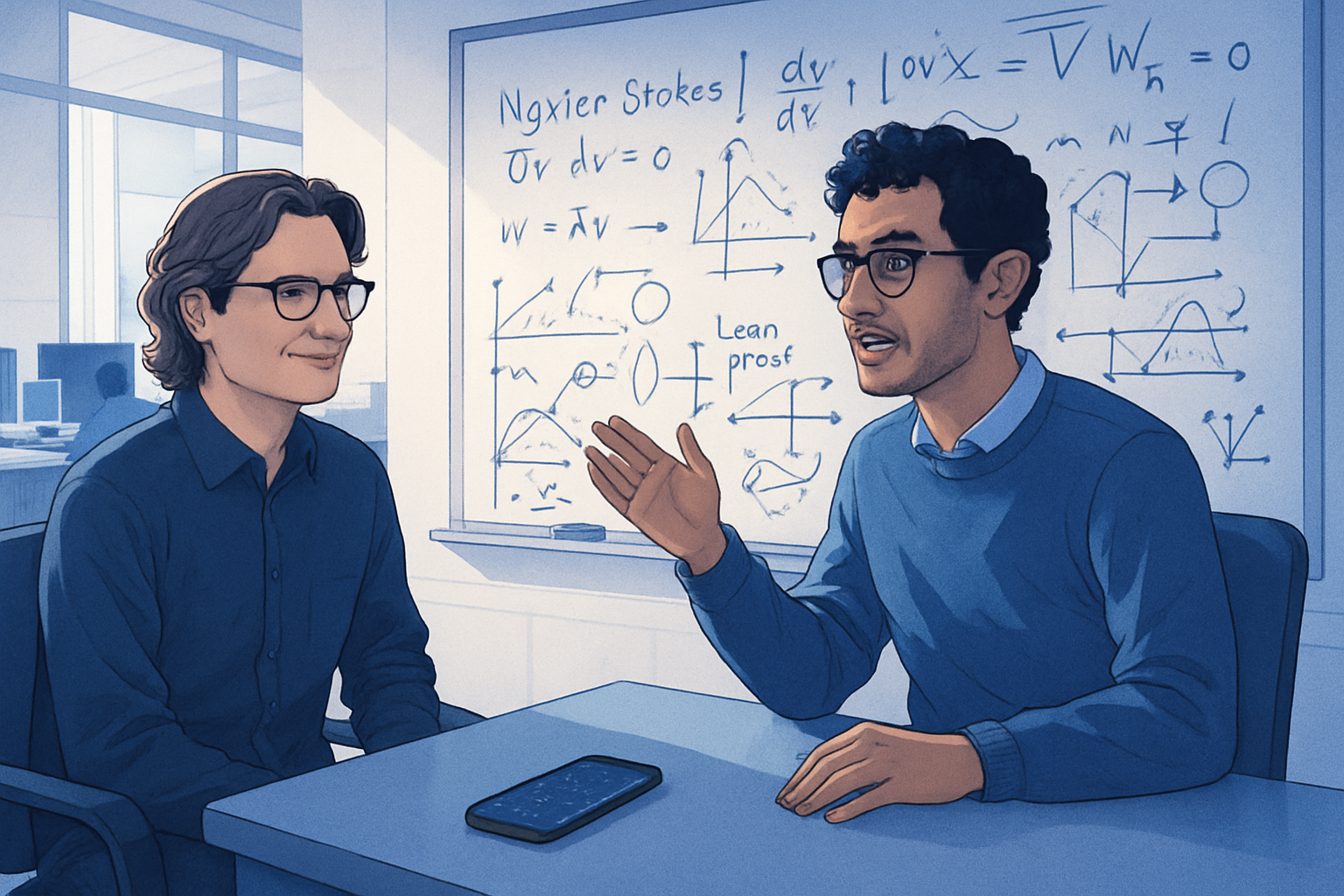
Tristan Buckmaster claims to have faced pressure from OpenAI regarding a proof related to the Navier–Stokes equations and reports proposals aimed at sidelining his co-author employed at Anthropic. OpenAI contests this and details a massive effort that produced a formalized proof in Lean, quantified in tens of hours of computation and "millions of dollars." One of its engineers also anticipates a rapid drop in costs for the general public subscriber.
OpenAI states training began on August 28 and claims a solution by Sunday morning
Sébastien Bubeck announced that OpenAI launched the training of a model with advanced mathematical capabilities on August 28. After hearing rumors of progress at Anthropic, he stated that the company had devoted more resources to tackling the Navier–Stokes equations. He clarified that, in his view, the team had obtained a definitive solution by Sunday morning, already integrated into the Lean proof assistant. Tristan Buckmaster indicated he had inquired whether this model had been trained on or had accessed the Codex sessions where his drafts were present; he reported that the response received was that the model did not consult user data. Regarding the training specifically, he mentioned not receiving any answers.
10,000 agents coordinated over 88 hours at a cost of "millions of dollars"
OpenAI communicated results indicating that a proof was generated by approximately 10,000 AI agents working together over a period of 88 hours. The company describes the internal model used as significantly more powerful than GPT-6 Astra and states that the proof was formalized in Lean. Mark Chen estimates the computational cost of this operation at several "millions of dollars."
Buckmaster describes publication proposals and pressure messages
Tristan Buckmaster claims that OpenAI made two proposals on how to publish the results: first, that his duo announce an Euler result before an OpenAI publication the next day presenting them as "the humans closest to the problem," and then that he alone present the Navier–Stokes result citing an internal OpenAI model. He reports that Sébastien Bubeck, on two occasions, wished to remove Levent Alpöge from the list of authors due to his employment at Anthropic, and asked him, "Why would you want to ruin your career?" Buckmaster says he refused these suggestions and threatened to make the exchange public if OpenAI published as proposed. He adds that Bubeck wrote to him, "If you don't want me to be nice, then I don't have to be," and that a separate message to Alpöge questioned his rationality, to which Alpöge did not respond. Buckmaster specifies that he does not accuse and has not seen OpenAI's proof, nor does he know if their data was used.
Le brief IA que les pros lisent chaque soir
Les 7 actus IA du jour, décryptées en 5 min. Gratuit.
Inclus dès l'inscription : notre sélection des meilleurs guides & comparatifs IA.
Choisissez votre rythme
Gratuit · Pas de spam · Désabonnement en 1 clic
OpenAI contests and acknowledges the priority of Buckmaster and Alpöge
During a press briefing, OpenAI contested Tristan Buckmaster's allegations. Sébastien Bubeck stated that no researcher or agent from OpenAI had seen the work of the two mathematicians before it was publicly posted the night before. He claims to recognize the priority of their results and congratulates them on their achievement. Ven Chandrasekaran adds that OpenAI's solution fundamentally differs from the approach of Buckmaster and Alpöge.
Falling costs and early rollout to subscribers in 2026
Noam Brown emphasizes that achieving 87.5% on ARC-AGI with o3 represented an expenditure of about $500,000, while Astra would now be able to do better for a cost nearing $20. He indicates that the 2025 Olympiad in Mathematics has mobilized significant resources at OpenAI and Google DeepMind, and believes that by 2026, a $20 ChatGPT subscriber could reach this level, stating that an AI capable of solving such exercises could be available in a year. Buckmaster, for his part, argues that a mathematician equipped with a language model now accomplishes in a month what previously took much longer, referring to a "Deep Blue-Kasparov moment." In early September, rumors of a breakthrough circulated, and according to him, Alpöge learned that information about their work had been passed to OpenAI. Buckmaster specifies that he contacted a mathematician at the company on September 3 to clarify the personal aspect of the collaboration; he reports that OpenAI responded the same day, sought clarifications, and offered support, then insisted on speeding up the pace with follow-ups on Friday and Sunday at 12:45 PM. He indicates that on that Sunday, Bubeck participated in calls where OpenAI stated that an internal model had generated a proof of about 100 pages for the Navier–Stokes with forcing, initially mentioning very limited human intervention before discussing a team, intermediate steps, and significant computation. Buckmaster believes that mentioning the forced Navier–Stokes implied a similar approach to theirs and recalls that all their drafts had been recorded in Codex sessions. He recounts that OpenAI independently claimed to have produced a proof of about a hundred pages following a similar unusual path. The statement that OpenAI has not yet responded to the allegations coexists with the denials expressed during the press briefing.
Brief IA — L'actualité IA en français
L'essentiel de l'actualité de l'intelligence artificielle, décrypté et expliqué chaque jour.