OpenAI Wins Legal Victory in Delhi Against ANI
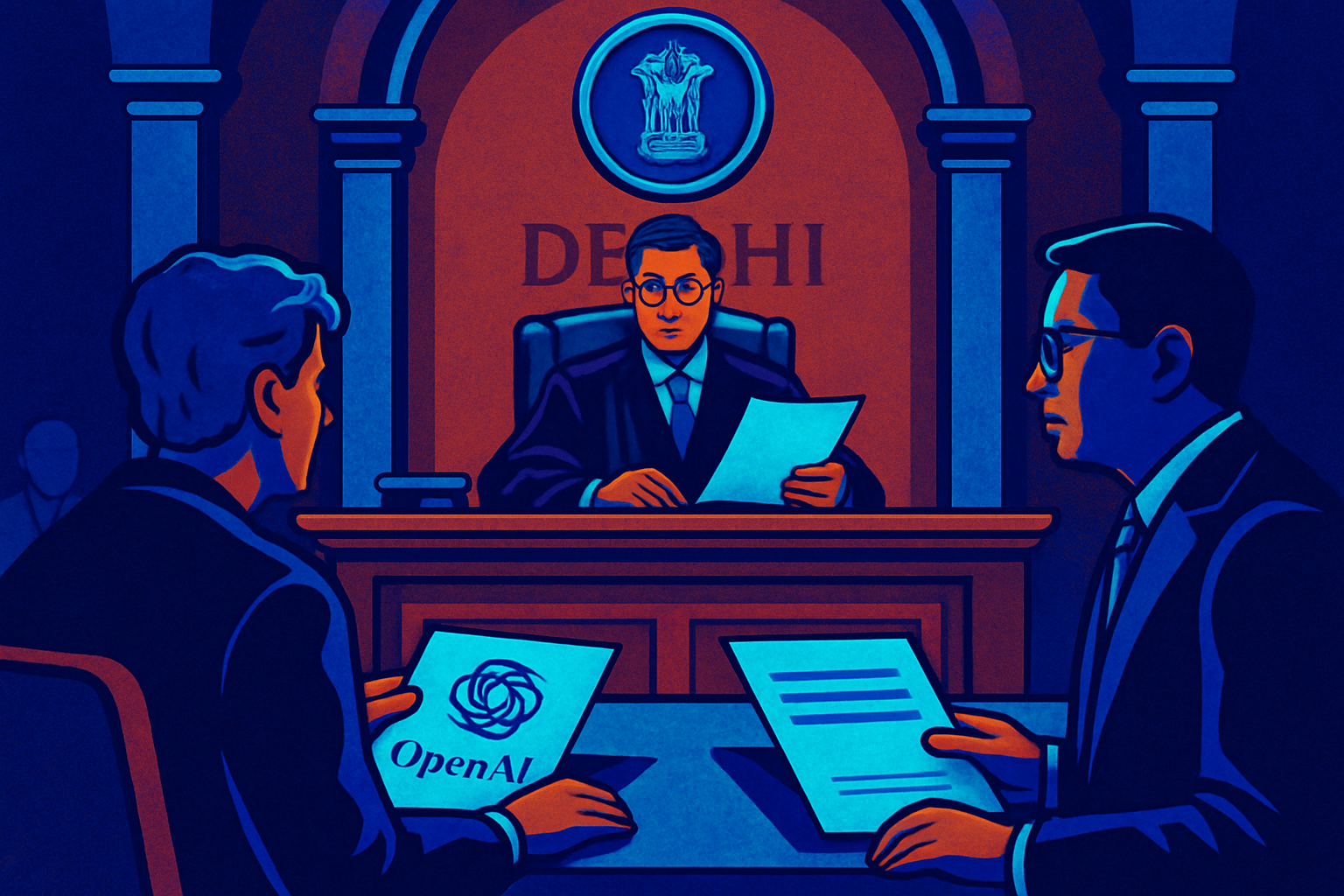
OpenAI Wins Legal Victory in Delhi Against ANI
The Delhi High Court has dismissed the Indian news agency ANI's request for a preliminary injunction against OpenAI for copyright infringement.
ANI failed to prove that ChatGPT reproduced its articles verbatim. The articles it submitted as evidence were published after the models had already been trained.
The judge found no economic harm to ANI, as OpenAI and the news agency operate in different sectors, and affirmed the public benefit of language models for education, research, and accessibility.
In an interim ruling, the Delhi High Court rejected the request from the news agency Asian News International (ANI) for a preliminary injunction against OpenAI. ANI, one of the largest news agencies in India, sued OpenAI for its use of copyrighted material for AI training and in the outputs of ChatGPT. Judge Amit Bansal denied the requested relief on both claims.
The ruling addresses memorization, retrieval-augmented generation (RAG), and the legal status of AI training. AI copyright expert Andres Guadamuz describes this judgment as an important early victory for OpenAI.
ANI's Evidence Undermined Its Copyright Claims
ANI submitted several outputs from ChatGPT to the court, claiming they were substantial copies of its articles. This approach failed, as OpenAI demonstrated that the models used, GPT-4 and GPT-4o, were trained on data from April 2022 and April 2024. The articles cited by ANI were primarily from August and September 2024, so they could not be part of the training data.
The judge's preliminary opinion was that the similarities arose from RAG, which allows a language model to retrieve information online in real time, similar to a search engine. ANI did not address RAG in its filing, so the court could not render a final judgment on the matter. The judge stated that RAG-based outputs could be considered a "communication to the public," a question the court will examine during the main proceedings.
ANI's case subsequently weakened. The agency had used adversarial prompts, explicitly asking the model to reproduce the articles "exactly." Yet, ANI could not produce a single verbatim copy. The judge found that the facts in news articles generally are not protected by copyright and that reproducing subjects and headlines did not constitute direct competition with ANI in this case.
The evidence also did not support ANI's claim that OpenAI permanently stores training data in its models and can reproduce the agency's work on demand. However, the court will revisit this issue during the main proceedings.
The Court Temporarily Treats AI Training as Fair Use
ANI also failed to prove that copying its work for AI training constituted copyright infringement. Both parties agreed that OpenAI had used ANI's content during training, but OpenAI argued that the material represented only a tiny fraction of the entire dataset and that the model extracted only non-expressive elements such as grammar, syntax, and linguistic patterns.
The judge examined exceptions under Indian copyright law and relied on a clause covering "private or personal use, including research," interpreting "research" broadly enough to encompass AI training.
For this exception to be valid, the judge established conditions. Training copies must come from legal sources, not from underground libraries or paid sites accessed without permission. OpenAI also never made the training copies public and handled them solely internally. Guadamuz notes that this is the first time a court has explicitly found that AI training falls under a private use exception.
The court conducted a three-part fairness test and supported OpenAI on all three points. OpenAI's use of ANI's works was limited to training, with no memorization or reproduction proven. ANI also could not show economic harm since both companies operate in different sectors. Even when users ask ChatGPT for ANI headlines, the model only returns topics and, at most, a few article titles.
Le brief IA que les pros lisent chaque soir
Les 7 actus IA du jour, décryptées en 5 min. Gratuit.
Inclus dès l'inscription : notre sélection des meilleurs guides & comparatifs IA.
Choisissez votre rythme
Gratuit · Pas de spam · Désabonnement en 1 clic
The judge cited American cases, including Bartz v. Anthropic and Kadrey v. Meta, where the outputs of language models were deemed transformative. He also referenced the earlier ruling on Google Books.
The judge further noted that trained language models enhance access to information, support education, advance scientific research, aid software development, enable translation, and create tools for people with disabilities.
International Copyright Cases on AI Present a Mixed Picture
The Delhi ruling adds to a growing list of court decisions worldwide that have led to contradictory conclusions. In the United States, a judge dismissed the lawsuit filed by Raw Story and AlterNet against OpenAI because the plaintiffs could not sufficiently prove harm, and the chances of exact copies were low. This court also ruled that facts are not protected by copyright.
The GitHub Copilot case also failed, as the plaintiffs could not present a single example of identical code. In contrast, The Intercept achieved a partial victory through a DMCA complaint regarding copyrighted material that had been removed before training.
In the case of Ross Intelligence v. Thomson Reuters, a court denied fair use because the AI research tool was in direct competition with Thomson Reuters' legal database Westlaw, rendering the use non-transformative. The court emphasized that this ruling applied only to this non-generative use case and could not be extended to large language models.
In the Anthropic case, a federal court in San Francisco deemed AI training with copyrighted works to be "spectacularly" transformative, a strong signal in favor of fair use. However, the court established a "comparison with Napster" because Anthropic had used pirated books from underground libraries as training data. Fair use does not cover material obtained illegally. Anthropic later paid $1.5 billion to book authors for using these pirated copies.
The U.S. Copyright Office rejected the AI industry's argument that training on "vast amounts of copyrighted works" largely falls under fair use. The official who drafted the report was dismissed by the Trump administration shortly after its publication.
In Europe, two courts reached opposing conclusions almost simultaneously. The Munich Regional Court ruled in the GEMA case that song lyrics were reproducible in model weights, constituting relevant reproduction under copyright. The High Court in London dismissed the Getty Images v. Stability AI lawsuit, ruling that an AI model is not a "counterfeit copy." New research showing that language models can memorize copyrighted books could intensify the debate on memorization.
Across all these cases, the same central questions remain unanswered. Do AI models permanently store training data? Can training be considered fair use? Where is the line between legally and illegally obtained data? And do copies generated by adversarial prompts reflect normal use?
AI and Media Face an Issue Beyond Copyright
Beyond copyright, another question arises for the media industry. Even if courts rule that AI training is legal, AI-powered search products could still destabilize the information market. A recent study by the Pew Research Center shows that click-through rates to external sites drop to just 8% with Google’s AI summaries, compared to 15% without AI summaries. Users tend to stop their searches right after getting the AI's answer. They do not check other sources.
For news agencies like ANI, this means that AI systems that summarize news and make clicking on the original source unnecessary could erode the industry's business model over time, even without direct copyright infringement.
The Munich I Regional Court also recently ruled that Google is directly responsible for false statements in its AI summaries, as these count as independent content rather than search results. The limited liability that traditionally protected search engine operators does not extend to AI-generated summaries.
This ruling could also become relevant for ChatGPT's RAG-based responses. When AI systems summarize news and make independent statements, their operators effectively become media providers, with all the responsibilities that entails. This shift could also lead courts to reconsider fair use. A key factor in the fairness test is whether the new product competes with the works it was trained on. If AI summaries replace the need to visit news sites, judges may find it harder to rule that the use is non-competitive.
Brief IA — L'actualité IA en français
L'essentiel de l'actualité de l'intelligence artificielle, décrypté et expliqué chaque jour.