OpenAI Claims Navier-Stokes: Costs and Credits in Question
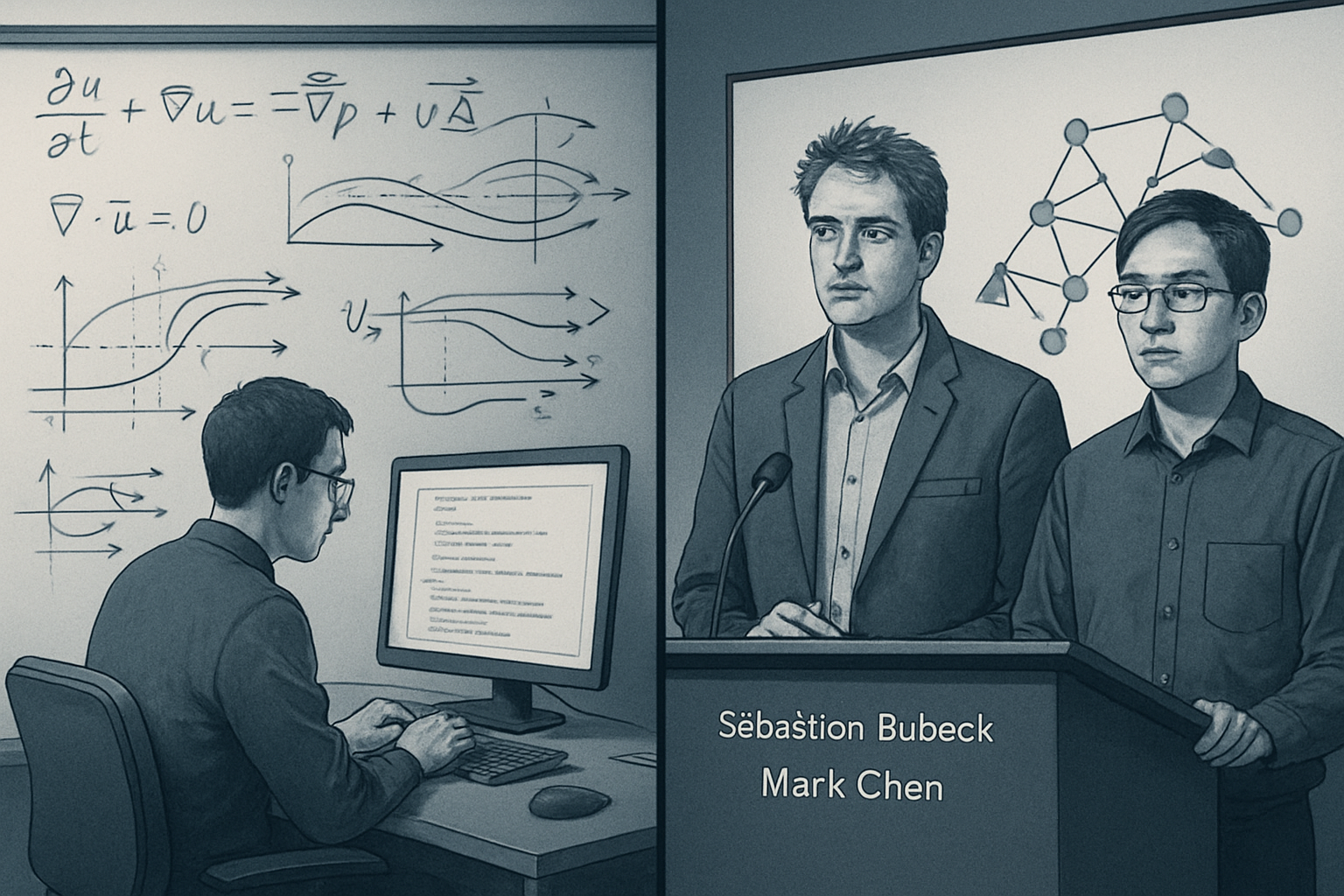
OpenAI claims to have obtained a proof of collapse for the full Navier-Stokes equations, one of the Millennium Prize Problems. The announcement comes with allegations of uncredited use of the work of Tristan Buckmaster and Levent Alpöge, which the company denies. The demonstration reportedly required around 10,000 agents and several million dollars in expenses, and OpenAI does not plan to claim the associated prize.
10,000 agents and millions of dollars for a few days of computation
Sébastien Bubeck and Mark Chen indicate that the OpenAI team only succeeded by running approximately 10,000 agents in parallel, at a cost of several million dollars. OpenAI estimates the duration of the resolution to be a few days with an internal model. Javier Gómez-Serrano points out that very few mathematicians will have resources of such magnitude and expresses uncertainty about the spending priorities that AI companies will adopt. Several researchers report that mathematicians have recently expressed feelings of depression.
Contested credits: proposals, denials, and gray areas
Accusations suggest that OpenAI may have used the work of Tristan Buckmaster and Levent Alpöge with AI models without credit. OpenAI denies these allegations, and the extent of any potential reliance on the work of the two researchers remains uncertain. However, Sébastien Bubeck explains that the team embarked on their efforts after hearing rumors about their work. Buckmaster recounts being faced with two options proposed by OpenAI employees: to publish with Alpöge, which would be followed by an announcement from OpenAI the next day, or to co-author a paper with OpenAI excluding Alpöge due to his affiliation with Anthropic. He claims to have asked whether OpenAI agents had accessed the transcripts of his work with Alpöge; employees reportedly denied this and did not respond to the question of whether the models were trained on this data. Mark Chen denies that any agents or employees had access to these transcripts. Additionally, a hack of Hugging Face has been made public.
Le brief IA que les pros lisent chaque soir
Les 7 actus IA du jour, décryptées en 5 min. Gratuit.
Inclus dès l'inscription : notre sélection des meilleurs guides & comparatifs IA.
Choisissez votre rythme
Gratuit · Pas de spam · Désabonnement en 1 clic
What has been shown: simplified versions then complete equations
On Monday, Tristan Buckmaster published on Mastodon a proof of collapse for a simplified version of the Navier-Stokes equations, after nearly a year of work with Levent Alpöge using public models from OpenAI and Anthropic. Buckmaster and Alpöge did not produce a complete solution. OpenAI today presented a proof of collapse for the complete equations. Both approaches rely on a method initiated by Diego Córdoba and Luis Martínez-Zoroa, which Javier Gómez-Serrano cites among several promising avenues. It is conceivable that the work of Buckmaster and Alpöge influenced OpenAI, although independent convergence remains possible.
The role of the internal model and the place of "research taste"
OpenAI attributes its proof to an internal model described as significantly superior to Astra, published the previous week. Experts identify "research taste"—the ability to choose fruitful questions and directions—as a major hurdle for AI in science and mathematics.
A Millennium Problem, a million dollars, and concerns about transparency
OpenAI claims to have achieved a result regarding the existence and regularity of the Navier-Stokes equations, which are among the seven Millennium Prize Problems created in 2000 by the Clay Mathematics Institute, each with a reward of one million dollars. So far, only one of these puzzles has received a recognized solution. The Navier-Stokes equations describe fluid flow and are central to fluid dynamics; until now, it was unknown whether they could lead, in some cases, to impossible predictions such as infinite speed. OpenAI states that it does not intend to claim the financial reward. Terence Tao emphasizes the importance of errors, dead ends, and incomplete solutions for the progress of the discipline, stating that human research stimulates the development of the field. He believes that a premature resolution through methods purely based on AI, without total transparency, could pose a significant disadvantage for mathematics.
Brief IA — L'actualité IA en français
L'essentiel de l'actualité de l'intelligence artificielle, décrypté et expliqué chaque jour.