OpenAI Revolutionizes ChatGPT Voice with GPT-Live
Le brief IA que les pros lisent chaque soir
Les 7 actus IA du jour, décryptées en 5 min. Gratuit.
Inclus dès l'inscription : notre sélection des meilleurs guides & comparatifs IA.
Choisis ton rythme
Gratuit · Pas de spam · Désabonnement en 1 clic
OpenAI Introduces GPT-Live for More Natural Conversations
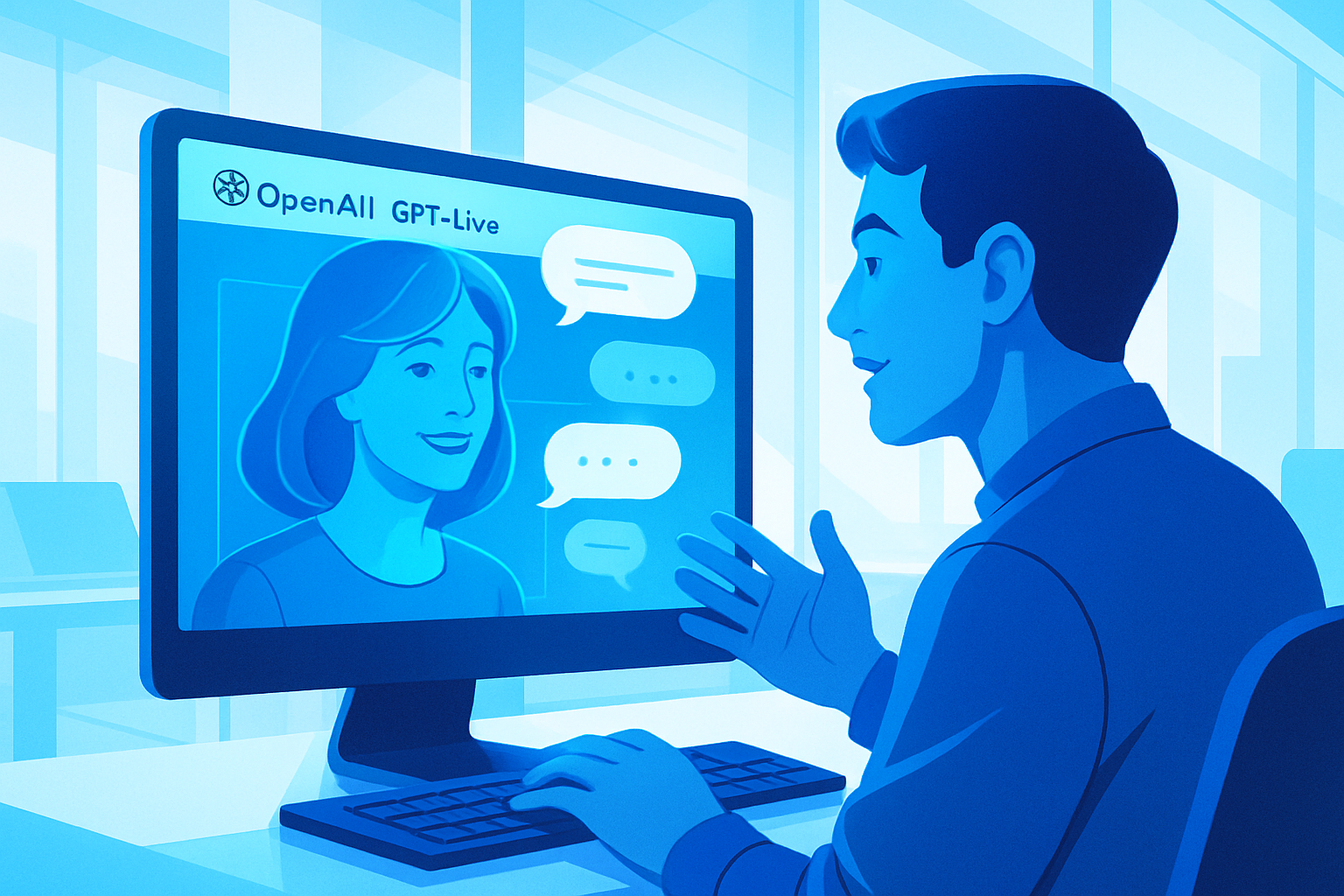
OpenAI has recently unveiled a significant update for its renowned chatbot, aimed at making human-machine interactions smoother and more natural. The new model, dubbed GPT-Live, is designed to enhance the dynamics of conversations by introducing more human-like dialogue elements. Unlike previous versions, this model incorporates interjections such as "mmhm," "yeah," or "got it" while the user is speaking, thereby eliminating the awkward pauses that characterized exchanges with the AI. This update aligns with OpenAI's trend of wanting ChatGPT to stop waiting for its turn.
GPT-Live Powers ChatGPT Voice
The update was revealed during a livestream on Wednesday, where OpenAI showcased the capabilities of GPT-Live, which now powers ChatGPT Voice, through a compelling demonstration. The model was tested in a scenario where a user simultaneously requested information about a meeting, the weather, and traffic. ChatGPT managed these requests fluidly, using verbal acknowledgments like "hmm" and "sure," while continuing to process the queries without losing the thread of the conversation.
Real-Time Translation and Full-Duplex Interaction
Another impressive feature of GPT-Live is its ability to translate languages in real-time. Unlike previous systems that required the user to finish speaking before providing a translation, GPT-Live operates in full-duplex mode. This means it can listen and respond simultaneously, making exchanges much more natural and fluid, according to OpenAI.
A More Human Approach to Interaction
Greg Brockman, president of OpenAI, emphasized that this update represents a step toward more intuitive interaction with computers. The goal is to create a user experience where the AI acts as an active participant in the conversation, rather than just a relay of information.
Competition Intensifies
OpenAI is not alone in this quest to humanize voice assistants. In May, Thinking Machines, led by former OpenAI CTO Mira Murati, announced it is working on similar technology. Their approach aims to manage continuous interactions across various media, including audio, video, and text, while avoiding the typical interruptions of traditional chatbots.
Towards Smoother Human-Machine Interaction
Thinking Machines' efforts focus on creating models capable of "managing interaction natively," making exchanges between humans and AI more fluid. The idea is to no longer force users to adapt to the limitations of AI interfaces, but rather to make these interfaces more adaptive and intuitive.
Addressing Criticism of Language Models
This update comes at a time when AI language models are often mocked online for their artificial tone and sometimes awkward responses. Users frequently poke fun at their tendency to overuse expressions like "awesome," as well as the awkward pause before a response is formulated. With GPT-Live, OpenAI hopes to overcome these criticisms by offering a more authentic and engaging experience.
Brief IA — L'actualité IA en français
L'essentiel de l'actualité de l'intelligence artificielle, décrypté et expliqué chaque jour.