OpenAI: Sam Altman Announces Massive Price Cuts for GPT-5.6
Le brief IA que les pros lisent chaque soir
Les 7 actus IA du jour, décryptées en 5 min. Gratuit.
Inclus dès l'inscription : notre sélection des meilleurs guides & comparatifs IA.
Choisis ton rythme
Gratuit · Pas de spam · Désabonnement en 1 clic
OpenAI Drastically Reduces Prices for Its AI Models
Sam Altman, the CEO of OpenAI, recently announced a significant price reduction for some of the company's latest artificial intelligence models. This decision marks a strategic turning point for OpenAI, which aims to provide better value for its users. Altman expressed this intent through a message on X, highlighting the company's goal of making artificial intelligence accessible at all price levels.
Spectacular Price Cuts for GPT-5.6
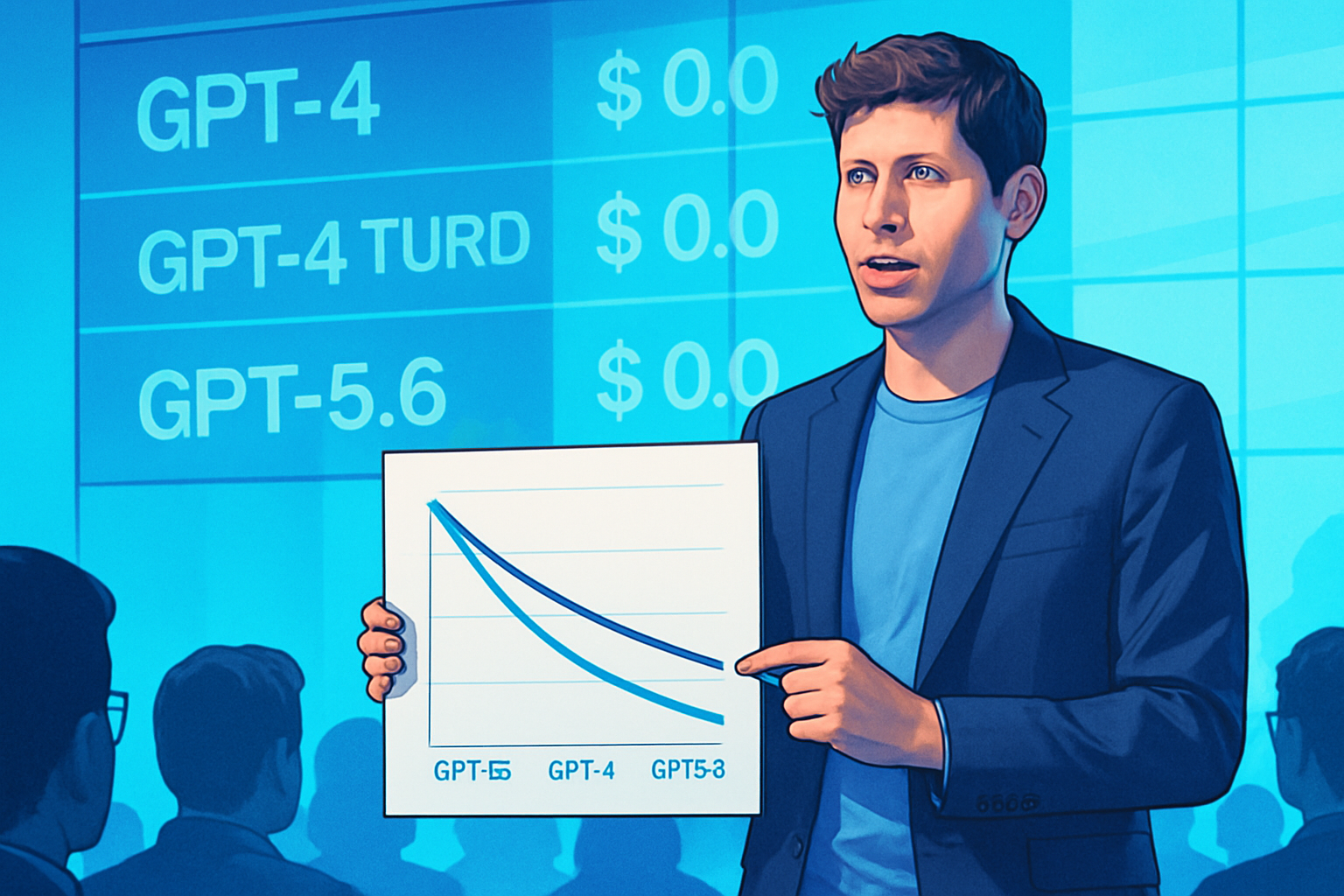
The price reductions announced by OpenAI are impressive. The GPT-5.6 Luna model sees its cost decrease by 80%, dropping to just $0.20 per million input tokens and $1.20 per million output tokens. Meanwhile, GPT-5.6 Terra benefits from a 20% reduction, with a new price of $2 for input and $12 for output. Additionally, GPT-5.6 Sol now offers a fast mode in the API, increasing speed by up to 2.5 times for double the cost, while maintaining the same level of intelligence.
Impact on Subscriptions and the Industry
OpenAI clarified that these new pricing structures would also influence how usage is accounted for in paid subscriptions, particularly when using Codex and ChatGPT Work. Jacob Bourne, a senior analyst at EMARKETER, commented on this announcement, stating that the era of "tokenmaxxing" is coming to an end. According to him, companies are now realizing that it is easy to consume tokens without gaining added value, prompting them to respond to the rising costs of AI.
Model Optimization and Increased Efficiency
OpenAI's price reductions are the result of ongoing improvements to the models and the inference systems that run them. The company has been working on "harnessing," a term that refers to the software that connects the AI model to various tools. This optimization allows for more efficient routing, ensuring that computing capacity is utilized optimally. OpenAI emphasized that these improvements enable tokens to be generated more efficiently and help avoid unnecessary repetitions in agents' work.
Competition and Market Pressure
Although GPT-5.6-Sol, OpenAI's most advanced model, is not affected by these announcements, the company recently launched the 5.6 model series after suspending a broader rollout at the request of the U.S. government. Pricing remains a major issue in the AI sector, especially as competitors like Moonshot AI and Anthropic explore new pricing approaches. Moonshot AI, for instance, recently introduced the Kimi K3 open-weight model, increasing pressure on OpenAI's closed models.
Towards Greater Pricing Flexibility
Arun Chandrasekaran, an analyst at Gartner, stated that these price reductions signal a shift towards more flexible pricing approaches. This could represent a crucial moment for buyers looking to maximize the value of their AI investments. Chandrasekaran also noted that this pricing competition could test the business models of AI labs ahead of highly anticipated IPOs, as OpenAI recently filed a confidential application for an IPO.
Industry Reactions and Future Outlook
Sam Altman and other AI leaders have often heard companies express doubts about the profitability of their AI investments. Other industry players, such as Google and Microsoft, are also emphasizing cost efficiency. Satya Nadella, CEO of Microsoft, recently highlighted the importance of cost efficiency during a quarterly earnings call, showcasing the company's MAI-Thinking-1 model. Nadella explained that Microsoft is working on a new system of models that separates harnessing, context, memory, and action space to improve the cost/result ratio.
Brief IA — L'actualité IA en français
L'essentiel de l'actualité de l'intelligence artificielle, décrypté et expliqué chaque jour.